AI Native 的分界线
The Boundary of AI Native
把 AI Native 当一把诊断尺用:先看约束有没有真的被重画,再决定要不要贴这个标签。
Treat AI Native as a diagnostic, not a label to hand out: check whether the constraints actually got redrawn before you reach for the word.
当 AI 只让旧流程更快,它仍是 AI-enabled;当判断、上下文、权限与验证因此被重新安排,才值得把它当作 AI-Native 的候选形态。这个区分是工作假设,不是授勋。When AI only makes the old workflow faster, it remains AI-enabled. When judgment, context, permissions, and verification are rearranged because of it, the organization becomes a candidate for AI-Native. This is a working hypothesis, not a badge.
- Coase, 1937 - Theory of Firm
- Weick, 1979 - Organizing as a verb
- Beer, 1972 - Brain of the Firm
- Andreessen, 2011 - Software is eating
你在传统流程上接进了 ChatGPT,让工程师用 Cursor 写代码,让客服用 AI 起草回复——这会带来价值,但未必已经改了组织。先别急着给它命名,顺着一条真实工作流追问:谁决定目标?agent 得到哪些上下文?它能动到哪里?错了由谁发现、谁承担、怎么回滚?若这四件事仍按旧方式发生,比较准确的说法是 AI-enabled。把“用了 AI”直接等同于 AI Native,只会遮住真正需要重画的部分。
You have added ChatGPT to an existing workflow, let engineers write code with Cursor, and let support draft replies with AI. That can create value without yet changing the organization. Before naming it, trace one real workflow: who sets the goal, what context reaches the agent, what it is allowed to change, and who detects, owns, and rolls back an error? If those four things still work as before, AI-enabled is the more accurate name. Treating “uses AI” as AI-Native hides the part that still needs redesign.
差别往往在第一次出错时才露出来。一个 agent 给出了不合适的答复,或改坏了一段代码,流程会把谁推到台前?如果仍是原来的负责人临时补位,仍靠原来的文档拼上下文,仍要沿着原来的层级申请权限,仍在末端补救,那么组织只是跑得更快,并没有换一套运作方式。
The real difference often appears at the first mistake. An agent gives an unsuitable reply or breaks a piece of code: who does the workflow put in front of the problem? If the same owner still steps in at the last minute, assembles context from the same documents, requests permission through the same hierarchy, and repairs the damage at the end, the organization is merely moving faster. It is not operating differently.
这也把“AI 转型”放回它应有的位置。老组织当然可以从局部工作流开始重画;只是迁移成本、既有责任链和遗留系统不会因为模型更强而消失。与其给团队打成熟度分数,不如从一条高频、可回滚的流程开始试验:记录判断、上下文、权限和验证怎样变化。若结果只停在更快产出,就诚实地保留 AI-enabled;只有结构变化同时解释了新能力和新风险,这个词才有分析价值。
This also puts “AI transformation” in its proper place. An established organization can start redrawing one workflow at a time, but migration cost, inherited accountability, and legacy systems do not disappear because models improve. Rather than giving a team a maturity score, begin with one frequent, reversible workflow and record how judgment, context, permissions, and verification change. If the result stops at faster output, honestly keep AI-enabled. The term earns analytical value only when a structural change explains both a new capability and a new risk.
因此它最适合有架构权的人:创业者、能搭建独立 greenfield 单元的负责人,或愿意把局部流程当实验的人。真正的问题是:在今天的能力与责任条件下,哪一部分值得先重画,又该用什么观察证明这次重画没有把风险藏起来?
It is therefore most useful to people with architectural latitude: founders, leaders who can stand up an independent greenfield unit, or teams willing to treat a local workflow as an experiment. The real question is this: under today’s capabilities and accountability conditions, what should be redrawn first, and what observation would show that the redraw has not merely hidden its risk?
"AI Native"三种本质不同的现象
“AI Native”: Three Fundamentally Different Phenomena
先给这个被用滥的词做一次分诊。
First, triage an overused term.
"AI Native"其实指三件事:结构上把 agent 当工种、运营上让 AI 打头阵、本质上让 agent 网络成为主体。先说清讲哪一种,讨论才不各说各话。“AI Native” actually names three things: agents as a role in the structure, AI leading every workflow in operations, agent networks as the primary actor in essence. Name which one you mean and the discussion stops talking past itself.
结构视角Structural - Agent as team member
Structural Perspective: Agent as Team Member
这个视角把 AI Agent 当员工看——有工号(Microsoft Agent ID)、职责描述、绩效指标,甚至能被解雇。组织图上它和人平起平坐。最容易懂,也最容易陷入"AI 员工"这种拟人化误读。
This perspective treats an AI Agent like an employee: its own employee ID (Microsoft Agent ID), a job description, performance metrics, even the possibility of being “terminated.” Agents sit next to humans on the org chart. It is the easiest reading to grasp, and also the one most prone to the anthropomorphic misreading of “AI as staff.”
Salesforce Agentforce 3
ServiceNow AWM
Lattice "AI Employee" (撤回)Lattice “AI Employee” (withdrawn)
运营视角Operational - AI-first workflows
Operational Perspective: AI-First Workflows
这个视角反过来问:每条 workflow 先问 AI 能接哪一步,再设计人在哪里介入,而不是把 AI 塞进原有流程。产出确实最高,但也最容易变成表演——通稿写着"AI 优先",流程一步没动,这就是"AI Theater"。
This perspective flips the question: for every workflow, ask which step AI can own first, then design where humans step in, rather than inserting AI into a process that was never redrawn. It is the most productive reading, and the easiest to hollow out into theater: the memo says “AI-first,” and not one step of the actual process has moved.
Luis von Ahn Duolingo memo
IBM AskHR 自动化IBM AskHR automation
Klarna 客服 AI 化(与回撤)Klarna customer-service AI-ification (and partial rollback)
本质视角Ontological - Agent-first organization
Ontological Perspective: Agent-First Organization
这个视角最激进:组织的主体不是人,是 Agent 网络,人退到判断与责任的锚点位置。2026 年它还在边界探测阶段,而且诚实地说,探测结果大多是负的——Project Vend 里的 Claudius 亏本经营,被员工套话打折,还编过收款账户。这些实验证明的是可能性的边界在哪,不是这条路已经走通。但正因为还没走通,才最值得长期盯着。
This is the most radical perspective: the organization’s primary actor is not a person but the agent network, with humans pushed back to the anchor point of judgment and accountability. As of 2026 it is still probing that boundary, and honestly, most of the probes come back negative: Project Vend’s Claudius ran at a loss, got talked into discounts by employees, and once fabricated a payment account. What these experiments prove is where the boundary of possibility sits, not that the road is open. Precisely because it isn’t open yet, this is the perspective most worth watching.
Anthropic Project Deal
Sakana AI Scientist
MetaGPT / ChatDev 实验MetaGPT / ChatDev experiments
- KEY INSIGHT
- 三种视角不矛盾——它们是 AI Native 这个连续光谱上的不同位置
- The three perspectives are not mutually exclusive; they mark different positions on a continuous spectrum of AI Native.
- WARNING
- 多数公开讨论混淆三种视角,导致"AI Native"成为含糊修辞
- Most public discussions conflate all three perspectives, reducing “AI Native” to an empty slogan.
这三种视角不矛盾,是同一光谱上的三个位置——而一个真正成熟的 AI Native 组织三者都占:结构上,agent 是正式的生产单位(视角一);运营上,每条工作流都先问 AI 能接哪一步(视角二);到了真正想探边界的单元,还有 agent 自主运营的实验(视角三)。分清这三层,后面的讨论才不会各说各话。
These three readings are not options you pick between; they mark three positions on one spectrum, and a genuinely mature AI-Native organization occupies all three at once: structurally, agents hold formal production roles (Perspective 1); operationally, every workflow starts by asking which step AI can own (Perspective 2); and at the units actually pushing the frontier, there are experiments in autonomous agent operation (Perspective 3). Keep these three apart, or the rest of this discussion talks past itself.
本方法论的架构支柱同时回应这几个视角——"AI 优先即默认"是运营视角;"Agent 即默认工种"和"工作流即代码"在结构与运营之间;"人作为判断与责任锚"则锚定本质视角的边界:哪怕在最激进的 Agent-first 实验里,也要有个具体的人接住最终的后果。这是本方法论的押注,不是已经证成的事实——后果能不能一直锚在某个具体的人身上,恰恰是本卷最先可能被反例掀翻的一注。
The architectural pillars of this methodology respond to all three perspectives simultaneously: “AI-first as default” addresses the operational perspective; “Agent as the default worker” and “workflow as code” bridge the structural and operational; and “humans as the anchor of judgment and accountability” fixes the boundary of the ontological perspective: even in the most radical Agent-first experiment, a specific person must still catch the ultimate consequence. This is the methodology’s bet, not an established fact: whether the consequence can stay anchored to a specific person is precisely the first of this volume’s wagers a counter-example might overturn.
前提,正在同时失效
The Premises Are Failing
逐一点名:几股力量,各抽掉旧设计的哪条地基。
Name them one by one: which force pulls which footing out from under the old design.
几股力量同时抽走旧组织设计的底层假设:协调不再必须由人做,岗位让位于工作流。AI 只是当下最可落地的触发器,真正在变的是组织约束往哪迁移。Several forces pull the founding assumptions of old organizational design out at once: coordination no longer needs humans, roles give way to workflow. AI is merely the most buildable trigger today; the real shift is where organizational constraints migrate.
- Coase boundary
- Workflow inversion
- Judgment scarcity
- Algorithmic feudalism
第一股力量,协调机器化。科斯(Coase)的交易成本(搜寻、议价、监督、执行)在 AI agent 介入后能被部分甚至整体机器化,内部协调的成本曲线因此整体下移。以前非靠层级盯着不可的活,现在靠 telemetry 和 agent guardrails 就能盯住。
The first force: coordination gets mechanized. Coase’s transaction costs (search, negotiation, monitoring, enforcement) can now be partly or wholly taken over by AI agents once they intervene, pulling the whole curve down. Work that used to need a manager watching over it now gets watched by telemetry and agent guardrails instead.
第二股力量是工作单位的反转。在传统组织里,你定义角色,工作流从角色之间的互动中涌现出来。在 AI Native 组织里,你定义工作流,角色从工作流的需求中涌现出来。这是设计逻辑的彻底反转:组织的核心文档是工作流规约,而非岗位说明书。
The second force is the work-unit inversion. In a traditional organization, you define roles and workflows emerge from the interactions between them. In an AI Native organization, you define workflows and roles emerge from the requirements of those workflows. This is a complete inversion of design logic: the organization’s core document is not a job description but a workflow specification.
承认谱系:「先定义工作流、角色随之涌现」并非全新念头——Hammer-Champy 的业务流程再造(BPR)与 Team Topologies 早已主张先重画流程、结构随之跟随。旧 BPR 多数失败,败在流程一经重画即僵化、跨环节隐性协调成本被低估。AI 改的正是这两条根因:agent 把重画工作流与跑一轮迭代的成本压低约一个量级,重画因此可频繁、可逆;共享上下文中枢又把靠人默会的协调显性化。但须标注新风险——协调塌进单一中枢,认知负载集中到一点,有上限,也是新的单点脆弱。Acknowledge the lineage: “define the workflow first and roles emerge” is not a new idea. Hammer-Champy’s Business Process Reengineering (BPR) and Team Topologies both argued for redrawing process first and letting structure follow. Old BPR mostly failed, on two counts: a redrawn process turned rigid, and cross-step tacit coordination costs were underestimated. AI changes exactly those two root causes: agents drop the cost of “redrawing a workflow” and “running one iteration” by roughly an order of magnitude, so redrawing can be frequent and reversible; a shared context hub makes formerly tacit coordination explicit. But label the new risk honestly: collapsing coordination into a single hub concentrates cognitive load at one point, which has a ceiling and is itself a new single-point fragility.
还有一股力量:瓶颈从执行挪到了判断。AI 能以接近零的边际成本生成、转换、总结、执行;它做不好的事——决定什么值得做、在几个选项里怎么选、为后果担责、把组织方向稳住——变成了新的稀缺资源。组织里最值钱的人,因此从能干活的人变成了能拍板负责的人。
Another force: the bottleneck moves from execution to judgment. AI generates, transforms, summarizes, and executes at near-zero marginal cost; what it still cannot do well (deciding what’s worth doing, choosing among options, owning the consequences, holding the organization’s direction) becomes the new scarce resource. The most valuable person in the org stops being the one who can get things done and becomes the one who can call the shot and answer for it.
这三股力量合起来说的是一件事:传统组织设计一直在为错的目标优化——清晰的角色、可预测的流程、人居中协调。AI Native 设计要的是快的工作流、嵌进流程里的判断、机器居中协调。换的是优化目标本身,不是调几个参数。
Put these three forces together and one thing follows: traditional organizational design has been optimizing for the wrong target: clear roles, predictable process, human-mediated coordination. AI-Native design optimizes for fast workflows, judgment embedded in the process, machine-mediated coordination. The target itself changed; this is not a parameter tweak.
还有一个常被忽略的结构性事实加固这个判断:LLM 反转了技术扩散的历史方向。电力、计算、GPS 都是政府与企业先用、消费者后用;LLM 反过来:先触达数十亿消费者,组织反而滞后。Karpathy 2025/6 把这件事当作主题来讲[R6],实证也跟上了:Bick-Blandin-Deming 的全国调查(NBER WP 32966 → Management Science, 2026[R7])测得 2024 年底约 40% 的 18–64 岁人口已在使用生成式 AI——整体采纳快于 PC 与互联网同期,且由消费端驱动;而企业的正式采纳率仅 5-9%。这意味着组织重构的知识此刻在个体手里、不在制度里——AI Native 创业者不在等技术成熟,而在等组织形态追上技术。口径的诚实注脚:同一研究显示企业工作场所采纳两年达 28%,与 PC 时代速度相当——组织是相对消费浪潮慢,不是绝对慢。
There is a structural fact frequently overlooked that reinforces this judgment: LLMs reversed the historical direction of technology diffusion. Electricity, computing, and GPS all reached governments and enterprises first, consumers later; LLMs went the other way: touching billions of consumers first, while organizations lagged. Karpathy made this the theme of his 2025/6 talk[R6], and the empirical record followed: the Bick-Blandin-Deming national survey (NBER WP 32966 → Management Science, 2026[R7]) found that by end-2024, ~40% of the US population aged 18–64 were already using generative AI: adoption faster overall than the PC or the internet at the same stage, and driven by the consumer end. Formal enterprise adoption stood at only 5-9%. This means the knowledge of how to restructure organizations currently resides with individuals, not institutions. AI Native founders are waiting for organizational forms to catch up with the technology, not for the technology to mature. An honest footnote on the data: the same study shows two-year workplace adoption at 28%, comparable to the PC era: organizations are relatively slow against the consumer wave, not slow in absolute terms.
Coase 边界的当代重画The Coase Boundary, Redrawn
The Coase Boundary, Redrawn
Ronald Coase 在 1937 年提出企业之所以存在,是因为内部协调比市场协调便宜。这个回答稳定了 80 年,直到 AI Agent 出现。Williamson、Jensen-Meckling 进一步把"代理成本"加入对比,给出了"企业最优规模 = 内部追加一笔交易的边际成本 = 市场完成同一交易的边际成本"这个均衡条件。
Ronald Coase proposed in 1937 that the firm exists because internal coordination is cheaper than market coordination. That answer held for eighty years, until AI agents arrived. Williamson and Jensen-Meckling later added “agency costs” to the comparison, yielding the equilibrium condition: the optimal firm size is the point at which the marginal cost of adding one more transaction internally equals the marginal cost of completing that same transaction through the market.
AI Agent 的引入根本性地改变了这个均衡。三类成本同时下降——搜寻成本(RAG / 向量库让组织记忆秒级可达)、议价成本(Agent-to-Agent 协议如 MCP、A2A 让自动议价成为可能)、监督成本(实时观察性如 LangSmith / Helicone 让远程异步监督优于现场监督)。其逻辑结果是:传统企业的边界(哪些活动留在内部 vs 外包给市场)会大规模重画。Anysphere 以约 300 人做到 $20 亿 ARR(2026/2,人均约 $600 万,仍是 SaaS 巨头的十倍量级)、Cognition 以收购 Windsurf 前累计净烧钱不足 $2,000 万走到 $260 亿投后估值(2026/5〔TechCrunch〕)——是Coase 边界向"市场端"压缩的早期实证,不是孤立的异常值。
The introduction of AI agents fundamentally alters this equilibrium. Three categories of cost fall simultaneously: search costs (RAG / vector stores make organizational memory accessible in seconds), negotiation costs (Agent-to-Agent protocols such as MCP and A2A make automated negotiation possible), and monitoring costs (real-time observability tools such as LangSmith / Helicone make remote asynchronous supervision superior to on-site supervision). The logical consequence: the boundaries of the traditional firm (which activities stay internal, which get outsourced to the market) will be redrawn at scale. Anysphere reached ~$2B ARR with roughly 300 people (2026/2, ~$6M revenue per person, still ten times the figure for SaaS giants); Cognition reached a $26B post-money valuation (2026/5〔TechCrunch〕) on under $20M of cumulative net burn before its acquisition of Windsurf. These are early empirical evidence of the Coase boundary compressing toward the market end, not isolated outliers.
这条推演在 2025 年获得了正面的学术对话对象。NBER 工作论文《The Coasean Singularity?》(Shahidi, Rusak, Manning, Fradkin & Horton, WP 34468, 2025/11[R1])把话说得更直接:交易成本的全部构成要素(查询价格、谈判条款、签订合约、监督履约)恰好是 AI Agent 能以极低边际成本执行的任务类型;一旦有效执行,1937 年定义的 make-or-buy 边界将显著移动。论文给存量市场画的三阶段路径是:增强人类 → 整任务替代(人类转向判断、监督与关系工作)→ 工作流围绕 Agent 能力重组,和本规约的瓶颈诊断说的是同一个道理;而它对全新市场的判断是:agent-first 市场将直接从终点状态设计——这正是「只为 greenfield 而写」这一立场的学理版本。诚实的另一半也要引:标题里的问号是作者自己打的——拥塞、价格混淆、监管构成新摩擦,"有效执行"的前提在今天尚未满足,这是理论预测,不是已实现的事实。
This reasoning found a direct academic interlocutor in 2025. The NBER working paper The Coasean Singularity? (Shahidi, Rusak, Manning, Fradkin & Horton, WP 34468, 2025/11[R1]) states it more bluntly: every component of transaction costs (querying prices, negotiating terms, signing contracts, monitoring performance) is precisely the type of task that AI agents can execute at near-zero marginal cost; if effectively executed, the make-or-buy boundary defined in 1937 will shift substantially. The paper charts a three-stage path for incumbent markets: augmenting humans → whole-task substitution (humans shift to judgment, oversight, and relational work) → workflows reorganized around agent capabilities. This path lines up with this atlas’s bottleneck diagnosis; and its verdict on greenfield markets is: agent-first markets will be designed directly from the endpoint state. That is the academic formulation of why this atlas is drawn only for greenfield. The caveats must be cited too: the question mark in the title is the authors’ own. Congestion, price confusion, and regulation constitute new frictions, and the precondition of “effective execution” has not yet been met. This is a theoretical prediction, not an accomplished fact.
但同时,一种新的成本兴起——算法封建主义(algorithmic feudalism)。当 AI 能力被 OpenAI、Anthropic、Google、Microsoft 四家巨头垄断,"AI Native 组织"实际上把核心生产要素外包给一个高度集中的供应商寡头,构成一种新的"地租依附"关系。这就是为什么"多模型架构"在架构支柱中是基础性的——它是当代 Coase 边界设计中的"主权保留"。
At the same time, a new cost is rising: algorithmic feudalism. When AI capabilities are monopolized by four giants (OpenAI, Anthropic, Google, and Microsoft), an “AI Native organization” in effect outsources its core means of production to a highly concentrated supplier oligopoly, creating a new form of rent dependency. This is why the “multi-model architecture” is foundational among the architectural pillars: it is the “sovereignty reservation” in contemporary Coase boundary design.
代理理论的扩展Agency Theory, Extended
Agency Theory, Extended
Jensen-Meckling 1976 年的代理理论建立在一个清晰的二元结构上——委托人(principal,如股东)与代理人(agent,如经理)。代理成本来自信息不对称、目标分歧、激励错位。整个公司治理结构(董事会、薪酬委员会、KPI、绩效考核)都是这个理论的工程化实现。
The Jensen-Meckling (1976) agency theory rests on a clear binary structure: principal (e.g., shareholders) and agent (e.g., managers). Agency costs arise from information asymmetry, goal divergence, and misaligned incentives. The entire apparatus of corporate governance (boards, compensation committees, KPIs, performance reviews) is the engineering implementation of this theory.
AI Agent 介入后,这个二元结构变成了三元结构——principal-agent-agent。人类经理代理股东,AI Agent 又代理人类经理。责任链多了一层,问题是这一层的责任如何分配?Air Canada 案(2024 年 BC 省 BCCRT 在 Moffatt v. Air Canada 中判决公司必须为 chatbot 承诺承担法律责任)首次明确了第一层答案——公司不能用"我们的 AI 说错了"作为免责理由。但更深的问题尚未解决——当 AI Agent 之间互相调用、互相代理(如 Anthropic Project Deal 中员工授权 Claude Opus 代为议价),责任链如何追溯?
Once AI agents intervene, this binary structure becomes a ternary structure: principal-agent-agent. Human managers act as agents for shareholders; AI agents in turn act as agents for human managers. The accountability chain gains one more layer, and the question is how accountability at that layer is allocated. The Air Canada case (2024, BC BCCRT ruling in Moffatt v. Air Canada that the company must bear legal responsibility for its chatbot’s commitments) settled the first-layer answer for the first time: a company cannot use “our AI got it wrong” as a disclaimer. But the deeper question remains unresolved: when AI agents call and proxy one another (as when an employee in Anthropic Project Deal authorizes Claude Opus to negotiate on their behalf), how is the accountability chain traced?
2025 年的组织经济学给这个三元结构补上了更激进的一块。Hadfield 与 Koh 在《An Economy of AI Agents》(arXiv:2509.01063,NBER 变革性 AI 经济学手册章节[R2])中重新检视经典文献(Coase 的协调摩擦、Williamson 的交易成本、Grossman-Hart 的产权、Holmström-Milgrom 的代理模型)并指出:这些理论识别的企业规模上限,全部源于人类固有约束(沟通速率受限、偷懒倾向),而这些约束"似乎内在于人类、却不内在于 AI"——Agent 近即时通信,奖励函数可以被直接设计为不偷懒,于是监督与履约这两大组织开销在理论上变得不必要。论文进一步引用 Chen-Elliott-Koh 的形式模型(Journal of Economic Theory, 2023):当 AI 压低维持异质能力的组织成本时,经济可能发生突变式相变——从大量专业化企业转向少数横跨众多行业的巨型企业。引用须保留原文的虚拟语气:这是条件性预测("如果 Agent 确实能……"),NBER 同卷评论人 Kevin Bryan 也对变化速度提出了制度性异议——但它把"组织规模的旧均衡正在失效"从直觉升格成了可检验的理论命题。
Organizational economics in 2025 added a more radical piece to this ternary structure. Hadfield and Koh, in An Economy of AI Agents (arXiv:2509.01063, a chapter in the NBER Handbook on the Economics of Transformative AI[R2]), revisit the canonical literature (Coase’s coordination friction, Williamson’s transaction costs, Grossman-Hart property rights, Holmström-Milgrom agency models) and observe that every size limit on the firm identified by these theories derives from constraints inherent to humans (bounded communication rates, shirking tendencies), and that these constraints “seem intrinsic to humans but not to AI”: agents communicate near-instantaneously, and reward functions can be designed directly against shirking, making monitoring and enforcement (the two largest organizational overheads) theoretically unnecessary. The paper further cites the formal model of Chen-Elliott-Koh (Journal of Economic Theory, 2023): when AI lowers the organizational cost of maintaining heterogeneous capabilities, the economy may undergo a discontinuous phase transition: from many specialized firms to a small number of mega-firms spanning numerous industries. Citations must preserve the paper’s conditional mood: this is a conditional prediction (“if agents truly can…”); NBER co-volume commentator Kevin Bryan also raised institutional objections about the speed of change. But the paper elevates “the old equilibrium of firm size is failing” from intuition to a testable theoretical proposition.
这就是为什么"人作为判断与责任锚"在架构支柱中是不可妥协的——不是因为人比 AI 决策更准,而是因为只有人能承担后果。Lattice 2024 年 7 月把 AI 列为"正式员工"3 天后撤回,是因为 HR 框架要求"员工"能承担责任,而 AI 无法。这是代理理论在 AI 时代仍然成立的最深部分——责任不能委托给无法承担后果的实体。
This is why “humans as judgment and accountability anchors” is non-negotiable among the architectural pillars: not because humans make more accurate decisions than AI, but because only humans can bear consequences. When Lattice listed AI as a “formal employee” in July 2024 and reversed course three days later, the essential reason was that the HR framework requires “employees” to be capable of bearing responsibility, which AI cannot do. This is the deepest part of agency theory that still holds in the AI era: accountability cannot be delegated to an entity incapable of bearing consequences.
控制论的回归Cybernetics, Returning
Cybernetics, Returning
Stafford Beer 在 1972 年《Brain of the Firm》中提出 Viable System Model(VSM)——任何能持续运转的组织都需要五个子系统:S1 操作单元(执行)、S2 协调(避免冲突)、S3 控制(资源分配与短期优化)、S4 智能(外环境扫描与长期规划)、S5 政策(身份与价值观)。这个模型在 1980 年代被广泛尝试但最终未能主流化,因为人类无法实时执行 S2 和 S3 所需的反馈密度。
Stafford Beer proposed the Viable System Model (VSM) in his 1972 Brain of the Firm: any organization that can sustain itself requires five subsystems: S1 operational units (execution), S2 coordination (conflict avoidance), S3 control (resource allocation and short-term optimization), S4 intelligence (external environment scanning and long-term planning), S5 policy (identity and values). The model was widely attempted in the 1980s but ultimately failed to go mainstream, because humans could not sustain in real time the feedback density that S2 and S3 require.
当代 AI Agent 让 VSM 重新成为可行的组织设计语言。具体的映射是——生成式 Agent 处于 S1(执行)与 S4(探索);telemetry 与 guardrails 处于 S2(协调)与 S3(实时控制);人类保留 S5(身份与价值观)。这就是为什么 Anthropic 据报道的"90 天最长规划周期"能够运转——不依赖年度战略来对齐组织,而依赖 S2/S3 层的实时反馈密度(口径注:该规划周期出自高管访谈与媒体报道,未经独立验证)。Cursor、Replit、Cognition 的极速迭代节奏也是同一逻辑——VSM 在 AI 时代第一次有了可落地的实现路径。
Contemporary AI agents make VSM viable once more as an organizational design language. The concrete mapping is: generative agents occupy S1 (execution) and S4 (exploration); telemetry and guardrails occupy S2 (coordination) and S3 (real-time control); humans retain S5 (identity and values). This is why Anthropic’s reported “90-day maximum planning horizon” can function: not by relying on annual strategy to align the organization, but by relying on real-time feedback density at the S2/S3 layer (sourcing note: this planning horizon comes from executive interviews and media reports; it has not been independently verified). The hyper-velocity iteration cadence at Cursor, Replit, and Cognition follows the same logic: for the first time, VSM has an implementable execution path in the AI era.
判断稀缺性的经济学The Economics of Judgment Scarcity
The Economics of Judgment Scarcity
Daron Acemoglu 2024 年在 MIT 的研究《The Simple Macroeconomics of AI》给出了一个谨慎的测算:AI 未来 10 年累计 GDP 贡献约 1.1-1.6%(年均 ~0.05%),远低于行业普遍宣称的数倍效应。MIT NANDA 2025/7 预印报告《The GenAI Divide》测得:定制化企业 GenAI 试点在约六个月观察窗口内,95% 没有可衡量的 P&L 影响(报告自述口径:52 家访谈 + 153 份问卷 + 300+ 公开部署,非同行评议;媒体流传的"150 访谈 + 350 问卷"系二手转述,详见 R14)。这两组材料不能证明一个普遍瓶颈,却提出了一个值得检查的问题:当执行被加速时,价值是否卡在流程其余部分,还是成本、证据与时间窗口尚不足以看见效果?
Daron Acemoglu’s 2024 MIT research The Simple Macroeconomics of AI offers a cautious estimate: AI’s cumulative GDP contribution over the next ten years will be approximately 1.1-1.6% (annual average ~0.05%), far below the multiples commonly claimed by the industry. The MIT NANDA 2025/7 preprint report The GenAI Divide measured that 95% of customized enterprise GenAI pilots showed no measurable P&L impact within an approximately six-month observation window (report’s self-stated method: 52 interviews + 153 surveys + 300+ public deployments, non-peer-reviewed; the widely circulated “150 interviews + 350 surveys” is a second-hand restatement; see R14). These materials do not prove a universal bottleneck. They pose a question worth checking: when execution accelerates, is value stuck elsewhere in the workflow, or are cost, evidence, and the time window still too weak to show an effect?
"判断稀缺"在经济学里有正主文献——出自 Agrawal、Gans 与 Goldfarb 的 prediction-vs-judgment 框架,并非 Acemoglu。他们 2018 年的形式模型(NBER WP 24626;同行评审版刊于 Information Economics and Policy, 2019[R3])给出三个本规约直接继承的结论:① AI 降低的是"预测"这一特定任务的成本:预测是决策的输入,不是决策本身;② 判断被形式化定义为"目标函数无法被描述或编码时人类所行使的能力":并非所有人类判断都与 AI 互补,更便宜的预测以相反方向影响不同类型判断的回报;③ 委托定理:即便人类参与能产出更优决策,人类仍会理性地把部分决策完全委托给机器:Agent 在严格优于人类之前就获得完全自治,是模型内最优选择的推论,并非失误。
口径校正:AGG 这条"目标函数无法被编码时的人类能力"是按 AI 能力反向定义的移动靶——AI 每强一次,"无法编码"的外延就收缩一寸。所以本方法论不把判断锚在"AI 做不到"上,而锚在一个正面、不随能力移动的定义:判断=为不可逆后果承担责任的授权节点(与全站责任锚同义;再往下退一层是"谁定义什么算好的后果",见下方断裂点)。它押的是"收缩有下界"——这是可错的赌注,不是定理。还要说清这注押在哪一层:判断变稀缺不是前提,是执行变便宜之后被推出来的结论;而把执行推向便宜的同一股力量,没理由在判断门口自动停步。所以本卷最先该盯的改判信号,不是外面谁来反驳,而是那条一向只压执行的成本曲线,开始稳定地压低拿主意本身的成本——真到那天,要改写的就不止哪根支柱,而是这卷立论的前提本身。
2025 年他们把"判断"进一步拆开(《The Economics of Bicycles for the Mind》, NBER WP 34034[R4]):机会判断(识别什么值得启动)在模型中恒为认知工具的互补品——AI 提升而非侵蚀它的价值;收益判断(知道在给定状态下采取何种行动)只在工具不过度削减人类努力时才互补;而实现技能被建模为认知工具的替代品。一句话翻译:AI 吃掉实现、抬高机会判断、对收益判断态度暧昧——这恰好是"人即判断锚点"与"操作者即编排者"两个世界观的经济学坐标。同一谱系里,Gans 的《AI as Strategist》(NBER WP 33650, 2025[R5])从控制权角度独立推出一个和 FIG 5.1 判断锚点地图讲同一个道理的结论:授予战略家正式控制权的增量价值随其可信度单调递减——所以组织应当逐域(domain-by-domain)而非统一地分配 AI 的控制与影响力:判断密集域人类主导、数据丰富域 AI 主要靠透明推理产生影响力而非权威。三篇全是理论模型而非实证:引用它们,是给"判断稀缺"找可对话、可证伪的学术对象,不是宣称已被证明。
“Judgment scarcity” has a canonical economics literature: the prediction-vs-judgment framework of Agrawal, Gans, and Goldfarb (AGG), not Acemoglu. Their 2018 formal model (NBER WP 24626; peer-reviewed version published in Information Economics and Policy, 2019[R3]) yields three conclusions this atlas inherits directly: ① AI reduces the cost of “prediction” as a specific task: prediction is an input to decisions, not the decision itself; ② judgment is formally defined as “the capability humans exercise when the objective function cannot be described or encoded”: not all human judgment is complementary to AI; cheaper prediction affects the returns to different types of judgment in opposite directions; ③ the delegation theorem: even when human involvement yields better decisions, humans will rationally delegate some decisions entirely to machines. Agents acquiring full autonomy before they strictly outperform humans is a corollary of optimal choice within the model, not a failure.
A calibration: AGG’s “the capability humans exercise when the objective function cannot be encoded” is a moving target defined in reverse from AI’s reach: each time AI strengthens, the extension of “cannot be encoded” contracts an inch. So this methodology does not anchor judgment on “what AI can’t do” but on a positive definition that does not move with capability: judgment = the authorized node that bears responsibility for irreversible consequences (synonymous with the site-wide accountability anchor; one layer deeper it retreats to “who defines what counts as a good consequence,” see the fracture below). Its bet is that “the contraction has a lower bound,” a fallible wager, not a theorem. It is worth naming which layer the wager sits on: judgment’s scarcity is not a premise but a conclusion pushed out once execution gets cheap, and the same force that drove execution cheap has no reason to halt politely at judgment’s door. So the first revision signal this volume should watch is not who argues against it from outside, but the moment that cost curve, which only ever pressed on execution, starts steadily pressing down the cost of making the call itself. The day it does, what gets rewritten is not one pillar but this volume’s own founding premise.
In 2025 they decomposed “judgment” further (The Economics of Bicycles for the Mind, NBER WP 34034[R4]): opportunity judgment (identifying what is worth starting) is modeled as a persistent complement to cognitive tools: AI raises rather than erodes its value; payoff judgment (knowing which action to take given a state) is complementary only when the tool does not excessively reduce human effort; implementation skill, by contrast, is modeled as a substitute for cognitive tools. In one sentence: AI consumes implementation, elevates opportunity judgment, and is ambivalent about payoff judgment. That is precisely the economic coordinate of “humans as judgment anchors” and “operators as orchestrators.” In the same lineage, Gans’s AI as Strategist (NBER WP 33650, 2025[R5]) independently derives from a control-rights angle a conclusion that lines up with the FIG 5.1 judgment-anchor map: the incremental value of granting a strategist formal control rights decreases monotonically with their credibility, so organizations should allocate AI control and influence domain-by-domain rather than uniformly: in judgment-dense domains humans lead; in data-rich domains AI exerts influence primarily through transparent reasoning rather than authority. All three are theoretical models, not empirical studies. Citing them gives “judgment scarcity” a scholarly interlocutor that can be engaged and falsified; it is not a claim that the thesis has been proven.
顺着这条线读,Acemoglu 的谨慎测算与 AGG 的微观模型提出同一个条件性诊断:当 AI 压低某类执行成本,而目标、验证与责任仍未同速自动化时,组织会更频繁地遇到判断问题——决定什么值得做、怎样在备选中选择、谁来承担后果、怎样维持方向(第 3 节把它写成工作模型)。这不等于 AI 永远不能参与判断,也不等于责任永远只能落在自然人身上;它描述的是当前法律、社会与治理安排下,授权与追责尚未被无损外包的现实。KPI 因而不该只量执行产出,还应量决策质量、验证覆盖和风险代价。Anysphere 人均创收约 $600 万(按 2026 年 ~300 人与 $2B ARR 同期口径计)是一条有趣但不足以解释机制的观察;人均 ARR 一旦成为目标,同样会被博弈。Goodhart 定律不给本方法论豁免权。
Reading along this line, Acemoglu’s cautious estimate and AGG’s microeconomic model suggest a conditional diagnosis: when AI lowers the cost of a class of execution while goals, verification, and responsibility are not automated at the same rate, organizations encounter judgment questions more often: what is worth doing, how to choose among alternatives, who bears consequences, and how to maintain direction (Section 3 writes this as a working model). This does not mean AI can never participate in judgment, nor that responsibility can forever rest only with natural persons. It describes a current legal, social, and governance arrangement in which authorization and accountability have not been losslessly outsourced. KPIs should therefore measure more than execution output: decision quality, verification coverage, and risk cost matter too. Anysphere’s approximate $6M revenue per head (using ~300 people and $2B ARR for 2026 on a same-period basis) is an interesting observation, not sufficient evidence for a mechanism; once revenue per employee becomes the target, it can be gamed too. Goodhart’s Law grants no exemption to this methodology.
上一段把"承担后果"当作人不可替代的最后理由。但这条正在被侵蚀:欧盟修订版《产品责任指令》(PLD,2024 通过、成员国自 2026 年 12 月起适用)把严格责任扩展到软件与 AI 系统——后果不再需要某个人"承担",而是被归因为产品缺陷、由保险池化定价、转成一笔可计算的成本;学界提出的"电子人格"(e-personhood)被欧盟明确否决,进一步说明责任会向法人与保险塌缩,而非停在某个自然人身上。含义:"后果承担"若被这样工程化,就不再能当基岩——它降级为④的一个可见执行机制(谁在名义上签字、谁的保单赔付)。真正不可外包的,要再往下退一层:谁来定义"什么算好的后果"——这个从根上定义"什么算数"、又因人而异的价值判断,保险定不了价、严格责任也归因不了。这正是本系列的基岩为何落在④、而非"后果承担"本身。The paragraph above treated “bearing consequences” as the final reason humans are irreplaceable. That line is being eroded: the EU’s revised Product Liability Directive (PLD, adopted 2024, applicable in member states from December 2026) extends strict liability to software and AI systems: consequences no longer need a person to “bear” them; they are attributed to a product defect, priced by insurance pooling, and converted into a computable cost. The “e-personhood” some scholars proposed was explicitly rejected by the EU, further showing liability collapses toward legal persons and insurers rather than resting on a natural person. Implication: if “accountability” is engineered this way, it can no longer be the bedrock; it is demoted to one visible execution mechanism of ④ (who nominally signs, whose policy pays out). What is genuinely un-outsourceable retreats one layer deeper: who defines “what counts as a good consequence” (a constitutive, heterogeneous value judgment that insurance cannot price and strict liability cannot attribute). This is exactly why this series’ bedrock sits at ④, not at “accountability” itself.
〔探索清单:PLD 是已生效法规(证据级 Ⅰ);"责任被稀释到不能再承重"是据此的推断,不是已证的事实。证伪条件:若出现一种制度安排,让某个具体的人对 AI 造成的后果负起不能转手、也不能用保险摊平的责任,这个断裂点就不成立。〕[Exploration ledger: the PLD is enacted regulation (evidence grade Ⅰ); “liability diluted past load-bearing” is an inference from it, not a proven fact. Falsifying condition: if an institutional arrangement emerges that holds a specific person to accountability for AI consequences that cannot be handed off or priced away by insurance, this fracture does not hold.]
把"公司"当作组织的自然形态,是一种近视——它是一组为特定历史约束临时拼装、并且分层叠加起来的解,绝非永恒的容器;每一层都比想象中年轻:
Treating the “corporation” as the natural form of organization is myopic. It is a set of solutions provisionally assembled for specific historical constraints and layered on top of one another, never an eternal container, each layer younger than we imagine:
三层加起来不过四百年,且每一层都是对当时人类协调约束的回应:信息只能逐级传递、信任只能靠科层背书、资本只能长期绑定。这正是 Coase(1937)与 Hadfield-Koh(2025[R2])指认的同一件事——企业规模的上限源于人类约束,不是自然法则。AI 真正动的不是"改造公司",而是拆掉公司赖以成立的那些老前提:协调、信任、讨价还价的成本一被重写,这套用了几百年的拼装就不再是唯一活法。Notion 创始人 Ivan Zhao 把话说得更直白——"公司是一项晚近的发明,它在规模化时退化,并触及上限"[R22]。本方法论要写的,是约束老前提被拆掉之后、从终点状态重新设计的那一种。
These three layers together span barely four hundred years, and each was a response to the human coordination constraints of its time: information could only travel step by step, trust could only be underwritten by hierarchy, capital could only be committed long-term. This is the same thing that Coase (1937) and Hadfield-Koh (2025[R2]) both identify: the upper limit on firm size derives from human constraints, not natural law. What AI actually moves is not “reforming the corporation” but dismantling the old premises the corporation stands on: once the cost of coordination, trust, and bargaining is rewritten, this centuries-old assembly stops being the only way to live. Notion co-founder Ivan Zhao put it more plainly: “The company is a recent invention; it degrades at scale and hits a ceiling”[R22]. What this atlas is drawing is the kind designed from the endpoint state, after the constraints have dissolved.
这几股力量各自瓦解了一个旧假设。它们合起来指向什么?把散落的线索装配成一个命题、检验它能否承重,是下一节的工作。
Each of these forces dismantles one old assumption. What they point to together is the work of the next section: assembling the scattered threads into a proposition and testing whether it can bear weight.
这份文档必须同时做两件互相拉扯的事:一边保持证据纪律,一边保留探索空间。处理方式是分两份清单,而非把所有话都说得保守——两份分开记的清单:一份记已被证实的,一份记还在探索的;分开记,才不会把猜想当结论。证据清单只登记已经有来源、口径和等级的事实或模型;探索清单允许提出尚未被证明的组织形态,但必须附先行指标、适用边界和证伪条件。证据清单负责不骗人,探索清单负责不僵死。两份清单混在一起,本方法论会退化成愿景营销;只剩证据清单,它又会失去对新形态的感知能力。
This atlas has to do two things that pull against each other: preserve evidence discipline while leaving room for exploration. The answer is not to make every sentence cautious, but to keep two ledgers, kept apart so a conjecture is never mistaken for a conclusion. The evidence ledger records only claims with sources, measurement bases, and grades. The exploration ledger permits organizational forms that are not yet proven, but only with leading indicators, scope boundaries, and falsification conditions attached. The evidence ledger keeps the method honest; the exploration ledger keeps it from going rigid. Merge the two and the methodology degrades into vision marketing. Keep only the evidence ledger and it loses sensitivity to new forms.
同理,AI 也不应被写成唯一原因。更本质的变量是组织约束的迁移:信息如何流动、判断如何承担、执行如何外包、资本如何结算、能源与算力如何定价、物理行动如何被机器化、责任如何被法律与社会承认。AI 是当前最强的触发器,因为它同时压低执行和协调成本;但未来组织形态会由一束技术共同塑造——agent 协议、机器支付、机器人、能源/算力基础设施、生物与脑机接口都可能改变不同约束。本章先从 AI 切入,是因为它现在最可落地;不是因为其他技术不重要。
By the same logic, AI should not be written as the only cause. The more fundamental variable is the migration of organizational constraints: how information flows, how judgment is borne, how execution is outsourced, how capital settles, how energy and compute are priced, how physical action is mechanized, and how responsibility is recognized by law and society. AI is the strongest current trigger because it lowers execution and coordination costs at once, but future organizational forms will be shaped by a bundle of technologies: agent protocols, machine payments, robotics, energy and compute infrastructure, and bio/brain-computer interfaces can each move a different constraint. This chapter starts with AI because it is the most buildable lever now, not because the other technologies are irrelevant.
组织中可被重画的部分
The Designable Part of Organization
这不是一条已被证明的等式,而是一副可被反例推动改写的模型。
This is not a proven equation. It is a model that counterexamples should force us to redraw.
当某类执行变得便宜、而判断仍需要人承担且上下文能够外化时,组织的设计重心会从产能转向判断与上下文。这是本卷的工作命题;它的边界与反例比口号更重要。When a class of execution becomes cheap, judgment still needs human ownership, and context can be externalized, organizational design shifts from capacity toward judgment and context. This is the volume’s working thesis; its scope and counterexamples matter more than the slogan.
- Fayol, 1916 - Five functions
- Coase, 1937 - Theory of Firm
- Simon, 1947 - Bounded rationality
- Dunbar, 1992 - Social brain
- Jarvis, 2019 - Company of One
- Altman, 2024 - One-person unicorn
这次推导要做的,是把争论放到可检查的地方,不是宣布一条终局结论。Coase 1937 年问:市场明明有效,公司为什么还要存在?答案是交易成本——市场协调有摩擦,于是把一部分协调收进组织内部自己做(完整论述见 第 2 节)。Simon 1947 年问:人既是有限理性的,组织又如何可能?答案是结构——用层级和流程补上单个大脑不够用的带宽。AI 没有取消这两问;它改变了其中一部分成本。于是真正要检验的是:哪些成本真的下降了,下降后新的排队点出现在哪里,谁仍要为结果签字,不只是“AI 会不会替代组织”这个问题。
This derivation does not announce an end-state. It moves the argument to things we can inspect. Coase asked in 1937: if markets are efficient, why do firms exist at all? The answer is transaction costs: market coordination has friction, so some coordination is brought inside the organization (full treatment in Section 2). Simon asked in 1947: if humans are boundedly rational, how is organization even possible? The answer is structure: hierarchy and process patch the bandwidth a single mind runs short of. AI does not cancel either question; it changes some of their costs. The test is therefore which costs actually fell, where new queues appear, and who still signs for the outcome — not simply “will AI replace organizations?”
先把这副模型当成一次有条件的押注。它押三件事:判断仍与人的责任相连;足够多的上下文可以外化并可靠流动;生成能力的增长快过验证与承担后果的能力。任一条件反转,模型都该降级或改写。特别是“判断带宽”只指人的带宽,不应偷偷延伸成对所有智能的永恒断言。
Treat this model first as a conditional bet. It bets on three things: judgment remains tied to human accountability; enough context can be externalized and moved reliably; generation improves faster than verification and consequence-bearing. Reverse any condition and the model should be weakened or redrawn. In particular, “judgment bandwidth” names human bandwidth, not an eternal claim about every form of intelligence.
尚未定稿 · 六个会改变这副模型的问题 UNSETTLED · Six Questions That Could Change This Model
这不是常见问答。每一题先给出项目此刻愿意押注的理解,再放进一个足以让它动摇的可能。读的时候不必急着选边;先想想,你会到哪里找下一条线索。
This is not an FAQ. Each question starts with the view this project is willing to use for now, then places a credible challenge beside it. There is no need to pick a side immediately. First ask where you would look for the next clue.
如果 agent 判断得比人更好,人还应该是最后的决定者吗?
If agents judge better than people, should people still make the final call?
先别用人的现有职责给「判断」下定义。解释取舍、回应质疑、出错后改向,目前确实和人或法人绑在一起;这也可能只是历史上的打包方式。若多 agent 协议能做出更好的选择、公开理由、接受申诉并在失败后修正,拒绝它取得最终决定权,也可能是在保住旧权力。可以去看那些人机意见相反的决定:谁的判断更校准?人的否决减少了不可恢复的错误,还是只增加等待?agent 押错时,又有没有人或制度真正接住后果?这几个观察未必站在同一边。
Do not define “judgment” by the duties people happen to hold today. Explaining trade-offs, answering challenges, and changing course after failure are currently bundled with people or legal entities; that bundle may be historical. If a multi-agent protocol makes better choices, exposes its reasons, accepts appeals, and revises after failure, denying it the final call may preserve old power. Look at decisions where people and agents disagree. Which side is better calibrated? Does the human veto prevent irrecoverable errors or mainly add delay? When the agent is wrong, does anyone actually absorb the consequence? Those observations may point in different directions.
让上下文自由流动,什么时候会变成一套监控系统?
When does free-flowing context become a surveillance system?
完整记录有一面很容易被忽略的好处:决定留下来,后来者可以追问,私人关系和「当时谁在场」就没那么容易垄断解释权。同一套记录也可能滑向监控,让人只写安全的话,把没法编码的犹豫和权力关系留在系统外。分界不在记录多不多,而在谁能看、谁能纠错、谁能删除,以及记录能否反过来伤害提供它的人。下一次决定出错时,不妨追问:更多上下文让弱势者获得了申诉依据,还是让所有人更不敢说真话?
Full records have an easily missed upside: decisions leave a trace, later participants can challenge them, and private relationships or “who was in the room” have less control over the story. The same record can slide into surveillance. People write only the safe version, while hesitation and power stay outside the system. The boundary is not the amount recorded. It is who can see, correct, delete, and use the record against the person who supplied it. After the next bad decision, ask whether more context gave weaker participants grounds for appeal or made everyone less willing to speak plainly.
协调变便宜以后,组织会变小,还是会大到前所未有?
When coordination gets cheaper, do organizations shrink or grow beyond precedent?
一个小团队可以调动更多 agent,不再靠层级和人数购买产能。可同一套技术也能让一个中心控制更大的业务表面,最后出现的,也许是少数超级组织,而非许多小组织。先别只数员工。所有权边界有没有缩小?权限半径到了哪里?效率收益最后落在谁手里?这些变化比“小而美”的故事更早暴露真实方向。
A small team can direct more agent work without buying capacity through hierarchy and headcount. The same technology can also let one center control a much larger operating surface. The result may be a few super-organizations, not many small ones. Headcount is not the first thing to watch. Did the ownership boundary shrink? How far does permission reach? Who ultimately keeps the gains? Those changes reveal the direction earlier than a story about small, elegant teams.
责任一定要落在一个具体的人身上吗?
Must responsibility belong to a specific person?
法律和治理目前仍会找一个具名的人或法人签字、赔付并修正方向。但责任并不天然等于一个人的良心:保险、合同、审计日志、补救基金和集体否决,也可能把承诺与补救写进协议。真正难的测试发生在合同没预见到的伤害出现时。协议能否认出「这不只是已定价的损失」,让受影响者进入修订过程,并真的改变下一次决定?如果能,责任也许可以成为制度属性;如果不能,分布式责任只是把无人判断包装得更完整。
Law and governance still look for a named person or legal entity to sign, pay, and correct course. Yet responsibility is not naturally identical to one person’s conscience. Insurance, contracts, audit logs, remediation funds, and collective veto can write commitments and repair into a protocol. The hard test arrives when harm falls outside what the contract anticipated. Can the protocol recognize that this is more than a priced loss, bring affected people into revision, and change the next decision? If so, responsibility may become an institutional property. If not, distributed responsibility is only a polished form of unheld judgment.
瓶颈真的搬家了,还是成本只是被藏到了别处?
Did the bottleneck move, or was the cost merely hidden elsewhere?
代码、设计稿和研究线索的局部生成成本确实在下降,但审核者、用户、数据劳动者、模型供应商和公共系统可能接过新的负担。暂时更稳妥的做法,是画完整条后果链,而不是只看内部吞吐。反过来说,成本转移也是专业化分工的常态,不可能把所有影响都算进一张表。问题因此变成:哪些外部成本不进入账本,就会让“效率提升”失去意义?
The local cost of producing code, design candidates, and research leads is falling, while reviewers, users, data workers, model providers, and public systems may pick up new burdens. For now, drawing the full consequence chain is safer than reading internal throughput alone. Yet cost transfer is also part of ordinary specialization, and no ledger can include every effect. Which external costs would make an efficiency claim meaningless if left out?
AI-Native 原生于模型,还是原生于持续变化的能力条件?
Is AI-Native native to models, or to continuously changing capability conditions?
这里暂且把 native 理解为一种可重画性:能力变化时,权限、上下文、验证和责任也能重新分配。反方可以更窄、更锋利:只有当机器参与者拥有持续状态、明确权限和主动行动能力,组织才称得上 AI-Native;一般的适应性不够。两种定义会导向不同观察。前者看结构能否随能力改写,后者看 agent 是否已经成为行动主体。哪一种更能解释实践中的成败?如果两种都说不出 AI 带来的独有结构,我们是否应该停止使用这个名字?
Here, native means keeping the organization redrawable: as capabilities change, permissions, context, verification, and responsibility can move with them. A narrower rival is sharper. An organization is AI-Native only when machine participants have persistent state, explicit permissions, and initiative; general adaptability is not enough. The definitions direct attention to different evidence. The first asks whether structure changes with capability. The second asks whether agents have become genuine actors. Which better explains success and failure in practice? If neither can name a structure unique to AI, should we stop using the term?
打开你们公司的组织图:一棵按部门画的树,标着谁汇报给谁。现在拿它问两个问题——上周那个把发布拖了三天的决定,卡在了哪个节点?做决定的人拿到了他需要的背景,还是靠三层转述、一路丢失?组织图答不上来,因为它画错了对象。真正决定快慢的,是另外两张图:判断在哪里发生(分布),上下文怎么抵达做判断的人(流动)。这就是 T1——组织不是人的集合,而是这两张图的叠加。两张图都逐项可查:判断是否发生在离上下文最近的位置?上下文是否不经人肉转译就能到?能检查,就能动手改——组织设计从此是工程,不再是画框框。
Open your company’s org chart: a tree drawn by department, marking who reports to whom. Now put two questions to it: last week’s decision that pushed the release back three days, at which node did it stall? Did the person deciding have the context they needed, or was it relayed down three layers and lost along the way? The org chart can’t answer, because it is drawing the wrong object. What actually sets the pace is two other maps: where judgment happens (distribution), and how context reaches the person making the judgment (flow). This is T1: an organization is not a collection of people but the superposition of these two maps. Both are checkable item by item: does judgment happen at the point closest to context? Does context arrive without human relay in the middle? What you can check, you can build: organizational design becomes engineering, no longer drawing boxes.
今天就能量 · 把 T1 变成两个可复现的数Measure it today · turning T1 into two reproducible numbers
"逐项可查"不必停在一句保证上。T1 的两侧,各有一把今天就能拿起来量、且两个人分开量还能对上的粗尺——粗糙,但足以把命题从修辞变成可核对的数。
“Checkable item by item” need not stay a promise. Each side of T1 has a crude ruler you can pick up today, one that two people measuring separately will still roughly agree on. Rough, but enough to turn the thesis from rhetoric into a number you can audit.
- 判断侧 · 判断密度。取你最常跑的 8–10 条工作流,把每一步标成"判断"(结果可能实质地走向两条不同的路,且有具名的人为之负责)或"执行"(机械、可自动)。数两件事:① 判断步骤里,仍卡在"排队等人"的比例;② 每个具名判断者平均背多少个判断节点。越 AI 化,②越高、①越低。
- Judgment side · judgment density. Take your 8–10 most-run workflows and tag each step “judgment” (the outcome could plausibly go two materially different ways, and a named person is accountable for it) or “execution” (mechanical, automatable). Count two things: (1) the share of judgment steps still stuck “waiting in a human queue”; (2) how many judgment nodes each named judge carries on average. The more AI-native, the higher (2) and the lower (1).
- 上下文侧 · 上下文抵达率。随机抽最近 20 个真实决策,逐个问:"做判断的人,是不用问人、不用翻聊天记录,就拿到了所需背景吗?"答"是"的比例,就是抵达率。
- Context side · context-arrival rate. Sample 20 recent real decisions and ask of each: “Did the person judging get the context they needed without asking a person and without digging through chat logs?” The share of “yes” is the arrival rate.
为什么算得上"可复现":两个人各自照这套规则量同一批工作流与决策,判断/执行的分类、抵达率的是非,绝大多数会一致;分歧本身也定位了模糊地带,正是下一步该讲清的地方。比起那份 2032 虚构文物里的精密仪表——第 12 节的"人均承载判断节点 218 个"是投影,不是测量——这更像是今天用一张表就能起步、且可逐季改进的版本。
Why this counts as reproducible: two people applying this rubric to the same workflows and decisions will agree on most of the judgment/execution splits and the arrival calls; where they diverge, the divergence itself locates the fuzzy zone that needs clarifying next. This is closer to a version you can start today with one spreadsheet and improve quarter by quarter than to the precision instrument in the 2032 fiction (the “218 judgment nodes per head” in Section 12 is a projection, not a measurement).
一个反身校准:判断常发生在工作流之前——在决定"这条工作流该不该存在"的那场对话里,它可能不留下任何工件痕迹。只数工件里可见的判断步骤,会系统性低估真实判断密度;所以这把尺子要一并翻决策日志(谁在何处改了方向),而不只看最终产物的 diff。
A reflexive calibration: judgment often happens before the workflow — in the conversation that decided whether this workflow should exist at all, and may leave no artifact trace. Counting only the judgment steps visible in the artifact systematically undercounts true judgment density, so the ruler must also read the decision log (who changed direction, where), not just the diff of the final product.
如果组织就是这两张图,那管理就不再是"管人",而是把这两张图画好、再让它们持续保持健康——这就是 T2。它有很具体的日常动词:第 4 节 章末的 THE KERNEL 把动词压成一句话——持续压缩串行瓶颈,把判断之前的排队等待交给 agent 网络去消化。这一节给的是名词,回答"组织是什么";那句动词回答的是"每周一早上具体做什么"。名词加动词,才凑成完整的内核。
If the organization just is these two maps, then management is no longer “managing people” but drawing the two maps well and keeping them healthy over time. That is T2. It has very concrete daily verbs: THE KERNEL block at the end of Section 4 compresses them into one line: continuously compress serial bottlenecks, and hand the queue that waits before judgment to the agent network to absorb. This blueprint gives the nouns, answering “what the organization is”; that verb answers “what to actually do on Monday morning.” Noun plus verb is what makes the kernel complete.
但 T1、T2 都只回答了"怎么造"。在它们前面,还压着一个更根本、也更容易被跳过的问题——"为何造"。四百年来这个问题被默认掉了:人手稀缺,效率就是天然的第一目标,组织为效率而建,人的意义被压在效率底下。AI 第一次让效率变得充裕——既然效率唾手可得,它就不再天然值得你把整个组织都围着它转(就像下文里,规模也从目标降成了变量)。真正值得重新围着它设计组织的,是那个被压了四百年的答案:让人去做值得做、也值得热爱的事——判断、探索、创造,为意义和价值担责。所以这套内核得倒过来读:把判断 × 上下文优化到极致,只是前提;让人回到判断、探索与创造,才是重画组织的理由。两者一旦颠倒,人反而成了喂养算法的零件——效率数字再漂亮,方向也是反的。
But T1 and T2 only answer “how to build.” Ahead of them sits a more basic question, and the one most easily skipped: “what to build it for.” For four centuries that question was assumed away: hands were scarce, so efficiency was the natural first goal; organizations were built for efficiency, and human meaning was pinned underneath it. AI makes efficiency abundant for the first time, and once efficiency is cheap to come by, it is no longer automatically worth building your whole organization around (just as scale, below, drops from goal to variable). What is now worth designing the organization around is the answer held down for those four centuries: letting people do work worth doing and worth loving — judgment, exploration, creation, and responsibility for meaning and value. So the kernel reads in reverse: optimizing judgment × context to the limit is only the precondition; returning people to judgment, exploration, and creation is the reason to redraw the organization at all. Invert the two and people become parts feeding the algorithm — however impressive the efficiency numbers, the direction is backwards.
「人只守显式节点」有个反面代价:HCI 自动化偏差文献(Parasuraman-Riley 1997)指出,长期不亲手过常规节点,人对错误的侦测灵敏度会钝化,真到该接管时反而看不出问题。所以它不是把人彻底移出环的许可,需配三道缓解:定期人工过常规节点(在环练习)、判断者轮换、对 agent 常规产出抽检。这与学习卷「错误侦测灵敏度」、工程卷「异步分诊」是同一道账。“Humans guard only the explicit nodes” carries a cost on the flip side: the HCI automation-bias literature (Parasuraman-Riley 1997) shows that when a person stops passing through routine nodes by hand, their sensitivity to error dulls, so at the very moment takeover is needed, they cannot see the problem. Explicit nodes are therefore not a license to take the human fully out of the loop; three mitigations belong with them: a periodic human pass over routine nodes (in-loop practice), rotation of judges, and spot-checks on the agent’s routine output. This is the same ledger as the Learning volume’s “error-detection sensitivity” and the Engineering volume’s “async triage.”
管理五职能的去向What Happens to Fayol's Five Functions
What Happens to Fayol’s Five Functions
1916 年,Henri Fayol 在《工业管理与一般管理》里把管理定义为五种职能:计划、组织、指挥、协调、控制。此后一百一十年,管理学教材都是这五个词的注脚。把 T2 套在这五个词上,可以逐项预言它们的去向——注意,没有一种是"被 AI 增强",也没有一种是凭空消失:每一种都被拆成两半,可结构化的一半下沉为基础设施,不可结构化的一半上浮为判断。
In 1916, Henri Fayol defined management as five functions in Administration Industrielle et Générale: planning, organizing, commanding, coordinating, and controlling. For a hundred and ten years afterward, management textbooks were footnotes to those five words. Applying T2 to each in turn yields a precise forecast of their fate. Note that not one is “augmented by AI,” nor does any vanish into thin air: each is split in two, with the structurable half sinking into infrastructure and the unstructurable half rising as judgment.
表的右侧两列藏着一个组织学结论:中层管理者恰好整层站在这条分界线上。中层的传统职能(信息上传下达、跨组转译、进度协调)几乎全部落在"可结构化"一侧。这不是"AI 取代中层"的耸动说法,而是一个结构事实:当上下文可以被系统继承,人肉路由器就从岗位退化为瓶颈(第 4 节 把它列为瓶颈而非职位)。幸存下来的,是中层里真正在做判断的人,而非"中层"这个层级本身——管理幅度(span of control)让位给判断幅度(span of judgment):一个人能为多大的图承担例外、不可逆与方向三类判断。
The two right-hand columns of the table conceal an organizational conclusion: middle managers as a class stand precisely on this dividing line. The traditional functions of middle management (relaying information up and down, translating across groups, coordinating progress) fall almost entirely on the “structurable” side. This is not the sensationalist claim that “AI replaces middle management”; it is a structural fact: once context can be inherited by a system, the human router degrades from a role into a bottleneck (Section 4 classifies it as a bottleneck, not a position). What survives is the individuals within middle management who are genuinely exercising judgment, not the tier itself. Span of control yields to span of judgment: how large a graph one person can bear responsibility for across the three classes of judgment (exception, irreversibility, and direction).
组织形态的光谱The Spectrum of Organizational Forms
The Spectrum of Organizational Forms
T1 有一个最容易被忽略的推论:规模从目标变量降级为自由变量。如果组织是判断的分布与上下文的流动,"多少人"就不再是组织的定义性属性,而是一个工程参数——由判断需要多少个不可替代的承担者决定。参数空间的两端,第一次被同一套原理覆盖。
T1 carries one corollary that is most easily overlooked: scale is demoted from a target variable to a free variable. If an organization is the distribution of judgment and the flow of context, “how many people” is no longer a defining attribute of the organization; it is an engineering parameter, determined by how many irreplaceable bearers of judgment the work requires. For the first time, both ends of the parameter space are covered by the same set of principles.
光谱最左端的完整论述详见 第 14 节《组织的下限·一人公司》:核心命题「规模是选择,连贯性是目的」、四个世界观与这些支柱、现实标定(Levels / Lou / Welsh 自报口径与 Altman 的一人独角兽赌局)、以及"极限解非普遍处方"的诚实注脚。它是 T1 在 N=1 处的极限解与试金石:把"组织必须是很多人"这个隐含假设,永久地变成一个待论证的命题。
The full treatment of the far-left end of the spectrum is in Section 14: The Lower Bound of Organization · One-Person Company, covering the core proposition “scale is a choice, coherence is the purpose,” the four worldviews and architectural pillars, real-world calibration (the self-reported figures of Levels / Lou / Welsh and Altman’s one-person-unicorn wager), and the honest caveat that “the limiting solution is not a universal prescription.” It is the limiting solution and litmus test of T1 at N=1: it permanently converts “an organization must be many people” from a hidden assumption into a proposition awaiting proof.
接下来几节回到光谱的主流区段,处理一个更难的问题:当组织确实需要不止一个人时,为什么"在旧结构上加 AI"注定失败。这些瓶颈,每一个都是 T1 的反面证明。
The sections that follow return to the mainstream segment of the spectrum, addressing a harder question: when an organization genuinely requires more than one person, why is “adding AI onto the old structure” destined to fail? These bottlenecks, each a proof-by-contradiction of T1.
"加 AI"解不开的结构性瓶颈
The Structural Bottlenecks That Overlaying AI Cannot Solve
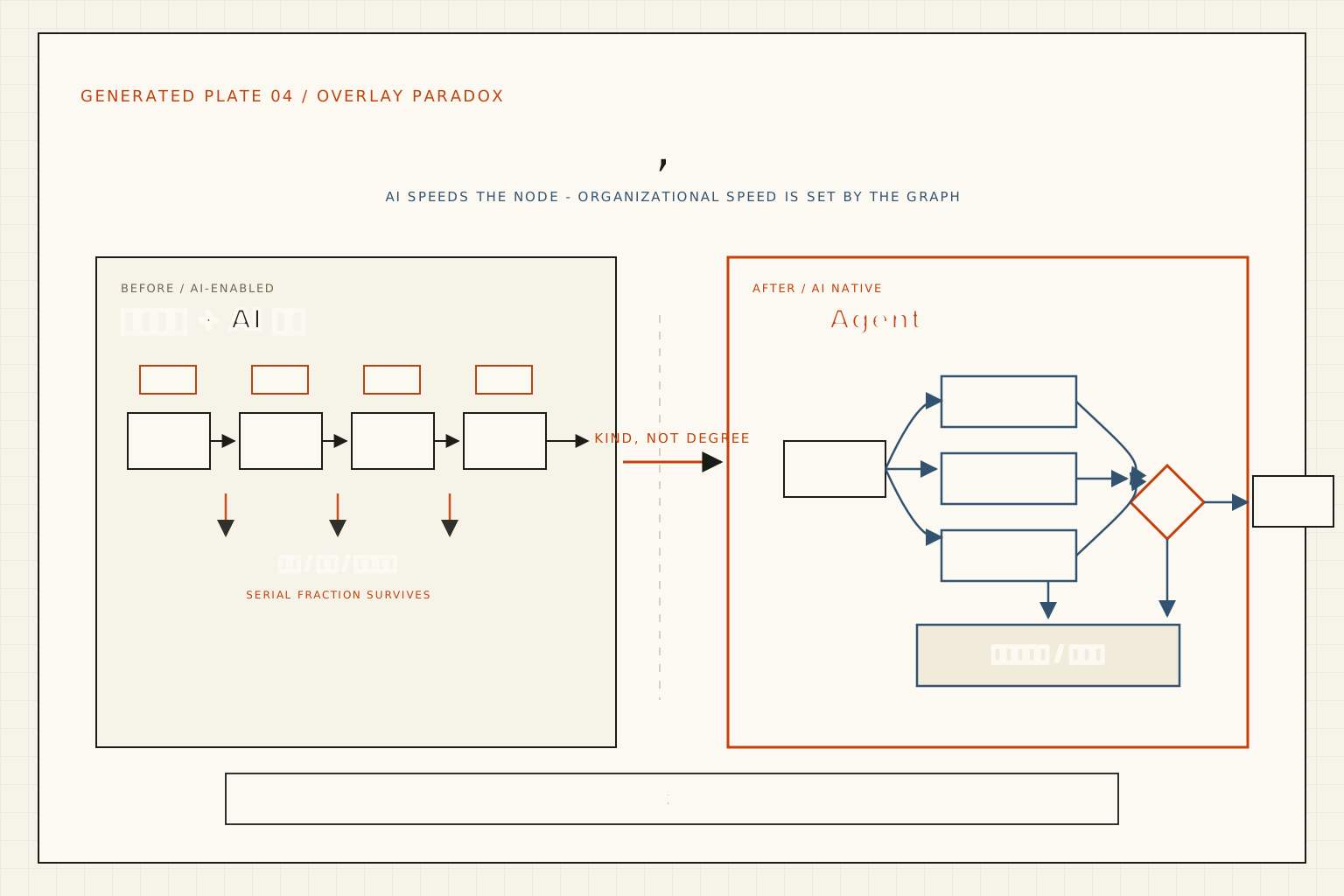
瓶颈从来不在节点的速度,而在图的形状。
The bottleneck has never been the speed of a node; it is the shape of the graph.
所以给每个人配上 AI 也几乎不动端到端吞吐:瓶颈长在图的形状里,工具触不到、转型绕不开。当前的押注是只有从底层重画工作流图才松得开它;但要盯着一个同样成立的反面——重画之后瓶颈未必消失,也可能只是从看得见的队列,搬到判断节点上的人、或系统要维护的上下文里,换了个更难计量的位置。So handing everyone AI barely moves end-to-end throughput: the bottleneck lives in the shape of the graph, where tools cannot reach and transformation cannot bypass it. The current bet is that only redrawing the workflow graph from the foundation loosens it; but watch an equally live rival—after the redraw the bottleneck may not vanish so much as relocate, out of the visible queue and onto the people at the judgment nodes or into the context the system must maintain, into a place that is harder to measure.
- Amdahl, 1967 - Limits of speedup
- Conway, 1968 - Committees invent
- Galbraith, 1974 - Info-processing view
- Brooks, 1975 - Mythical Man-Month
- Goldratt, 1984 - Theory of Constraints
- METR, 2025 - RCT: AI & dev speed
- 黄益贺, 2026 - AI原生组织的底层逻辑
- Huang Yihe, 2026 - The Underlying Logic of AI-Native Organizations
第 2 节 给出了测量结果:绝大多数企业 GenAI 试点对真实盈亏没有可衡量的影响。本章回答"为什么":因为这些组织把 AI 部署在节点上(让某个人、某个环节更快),而组织的吞吐量是图的属性——由依赖链的拓扑、协调成本的曲线、决策队列的深度决定。工具改变节点的速度,改不了图的形状。
Section 2 surfaced the measurement: the great majority of enterprise GenAI pilots show no measurable profit-and-loss impact. This chapter answers “why”: these organizations deploy AI on the nodes (making a person or a step faster), yet an organization’s throughput is a property of the graph, set by the topology of its dependency chains, the curve of its coordination cost, and the depth of its decision queues. Tools change the speed of a node; they do not change the shape of the graph.
一条流程若有 70% 的时间花在串行的等待、交接与审批上,那么即使把其余 30% 的执行加速一百倍,端到端也只快 1.42 倍。这就是"组织大量使用 AI 却没有变快"的数学结构:加速节点是工具问题,重画图是架构问题。AI 解决前者;这份规约的其余部分解决后者。
If 70% of a process’s time is consumed by serial waiting, handoffs, and approvals, accelerating the remaining 30% by a factor of a hundred still yields only a 1.42× end-to-end gain. That is the mathematical structure behind “organizations deploying lots of AI yet not getting faster”: speeding up nodes is a tooling problem; redrawing the graph is an architecture problem. AI solves the former; the rest of this specification solves the latter.
黄益贺(2026)描述过这条定律的一个具象版本(从业者观察,非受控研究):风投机构给每个分析师配上最强的 AI,让十个 agent 并行生成十份研究报告,然后所有报告仍由同一个人按顺序阅读、由同一个投委会按周期审议。生产端并行了,消费端依旧串行,两到四周的流程几乎没有缩短。他对此有一句精确的总结:"AI 不是自动让组织变快,它只是把串行瓶颈照得更亮。"——可并行的部分被 AI 加速之后,真正拖慢组织的环节会暴露得前所未有地明显:慢的不是写报告,是谁来读、谁来判断、谁来拍板。个体层面的证据同样刺眼:METR 2025 年的随机对照试验中(16 名资深开源维护者、246 个任务、各自深耕多年的百万行级代码库),开发者使用 AI 工具后实际慢了 19%,却自认为快了约 20%。研究者明确警告此结果不应外推到陌生代码库或从零构建的场景——但它至少确认了一件事:叠加层面的收益可能远比体感小,而体感本身不可信。
Huang Yihe (2026) described a concrete instance of this law (a practitioner observation, not a controlled study): a VC firm equips every analyst with the most powerful AI and lets ten agents generate ten research reports in parallel. All the reports are then still read sequentially by the same person, and reviewed on the same committee cadence. The production side parallelized; the consumption side remained serial. A two-to-four-week process barely shortened. His precise summary: “AI doesn’t automatically make an organization faster - it just illuminates serial bottlenecks more brightly.” Once the parallelizable parts are accelerated by AI, the stages that truly slow the organization become exposed as never before: the bottleneck is not writing reports, but who reads them, who judges them, who decides. Individual-level evidence is equally stark: in METR’s 2025 randomized controlled trial (16 experienced open-source maintainers, 246 tasks, each working in a million-line codebase they had cultivated for years), developers using AI tools were actually 19% slower, yet estimated themselves to be about 20% faster. The researchers explicitly cautioned against extrapolating to unfamiliar codebases or greenfield builds, but the trial nails one thing down: overlay-level gains may be far smaller than perceived, and perception itself cannot be trusted.
判别一个问题属于哪一层:工具层(单点执行慢,AI 直接可解)、流程层(顺序可重排,流程再造可解)、结构层(瓶颈由组织的存在方式本身产生,只能重构)。以下这些瓶颈全部位于结构层。每一个都按同一格式解剖:机制(传统组织为什么必然产生它)、为什么加 AI 无效(叠加悖论的具体形态)、AI Native 重构(映射到心智模型 M.01-M.05 与架构支柱)、检验信号(你的组织是否已经越过它)。
Diagnosing which layer a problem belongs to: tooling layer (a single node executes slowly; AI can fix this directly); process layer (sequence can be reordered; process reengineering can fix this); structural layer (bottleneck is generated by the organization’s very mode of existence; only restructuring can fix this). The following these bottlenecks all reside at the structural layer. Each is dissected in the same format: mechanism (why the traditional organization inevitably produces it), why overlay fails (the specific form of the overlay paradox), AI Native restructure (mapping to mental models M.01-M.05 and the architectural pillars), test signal (whether your organization has already cleared it).
读法:每张卡片在书目行下方标了它违反 T1 的哪一侧——判断分布 或 上下文流动,少数落在两者的交互。16 条里 14 条能干净归到这两根变量上;余下两条——B.15 动机抽干 与 B.16 生态位锁定——落在 T1 两轴之外:前者是人的内在动机,后者是组织间的生态依赖。不把它们硬塞进 T1,是对命题边界的诚实标注,也标出了 T1 还没覆盖、仍可被继续检验的两处。
How to read these: under each card’s citation line, a tag marks which side of T1 the bottleneck violates: judgment distribution or context flow, with a few at their coupling. Fourteen of the sixteen fall cleanly onto these two variables; the remaining two, B.15 motivation crowding-out and B.16 niche lock-in, sit outside T1’s two axes: one is intrinsic human motivation, the other inter-organizational ecosystem dependency. Not forcing them into T1 is an honest marking of the thesis’s boundary, and points to the two places T1 does not yet cover and can still be tested.
| ID | 瓶颈Bottleneck | 违反 T1Violates T1 | 一句话症状Symptom in one line |
|---|---|---|---|
| B.01 | 串行依赖链Serial dependency chain | 上下文流动context | 八成时间都在等人~80% of time spent waiting |
| B.02 | 协调成本平方律Coordination’s n² law | 上下文流动context | 新增产能被协调吃掉added capacity eaten by coordination |
| B.03 | 决策带宽天花板Decision-bandwidth ceiling | 判断分布judgment | 决策全堵在塔尖decisions jam at the apex |
| B.04 | 层级信息衰减Hierarchical signal decay | 上下文流动context | 坏消息逐层被削平bad news flattened layer by layer |
| B.05 | 部门墙与局部最优Silos & local optima | 判断×上下文j×c | 价值流被部门墙切碎value stream cut up by silos |
| B.06 | 会议同步税The meeting sync-tax | 判断×上下文j×c | 半数工时耗在开会half the hours spent in meetings |
| B.07 | 知识私有化Knowledge privatization | 上下文流动context | 知识锁在个人脑里knowledge locked in individual heads |
| B.08 | 审批链与责任稀释Approval chains & diffused accountability | 判断分布judgment | 出事找不到担责人no one accountable when it breaks |
| B.09 | 人头即产能Headcount as capacity | 判断分布judgment | 扩产能只能靠招人scaling capacity means hiring |
| B.10 | 规划节奏失配Planning-cadence mismatch | 判断分布judgment | 环境周变,资源年锁world shifts weekly, resources locked yearly |
| B.11 | 试错成本与风险规避Trial cost & risk aversion | 判断分布judgment | 试错太贵,只做安全事trials too costly, only safe bets |
| B.12 | 指标剧场Metrics theater | 上下文流动context | 指标沦为表演博弈metrics become performed theater |
| B.13 | 信任半径坍缩Trust-radius collapse | 上下文流动context | 没安全感就瞒问题no safety, so problems get hidden |
| B.14 | 权力梯度与议程垄断Power gradient & agenda capture | 判断分布judgment | 选项没上桌就已死options die before reaching the table |
| B.15 | 动机抽干Motivation crowding-out | 不在两轴off-axis | 效率叙事抽干意义efficiency narrative drains meaning |
| B.16 | 生态位锁定Niche lock-in | 不在两轴off-axis | 命脉攥在外部供应商lifeline held by an outside vendor |
串行依赖链The Serial Dependency Chain
传统流程是一场人传人的接力赛:需求 → 设计 → 构建 → 评审 → 发布,每一棒之间是队列与等待。精益研究反复测得流动效率不足 15%:一项工作 85% 以上的生命周期处于"等人"状态。总时长由串行链决定,与任何单个环节的内部效率无关。
The traditional process is a human relay race: requirements → design → build → review → ship, with queues and waiting between every baton pass. Lean research consistently measures flow efficiency below 15%: over 85% of a work item’s lifecycle is spent waiting for someone. Total duration is determined by the serial chain, independent of the internal efficiency of any individual stage.
给每个环节配 AI 加速的是"棒内奔跑",碰不到"棒间等待"。十个 agent 并行写出十份报告,最终仍由同一个人按顺序阅读:生产端并行了,消费端依旧串行。按阿姆达尔定律,串行占比 70% 时,无论把其余部分加速多少倍,总收益上限也只有 1.43 倍。更糟的是,上游加速会在未扩容的下游堆出更深的队列。约束理论早已断言:非瓶颈处的改善是幻觉。
Equipping each stage with AI accelerates “running with the baton”; it never touches “waiting between baton passes.” Ten agents write ten reports in parallel; they are still read sequentially by the same person: the production side parallelized, the consumption side remains serial. By Amdahl’s Law, when serial fraction is 70%, no matter how much you accelerate the rest, the total gain ceiling is only 1.43×. Worse: upstream acceleration piles deeper queues at unscaled downstream stages; the Theory of Constraints established long ago that improvement at a non-bottleneck is an illusion.
M.01 把组织声明为工作流图,支柱 02"工作流即代码"重画拓扑:可并行的全部并行扇出;交接消失,因为流转的是同一份上下文而非互相抛接的文档;审批从"排队等人"变为策略即代码的自动门加例外上报。人只出现在少数判断节点上。
M.01 declares the organization as a workflow graph; Pillar 02 “workflow-as-code” redraws the topology: everything parallelizable fans out in parallel; handoffs disappear because what flows is a shared context, not documents tossed back and forth; approvals shift from “queuing for a human” to policy-as-code automated gates with exception escalation. Humans appear only at a small number of judgment nodes.
协调成本平方律The Quadratic Coordination Tax
n 个需要对齐的人产生 n(n−1)/2 条沟通信道,组织每长大一圈,新增产能就被新增协调吃掉一块。Brooks 定律"给延期项目加人会让它更延期"只是这条曲线最著名的切片。整个中层管理的本质,就是组织为这条平方曲线雇佣的人肉路由器。
n people who need to align produce n(n−1)/2 communication channels; every time the organization grows by one ring, a slice of new capacity is consumed by new coordination. Brooks’s Law (“adding people to a late project makes it later”) is just the most famous cross-section of this curve. The entire function of middle management is the human routing layer the organization hires to service this quadratic curve.
每人配 AI 不减少信道数量,反而提高每条信道的流量:更多文档、更多消息、更快的来回,拥塞加剧。AI 纪要与摘要是在给平方曲线做无损压缩,曲线本身纹丝不动。
Giving everyone an AI does not reduce the number of channels; it increases the traffic on every channel: more documents, more messages, faster back-and-forth, greater congestion. AI meeting minutes and summaries merely compress the traffic running over the quadratic curve; the curve itself does not move.
M.03 上下文即核心资产——对齐通过共享上下文库完成,而非点对点同步。任何成员(人或 agent)从同一份机器可读的真相出发工作,信道结构从 O(n²) 网状坍缩为 O(n) 星形;agent 之间走结构化协议(任务、事件、状态机),根本不"开会"。
M.03 (context as core asset): alignment happens through a shared context store, not point-to-point sync. Every member (human or agent) works from the same machine-readable source of truth; channel structure collapses from O(n²) mesh to O(n) star. Agents coordinate via structured protocols (tasks, events, state machines); they do not “have meetings.”
决策带宽天花板The Executive Bandwidth Ceiling
传统组织用"判断集中到塔尖"换取一致性:重要决策逐级上报,CEO 的清醒时间成为全组织吞吐的硬上限。Simon 的有限理性在组织层面的表现是:组织越大,决策队列越深,一线感知与决策点之间的距离越远。
The traditional organization trades “concentrating judgment at the apex” for consistency: important decisions escalate tier by tier, and the CEO’s waking hours become the organization’s hard throughput ceiling. Simon’s bounded rationality at the organizational scale means: the larger the organization, the deeper the decision queue, and the greater the distance between frontline perception and the decision point.
给高管配 AI 摘要、给汇报配 AI 润色,只是让队列中的文档更漂亮、队列前进略快。决策延迟的主项是"排队等判断",不是"读材料太慢":单点带宽没变,天花板就没变。
Giving executives AI-generated summaries and AI-polished reports just makes the queued documents prettier; the queue moves only marginally faster. The dominant source of decision latency is “queuing for judgment,” not “reading too slowly.” Single-point bandwidth unchanged, ceiling unchanged.
第 2 节 判断稀缺性经济学的组织化:可编码的判断写成 guardrails 与策略,下放给 agent 与一线——M.05"人即判断锚点"指的是判断有锚,不是判断有漏斗。高层只保留三类判断:例外、不可逆、方向。决策权随上下文走,不随职级走。对必须保留在塔尖的判断,把判断前的预消化全部交给 agent(读完材料、对齐观点、列出假设、整理反方证据、标注不确定性),人面对的是一张高度浓缩的决策地图,不再是原始材料的洪流。
Section 2’s economics of judgment scarcity, institutionalized: codifiable judgments are written as guardrails and policies, delegated to agents and the frontline. M.05 “human as judgment anchor” means judgment has an anchor, not a funnel. Leadership retains only three categories of judgment: exceptions, irreversibles, and direction. Decision authority follows context, not hierarchy. For judgments that must stay at the apex, pre-digest everything before the judgment with agents (read materials, align viewpoints, list assumptions, compile counter-evidence, flag uncertainties) so humans face a highly condensed decision map, not a flood of raw material.
层级信息衰减Hierarchical Signal Decay
信息每向上传一层都被压缩、平滑、政治化,坏消息衰减得最快。控制论给过精确诊断。Ashby 必要多样性定律:当调节者拿到的信息品类少于系统扰动的品类,控制必然失败。传统组织的报告链是一台逐层削减多样性的机器。
With every tier that information travels up, it is compressed, smoothed, and politicized; bad news decays fastest. Cybernetics offers a precise diagnosis, Ashby’s Law of Requisite Variety: when the variety of information reaching the regulator is less than the variety of disturbances in the system, control must fail. The traditional organization’s reporting chain is a machine that strips variety away layer by layer.
AI 帮中层把周报写得更流畅,等于更高效地生产失真。失真不来自写作能力,来自"层级转述"这个信道本身:每一层都有选择性呈现的激励,AI 只会把选择性呈现做得更专业。
AI helping middle managers write smoother weekly reports is producing distortion more efficiently. Distortion does not come from writing ability; it comes from the channel of “hierarchical retelling” itself. Every tier has an incentive to present selectively; AI just makes selective presentation more polished.
支柱 05 可观测性先于规模:工作流原生埋点,决策者直接查询现场数据与 agent 执行轨迹。人肉报告链被"随时可查询的状态"替代,汇报从周期性叙事变成对同一套遥测的不同视图。
Pillar 05 (observability before scale): instrumentation native to the workflow, decision-makers querying live data and agent execution traces directly. The human reporting chain is replaced by “always-queryable state”; reporting becomes different views over the same telemetry rather than periodic narrative.
部门墙与局部最优Functional Silos & Local Optima
按职能切分让每个部门优化自己的 KPI,端到端价值流被切成片段,部门交界处堆积着队列、翻译损耗和"这不是我们的问题"。Conway 定律保证你的产品结构最终复刻这堵墙。
Organizing by function causes every department to optimize its own KPIs; the end-to-end value stream is sliced into fragments; queues, translation loss, and “that’s not our problem” accumulate at every departmental boundary. Conway’s Law guarantees your product architecture will eventually mirror this wall.
每个部门各自采购 AI 工具,墙反而更厚:数据孤岛之上又叠了一层工具孤岛,跨墙交接依旧靠人开会翻译。每个局部都更快了,全局还是次优,而且次优得更快。
Each department purchases its own AI tools, making the walls thicker: a layer of tool silos stacked on top of data silos; cross-wall handoffs still require humans to meet and translate. Every local optimum improved, global outcome still suboptimal, and now suboptimal faster.
M.01 围绕端到端价值流设计组织:一条工作流从客户触发直到客户收到,由跨域 agent 编队走完全程,职能变成"被工作流调用的能力",不再是"占有工作的领地"。Operator 拥有整条流,不是其中一段。
M.01 designs the organization around end-to-end value streams: one workflow from customer trigger to customer receipt, traversed by cross-domain agent ensembles; functions become “capabilities invoked by the workflow,” no longer “territories that own work.” The Operator owns the whole stream, not a segment of it.
会议同步税The Synchronous Coordination Tax
会议是传统组织的默认协调原语:一种要求所有参与者同时在场的阻塞调用。管理者 30-50% 的时间花在会上,日历碎片进一步杀死深度工作。会议泛滥的根因是两个缺失:状态不可见,决策权不明确,于是只好用"同时在场"兜底。
Meetings are the default coordination primitive of the traditional organization: a blocking call that requires all participants to be present simultaneously. Managers spend 30-50% of their time in meetings; calendar fragmentation further kills deep work. The root cause of meeting proliferation is two absences: state is not visible, and decision authority is not defined, so “all present at once” becomes the fallback.
AI 纪要、AI 排程降低了开会的边际成本,于是会议更多了,这是杰文斯悖论的会议版。工具优化的是"怎么开会",问题却是"为什么需要开会"。
AI meeting minutes and AI scheduling lower the marginal cost of meetings, so there are more meetings. This is the meeting-world version of Jevons’s Paradox. The tools optimize “how to meet”; the real question is “why meetings are needed at all.”
支柱 02 让协调走异步状态机:工作流状态对所有参与者可见,交接由事件触发,决策带理由记录在案。同步在场只保留给真正需要它的三件事:判断分歧、关系建立、危机处理。AI Native 组织的默认是 async-first,日历近乎空白。
Pillar 02 routes coordination through asynchronous state machines: workflow state is visible to all participants, handoffs are event-triggered, decisions are recorded with rationale. Synchronous presence is reserved for the three things that truly require it: adjudicating judgment disagreements, relationship-building, and crisis response. The AI Native organization defaults to async-first; calendars are nearly empty.
知识私有化Tacit Knowledge Lock-in
关键知识活在个人头脑、私聊记录和"去问老王"里。新人上手以月计,老人离职即知识蒸发,bus factor 长期为个位数。更糟的是私有化被激励结构强化:不可替代性就是职业安全。
Critical knowledge lives in individual minds, private chat histories, and “go ask Zhang Wei.” Onboarding new hires takes months; when veterans leave, knowledge evaporates; the bus factor stays in the single digits indefinitely. Worse, privatization is reinforced by the incentive structure: irreplaceability is job security.
给每人配 AI 助手改变不了知识的私有属性:AI 能检索写下来的一切,唯独检索不了从未写下的东西。二十年来,让企业知识库项目一再失败的,是"写下来"从未成为工作本身的一部分——搜索技术从来不是瓶颈。
Giving everyone an AI assistant does not change the private nature of knowledge: AI can retrieve everything that was written down; it cannot retrieve what was never written. What has made enterprise knowledge-base projects fail for twenty years is that “writing things down” was never made part of the work itself — search technology was never the bottleneck.
M.03 加支柱 03 上下文工程作为系统实践:知识只有进入机器可读的上下文库才算"存在"——决策连同理由入库,流程以代码形式自文档,agent 的执行轨迹自动沉淀为组织记忆。上手时间可以从以月计压到以天计——前提是流程与知识已经写成 agent 可读的形式。
M.03 plus Pillar 03 (context engineering as a system practice): knowledge only “exists” once it enters a machine-readable context store. Decisions are stored with their rationale; processes self-document as code; agent execution traces are automatically deposited into organizational memory. Onboarding time can compress from months to days, provided the processes and knowledge have already been written into a form agents can read.
审批链与责任稀释Approval Chains & Diffused Accountability
传统组织用多级签字管理风险,但签字越多责任越稀:每个人都默认上一级看过了、下一级会把关,社会心理学称之为责任分散效应。审批链的实际功能往往是责任分摊仪式,而非质量控制:出事之后,找不到"做决定的那个人"。
The traditional organization uses multi-tier sign-off to manage risk, but the more signatures there are, the more diffuse accountability becomes: each person assumes the tier above reviewed it and the tier below will catch it. Social psychology calls this the diffusion of responsibility. The actual function of the approval chain is often not quality control but a ritual of distributing blame: when something goes wrong, there is no “person who made the decision” to be found.
AI 起草材料、AI 预审,让链条空转得更快——"人人有份、无人负责"的结构原封未动。甚至更糟:"AI 预审通过"成为新的集体免责理由。
AI drafting materials and AI pre-review make the chain spin faster; the structure of “everyone involved, no one accountable” is untouched. It may even worsen: “AI pre-review passed” becomes the new collective disclaimer.
M.05 与支柱 06:审批收敛为少数显式判断节点,每个节点单人、具名、权责成对。可编码的检查全部交给自动门:测试、策略、合规规则;人签的字只剩一种含义:"这个后果我来承担。"
M.05 and Pillar 06: approvals converge to a small number of explicit judgment nodes; each node is a single named individual with paired authority and accountability. All codifiable checks go to automated gates: tests, policy rules, compliance checks. The only meaning left in a human signature: “I own this outcome.”
人头即产能Headcount-as-Capacity
传统组织扩张能力只有一个原语:招聘。周期以月计、成本固定化、错配难逆转,于是产能规划变成赌博,组织在"人手不够"与"养着闲人"之间永久摆动。预算以人头计、权力以下属数计——这也是帝国构建行为的经济根源。
The traditional organization has only one primitive for expanding capability: hiring. Cycles measured in months, costs that become fixed, mismatches that are hard to reverse: capacity planning becomes a gamble, and the organization oscillates permanently between “not enough hands” and “carrying dead weight.” Budget is counted in headcount; power is measured in the number of direct reports. This is also the economic root of empire-building.
AI 招聘工具加速的是旧通道:更快地筛简历、更快地面试,但从不质疑"能力 = 人头"这个等式。各部门继续以多要人头为目标,AI 反而成了新论据:"我们需要再招五个 AI 工程师。"
AI recruiting tools accelerate the old channel (faster resume screening, faster interviews) while never questioning the equation “capability = headcount.” Departments continue to target more headcount; AI becomes the new argument: “We need to hire five more AI engineers.”
M.02 Agent 即默认工种:任何新能力需求,默认先问"工作流加 agent 能否承担",招人只为增加判断密度。产能变成弹性量:agent 实例随负载伸缩,组织能力与组织人数解耦。这正是人均创收 $600 万量级的结构基础(第 2 节,口径见 第 9 节)。
M.02 (agent as default job type): for any new capability requirement, the default first question is “can a workflow plus agent handle this?” Hiring is reserved for increasing judgment density. Capacity becomes elastic: agent instances scale with load, and organizational capability is decoupled from headcount. This is the structural basis for the $6M revenue-per-person scale (Section 2; scope defined in Section 9).
规划节奏失配The Planning Cadence Mismatch
年度预算加季度 OKR 的节奏继承自工业时代的资本开支周期。环境以周为单位变化,资源以年为单位锁定,组织对机会的响应速度被规划日历锁住。年中发现方向错了?等明年预算。
The annual budget plus quarterly OKR cadence is inherited from the industrial era’s capital expenditure cycle. The environment changes by the week; resources are locked by the year, so the organization’s speed of response to opportunity is capped by the planning calendar. Discover mid-year that the direction is wrong? Wait for next year’s budget.
AI 让规划文档的生产快了十倍(三天做出过去三周的 PPT),但"批准、锁定、执行、年终复盘"的律动没变。更快地制定一个一年不变的计划不叫敏捷,叫更精致的僵化。
AI makes planning document production ten times faster (a three-week slide deck now takes three days), but the rhythm of “approve, lock, execute, year-end review” is unchanged. Producing a year-locked plan faster is more refined rigidity, not agility.
支柱 07 持续演化:资源跟随工作流遥测动态再分配——表现好的流自动获得更多算力、预算与 agent 配额,表现差的流被自动收缩。规划从年度仪式变成持续运转的内部资源市场,节奏与反馈周期同阶。
Pillar 07 (continuous evolution): resources are dynamically reallocated following workflow telemetry. Well-performing flows automatically receive more compute, budget, and agent quota; poorly performing flows are automatically contracted. Planning transforms from annual ritual into a continuously operating internal resource market whose cadence is in phase with the feedback cycle.
试错成本与风险规避Experiment Cost & Risk Aversion
传统组织里一次尝试等于立项加排期加占人加失败追责。试错又贵又伤人,于是只做"安全"的事——March 所说的 exploitation 挤出 exploration,组织系统性地低配探索。创新死于"值得吗"的会议,而非死于失败。
In the traditional organization, one attempt equals project approval plus scheduling plus headcount allocation plus accountability for failure. Experimentation is expensive and painful, so the organization only does what is “safe”: March’s exploitation crowds out exploration, and the organization systematically under-invests in discovery. Innovation doesn’t die from failure; it dies in the “is this worth it?” meeting.
执行变快了,但立项流程、追责文化、机会成本核算原样保留——组织还是只批"看起来稳"的实验。AI 甚至放大了错觉:AI 生成的市场分析让坏主意显得更可信——见 第 11 节 的陷阱"合成自信"。
Execution is faster, but the project-approval process, accountability culture, and opportunity-cost accounting are untouched; the organization still greenlights only experiments that “look safe.” AI can even amplify the illusion: AI-generated market analyses make bad ideas look more credible (see Section 11’s failure pattern “Synthetic Confidence”).
M.04 持续学习即操作系统:agent 并行运行 N 个变体,由真实数据裁决,实验的单位成本低到不值得为失败追责——但这只对可逆、无第三方外溢的实验成立;不可逆、或会外溢到客户与第三方的决策,仍保留 accountability 锚(M.05),不因单位成本低而豁免。文化从"审批制"换轨为"回滚制":默认可试,越界自动回滚。探索从例外变成底色。
M.04 (continuous learning as the operating system): agents run N variants in parallel, adjudicated by real data; the unit cost of an experiment drops too low to justify accountability for failure, but this holds only for reversible experiments with no third-party spillover; irreversible decisions, or ones that spill over to customers and third parties, still keep an accountability anchor (M.05), and are not exempted just because the unit cost is low. Culture shifts from “approval regime” to “rollback regime”: everything is tryable by default, and anything out of bounds rolls back automatically. Exploration moves from exception to baseline.
指标剧场Metric Theater
传统组织度量个人产出——代码行、工时、关单数。Goodhart 定律保证指标一旦成为目标就被博弈:囤积信息以保不可替代、做指标表演以保排名、报喜不报忧以保预算。度量系统本身在制造反协作。
The traditional organization measures individual output: lines of code, hours logged, tickets closed. Goodhart’s Law guarantees that any metric, once it becomes a target, gets gamed: hoarding information to stay irreplaceable, inflating metrics to protect rankings, reporting only good news to protect budget. The measurement system itself manufactures anti-collaboration.
AI 把指标表演的成本降到零——合成产出无限供给,"看起来很高产"从未如此容易。继续度量个人产出,等于正式邀请全员用 AI 生产度量噪音。NANDA 测到的那批无成效试点里,相当一部分正是"AI 提升了指标、没碰到真实盈亏"。
AI reduces the cost of gaming metrics to zero: synthetic output comes in unlimited supply, and “appearing highly productive” has never been easier. Continuing to measure individual output is a formal invitation for everyone to use AI to produce measurement noise. A significant portion of the no-impact pilots NANDA measured are precisely “AI improved the metrics without touching the P&L.”
度量对象从个人换成工作流(支柱 05):吞吐、质量、成本、演化速度——由埋点客观采集,难以被个体博弈。人的评价转向 agent 无法供给的稀缺物:判断质量、上下文贡献、方向正确度(第 2 节 的 KPI 反转)。
The unit of measurement shifts from individuals to workflows (Pillar 05): throughput, quality, cost, and evolution speed, objectively captured by instrumentation and difficult for any individual to game. Human evaluation shifts toward scarcities that agents cannot supply: judgment quality, context contribution, directional correctness (the KPI inversion from Section 2).
信任半径坍缩Trust-Radius Collapse
组织的有效协作半径由心理安全决定——人只在"暴露问题不会被惩罚"时才上报坏消息、试验、求助。Edmondson 的研究反复显示:心理安全高的团队报告更多错误——差异来自报告意愿而非犯错频次。信任是吞吐量的隐形上限。
An organization’s effective collaboration radius is determined by psychological safety: people only report bad news, run experiments, and ask for help when “exposing problems carries no punishment.” Edmondson’s research consistently shows that high-psychological-safety teams report more errors; the difference comes from willingness to report, not frequency of mistakes. Trust is the invisible throughput ceiling.
Agent 让一切可观测,诱惑是把可观测变成全员监控。一旦遥测被用于考核与裁员,员工的理性反应是隐藏——隐藏 AI 用法、隐藏省下的时间、隐藏失败试验。监控越密,真实信号越枯竭。这是"裁员叙事自反噬"(见失败模式)的结构根源:你买了 X 光机,却让所有人学会了憋气。
Agents make everything observable; the temptation is to convert observability into surveillance of everyone. Once telemetry is used for performance reviews and layoffs, the rational employee response is to hide: hide AI usage, hide time saved, hide failed experiments. The denser the surveillance, the drier the true signal. This is the structural root of “the layoff narrative auto-cannibalization” (see failure modes): you bought an X-ray machine, but taught everyone to hold their breath.
把遥测的用途宪法化——可观测性服务于系统改进而非个人审判(支柱 05)。区分"看流程"与"看人":流程指标公开,个人产出不入考核。Mollick 的 Leadership/Lab/Crowd——激励对齐到分享而非惩罚,才能让 X 光机照出真相而非教会憋气。
Constitutionalize the purpose of telemetry: observability serves system improvement, not individual prosecution (Pillar 05). Distinguish “watching the process” from “watching the person”: process metrics are public; individual output is not factored into evaluations. Mollick’s Leadership/Lab/Crowd framework: align incentives toward sharing rather than punishment, and the X-ray machine reveals truth instead of teaching breath-holding.
权力梯度与议程垄断Power Gradient & Agenda Capture
组织里最关键的权力是"决定哪些提案进入议程",而非"否决提案"——Bachrach & Baratz 称之为权力的第二张面孔。议程设置权高度集中时,大量选项在被讨论前就已死亡,而组织对此毫无记录。
The most critical power in an organization is “deciding which proposals reach the agenda,” not “vetoing proposals.” Bachrach & Baratz call this the second face of power. When agenda-setting authority is highly concentrated, vast numbers of options die before they are discussed, and the organization has no record of this.
给决策者配 AI,放大的是既有议程持有者的产能——他能更快生成更多支持自己议程的材料。AI 不会自动质疑"为什么是这些选项"。更隐蔽的是:当 AI 推荐被当作中立,议程垄断就披上了客观的外衣,反而更难挑战。
Equipping decision-makers with AI amplifies the capacity of the existing agenda holder: they can generate more material supporting their own agenda, faster. AI does not automatically question “why these options?” More insidiously: when AI recommendations are treated as neutral, agenda capture dresses itself in the appearance of objectivity and becomes even harder to challenge.
Gans 的逐域控制权([R5])给出方向:透明推理是权威的替代品——让 AI 公开候选选项的全集与淘汰理由,议程从"谁有权设置"变为"图上可见的分支"。决策日志(支柱 03)把被否决的选项也记下来,议程垄断失去隐蔽性。
Gans’s domain-by-domain control authority ([R5]) points the direction: transparent reasoning replaces authority. Have AI surface the full candidate option set and the elimination rationale; the agenda moves from “who has the right to set it” to “a visible branch on the graph.” The decision log (Pillar 03) records rejected options too; agenda capture loses its concealment.
动机抽干Motivation Crowding-Out
自我决定论与动机挤出研究(Frey-Jegen 的元分析)显示:外在控制(监控、计件、把内在意义换成 KPI)会挤出内在动机。当一件原本有意义的工作被重新框定为"用 AI 多产出 X 倍",意义感会被效率叙事抽干,留下应付。
Self-determination theory and motivation crowding-out research (Frey-Jegen meta-analysis) show that extrinsic control (surveillance, piece-rate pay, replacing intrinsic meaning with KPIs) crowds out intrinsic motivation. When work that was originally meaningful is reframed as “produce X times more output with AI,” the sense of meaning is drained by the efficiency narrative, leaving only going through the motions.
把 AI 收益直接翻译成"同样的人产出翻倍"或"同样的产出裁一半人",是教科书级的外在化操作。短期数字好看,中期工匠精神、主人翁感、自发改进一起蒸发——而这些恰是 AI无法提供、只有人能注入组织的东西。你优化了产量,抽干了发动机。
Translating AI gains directly into “same people, double output” or “same output, half the people” is a textbook way to turn intrinsic motivation extrinsic. Short-term numbers look good; medium-term craftsmanship, ownership, and self-driven improvement evaporate together. These are precisely what AI cannot supply and only humans can inject into an organization. You optimized throughput and drained the engine.
把 AI 定位为"卸下苦工、释放判断"而非"同岗增产"——人的角色上移到 M.05 判断锚点与 M.06 编排者,工作变得更需要品味与主张,而非更像流水线。收益分配若指向"更难的好问题"而非"更少的人头",内在动机被放大而非挤出。
Position AI as “removing drudgery, freeing judgment” rather than “same role, more output”: the human role elevates to M.05 judgment anchor and M.06 orchestrator; work demands more taste and conviction, less assembly line. If the dividend of AI is directed toward “harder, better problems” rather than “fewer heads,” intrinsic motivation is amplified rather than crowded out.
生态位锁定Niche Lock-In
组织生态学(Hannan-Freeman 种群生态视角)提醒:组织的命运不只由内部效率决定,也由它在生态中的位置与依赖结构决定。当核心生产要素来自少数外部供应商,组织的生存权被锁进了别人的生态位。
Organizational ecology (the Hannan-Freeman population-ecology perspective) reminds us: an organization’s fate is determined not only by internal efficiency, but also by its position and dependency structure within the ecosystem. When core production inputs come from a small number of external suppliers, the organization’s survival rights are locked into someone else’s niche.
越深地"加 AI",越深地把核心能力外包给 OpenAI/Anthropic/Google 等少数模型供应商——算法封建主义。围绕单一供应商的 API 怪癖优化,短期最快,却在条款、定价、可用性变动时被挟持。这是结构性的生态位依赖,而非工具问题——单点故障被写进了组织命脉。
The deeper you “add AI,” the deeper you outsource core capabilities to a small number of model suppliers (OpenAI, Anthropic, Google): algorithmic feudalism. Optimizing around a single vendor’s API quirks is fastest short-term, but leaves you held hostage when terms, pricing, or availability change. This is structural niche dependency, not a tooling problem: single points of failure written into the organization’s life support.
支柱 04 多模型架构是这条瓶颈的正解:把模型层当作可替换的商品而非命脉,保留"主权"。抽象出供应商无关的内部接口、保留可迁移的上下文资产(M.03)、关键路径双供应商。生态位依赖不可消除,但可以从"命脉"降级为"成本项"。
Pillar 04 (multi-model architecture) is the correct answer to this bottleneck: treat the model layer as a replaceable commodity rather than a lifeline, preserving “sovereignty.” Abstract out vendor-agnostic internal interfaces, maintain portable context assets (M.03), dual-source critical paths. Niche dependency cannot be eliminated, but it can be downgraded from “lifeline” to “cost item.”
回到每张卡片底部的"检验信号",对照你的组织按下「命中」。没有及格线,只有一张片子:命中的每一项,都是工作流图上一条还没被删掉的串行边。
Return to the “Test Signal” at the bottom of each card and click “Hit” wherever it matches your organization. There’s no passing score, just an X-ray: every hit marks a serial edge on the workflow graph that hasn’t been deleted yet.
这些结构瓶颈几乎都被当成"协调/信息"问题。换一片透镜,同一张图上会亮起不同的受灾点——也会暴露原清单没覆盖的盲区(朱色行即补画的新瓶颈)。点某一维度,看同一批瓶颈在该维度下的表现与盲区;点任一格子看结论摘要。
These structural bottlenecks are almost always treated as “coordination/information” problems. Swap in a different lens and different damage points light up on the same diagram, exposing blind spots the original list did not cover (rows in vermilion are newly drawn bottlenecks). Click a dimension to see how this same set of bottlenecks behaves, and where its blind spots are, along that dimension; click any cell for a summary verdict.
| 瓶颈 \ 维度Bottleneck \ Dimension | 信息Information | 激励Incentive | 权力Power | 认知Cognition | 时间Time | 生态Ecology |
|---|
这些瓶颈的重构方案各不相同,但日常动词只有一个——压缩。判断本身不可并行(战略方向、投资决策、产品审美、内容把关必须由人承担),但判断之前的一切都可以:让 agent 预先读完材料、找出证据、对齐分歧观点、列出关键假设、整理反方论据、标注不确定性——把"原始材料的洪流"压缩成"一张决策地图"。压缩的对象是判断之前的等待,而非人的判断。
These bottlenecks have different restructuring prescriptions, but there is only one daily verb: compress. Judgment itself cannot be parallelized (strategic direction, investment decisions, product taste, editorial gatekeeping must be carried by humans), but everything before judgment can be: have agents pre-read materials, surface evidence, align divergent viewpoints, enumerate key assumptions, compile counter-arguments, and flag uncertainties, compressing “a flood of raw material” into “a decision map.” What is being compressed is the waiting before judgment, not human judgment itself.
第二个关键词是持续。瓶颈的边界随模型能力移动:今天必须由人串行处理的,明天可能被 agent 预处理;今天要反复口头解释的背景,明天通过 memory 与 context 系统自动继承。所以 AI Native 组织是一个持续迭代的产品,而非固定状态。Operator 的周期性三问:① 还有哪些事必须由人按顺序处理?② 其中哪些可以被 agent 预处理、被结构化?③ 哪些上下文可以被系统继承、不再依赖口头传递?每一轮回答,都从工作流图上再删掉几条串行边。
The second keyword is continuously. The boundary of bottlenecks moves with model capability: what must be processed serially by humans today may be pre-processed by agents tomorrow; background that requires repeated verbal explanation today will be automatically inherited through memory and context systems tomorrow. The AI Native organization is therefore not a fixed state but a continuously iterated product. The Operator’s periodic three questions: ① What still must be processed by humans in sequence? ② Of those, which can be pre-processed and structured by agents? ③ Which context can be inherited by the system without further dependence on verbal hand-off? Each round of answers deletes a few more serial edges from the workflow graph.
什么值得研究、什么不值得——AI 能找答案,难替你决定什么问题最重要。
What is worth investigating, and what is not. AI can find answers; it struggles to decide which questions matter most.
什么是好报告、好产品、好判断。标准不清,agent 跑得越快,垃圾生成得越快。
What counts as a good report, a good product, a good judgment. Without clear standards, the faster agents run, the faster garbage is generated.
历史判断、失败经验、行业框架若不能被系统继承,每次协作都从零开始。
If historical judgments, failure lessons, and domain frameworks cannot be inherited by the system, every collaboration starts from zero.
哪些可自动检查、哪些必须人工 review、哪些错误可容忍、哪些不可接受。
What can be automatically checked, what requires human review, which errors are tolerable, and which are not.
AI 提供信息、证据、反证与模拟,但"要不要做"仍由人承担后果。
AI provides information, evidence, counter-evidence, and simulations, but the consequences of “whether to do it” are still borne by a human.
泰勒制 → 丰田 TPS → 华为 IPD:用流程吃掉个人英雄主义,解决规模化问题[R46]。
Taylorism → Toyota TPS → Huawei IPD: use process to absorb individual heroics and solve the problem of scaling[R46].
Amazon / Google 实验文化 → 字节跳动 A/B 化组织:用数据迭代组织本身,解决迭代速度问题[R47]。
Amazon / Google experiment culture → ByteDance A/B-ified organization: use data to iterate the organization itself and solve the problem of iteration speed[R47].
执行交给 agent 网络,人收敛为判断节点,针对串行瓶颈。公开样本仍薄:Anthropic 自述 10 个团队(含法务、增长营销等非工程团队)已把 agentic 工作流嵌入部分流程[R21]——是嵌入部分流程,不是整体运转。
Execution delegated to agent networks; humans converge to judgment nodes, targeting serial bottlenecks. Public samples remain thin: Anthropic reports that 10 teams (including legal and growth marketing, not just engineering) have embedded agentic workflows into some processes[R21]: embedded into some processes, not running end-to-end.
没有一个瓶颈是"技术不够好"造成的。传统组织是为一个前提设计的机器——人类协调成本高昂且不可压缩。层级、会议、审批链、年度预算、人头制、个人 KPI,全部是那个前提下的最优解。这也是为什么 Ivan Zhao 把 AI 称作"组织的钢铁"——人类沟通不再必须是承重墙,两小时的周对齐会塌缩成五分钟的异步评审[R22]。但钢铁不会自己重盖房子:早期工厂把水车换成蒸汽机却保留其余一切,生产率只微涨;爆发发生在工厂围绕蒸汽机重新设计之后——截至本版(2026-07),大多数"加 AI"仍停在换水车阶段。这台机器没有坏,它只是在精确地解一道已经被删掉的题。
Not a single bottleneck is caused by “technology that is not good enough.” The traditional organization is a machine designed for one premise: human coordination costs are high and incompressible. Hierarchy, meetings, approval chains, annual budgets, headcount-based capacity, individual KPIs: all are the optimal solution under that premise. This is also why Ivan Zhao calls AI “steel for the organization”: human communication no longer has to be a load-bearing wall; a two-hour weekly alignment meeting can collapse to a five-minute async review[R22]. But steel does not rebuild houses on its own: early factories swapped waterwheels for steam engines while keeping everything else unchanged, and productivity barely rose; the real explosion came after factories redesigned themselves around the steam engine. As of this edition (2026-07), most “adding AI” is still at the waterwheel-swap stage. The machine is not broken; it is just solving a problem that has already been deleted.
AI 删除了前提,但不会自动删除解。把 AI 加装到旧解上,得到的是一个更快的旧组织——这些瓶颈原样保留,只是每个瓶颈处的队列前进得更体面了。这也是"转型"路径的根本困境:这些瓶颈中的每一个,在存量组织里都有既得利益的守护者——中层是平方律的雇员,审批链是风险部门的领地,人头预算是权力的度量衡。结构问题之所以是结构问题,就在于它不能在结构内部被投票废除。
AI deleted the premise but does not automatically delete the solution. Overlay AI onto the old solution and you get a faster old organization: these bottlenecks preserved intact, with queues at each bottleneck advancing more gracefully. This is also the fundamental dilemma of the “transformation” path: each of these bottlenecks has a vested-interest guardian in the incumbent organization: middle managers are employees of the quadratic law, approval chains are the risk department’s territory, headcount budgets are the measure of power. The reason structural problems are structural problems is precisely that they cannot be voted out from within the structure.
从新前提重新推导组织,这正是本规约其余部分的内容:第 5 节 的这些世界观是新前提的公理化,第 7 节 的架构支柱是推导规则,第 8 节 的运营底座是物理实现。
Re-deriving the organization from new premises is precisely what the rest of this specification covers: the worldviews of Section 5 are the axiomatization of the new premise; the pillars of Section 7 are the derivation rules; the operating substrate of Section 8 is the physical implementation.
底层世界观
Foundational Worldviews
支柱不是凭空立起来的,它们整个压在六个"组织现在该怎么看"的假设上。先把假设摊开,你才看得清支柱在替你赌什么。
The pillars are not raised from nothing; they rest entirely on six assumptions about how to see an organization now. Lay the assumptions out first, and you can see what the pillars are betting on.
支柱之前是六个假设:工作流图才是真相、agent 是默认工种、人是判断锚、上下文是基设、组织持续自学、操作者是编排者。它们是支柱的地基,不是中立的观察——最吃重的一条"人是判断锚"赌的是判断长期绑在人身上。这是本卷此刻的下注;哪天某类判断被 agent 稳定做得更好,松动的就不止一根支柱,而是这块地基。Before the pillars come six assumptions: the workflow graph is the truth, the agent is the default role, the human is the judgment anchor, context is infrastructure, the organization learns continuously, and the operator is the orchestrator. They are the pillars’ foundation, not neutral observations, and the load-bearing one—“the human is the judgment anchor”—bets that judgment stays bound to people. That is this volume’s current wager; the day agents do some class of judgment reliably better, what loosens is not one pillar but the ground under all of them.
组织即工作流图
Organization-as-Workflow-Graph
传统组织里,组织图是真相——显示谁向谁汇报。AI Native 组织里,工作流图是真相——显示什么流向哪里、什么触发什么、什么决定什么。组织图如果还存在,是工作流图的下游产物。组织图的权威也比想象中年轻。第一张现代组织图谱是 1855 年 McCallum 为 Erie 铁路所画;Mollick 据此提醒:从组织图谱到敏捷,现有组织技术全部预设"单一的、仅人类的智能"[R8],所以是重建,不是改装。
In a traditional organization the org chart is the truth: it shows who reports to whom. In an AI Native organization the workflow graph is the truth: it shows what flows where, what triggers what, what decides what. If an org chart still exists it is a downstream artifact of the workflow graph. The authority of the org chart is also younger than we imagine: the first modern org chart was drawn by McCallum for the Erie Railroad in 1855; Mollick uses that fact to remind us that every existing management technology from org charts to agile presupposes “a single, exclusively human intelligence” [R8]. So this is a rebuild, not a retrofit.
Agent 即默认工种
Agent as the Default Role
设计任何任务时的默认假设是——Agent 来做这件事。人类只在有特定理由时介入:判断、问责、关系。这反转了传统偏置:传统问"要不要自动化",AI Native 问"这真的需要人吗"。落到具体动作:一份竞品分析,过去默认派个人去查、去比、去成稿,卡在他的档期;现在默认 agent 拉数据、列对比、出初稿,人只在"该不该把这几家纳入""这个结论敢不敢下"两处落判。
When designing any task, the default assumption is an Agent does this. Humans intervene only when there is a specific reason: judgment, accountability, relationships. This inverts the traditional bias: the old question was “should we automate this?” The AI Native question is “does this genuinely need a human?” In concrete terms: a competitive analysis used to default to a person searching, comparing, and drafting, bottlenecked on their calendar; now it defaults to an agent pulling the data, laying out the comparison, and producing a first draft, with the human stepping in only at “should these players be in scope” and “can this conclusion be signed off.”
上下文即核心资产
Context as the Core Asset
新的资产类别——组织上下文(organizational context)。结构化、可被 Agent 检索的组织思考、决策、运营。它是 AI Native 组织建立的护城河,而且复利积累。Karpathy 把这件事的必要性说得更狠——LLM 患有"顺行性遗忘症",不像同事那样积累语境,上下文必须被显式工程化[R6]:这个资产是 Agent 可用的前提,而非锦上添花。
A new asset class: organizational context, the organization’s thinking, decisions, and operations structured so Agents can retrieve them. It is the moat an AI Native organization builds, and it compounds. Karpathy states the necessity more bluntly: LLMs suffer from “anterograde amnesia” and cannot accumulate context the way a colleague does, so context must be explicitly engineered [R6]. This asset is the prerequisite for Agent usability, not a luxury.
持续学习即操作系统
Continuous Learning as the Operating System
传统组织通过周期性干预改进。AI Native 组织持续改进——每一次工作流执行都被观察、评估、用来改进工作流本身。这是批处理 vs 流处理,应用到组织学习上。落到具体动作:过去销售话术一年改两次、靠季度复盘定;现在每通电话的成败都回流,本周成的打法下周就并进话术库,改进以周计而非以年计。
Traditional organizations improve through periodic interventions. AI Native organizations improve continuously: every workflow execution is observed, evaluated, and used to improve the workflow itself. This is batch processing vs. stream processing, applied to organizational learning. In concrete terms: a sales script used to be revised twice a year off quarterly reviews; now the outcome of every call flows back, and a play that worked this week folds into the script library next week, so improvement is measured in weeks, not years.
人即判断锚点
Humans as Judgment Anchors
人不是劳动力。人是判断者、责任承担者、品味设定者、关系持有者。听起来像是把人往后退了一步,其实是升级:人在组织里的角色,从"执行单位"变成"判断单位"。Karpathy 的验证瓶颈论说的是同一件事:AI 生成、人类验证,带滑块的部分自治,比不出事故就烧香的全自治更可靠[R6]。
Humans are not labor. Humans are judges, accountability holders, taste-setters, and relationship owners. It sounds like a step back, but it’s actually a promotion: the human role in the organization moves from “execution unit” to “judgment unit.” Karpathy’s verification-bottleneck argument makes the same point from another angle: AI generates, humans verify. Partial autonomy with a slider beats full autonomy that’s hoping nothing breaks [R6].
组织即生命系统
Organization as a Living System
传统组织被设计成工厂——部门、流程、岗位说明书,是一组刚性隔间。AI Native 组织被设计成生命系统——一切流动,发现问题的"细胞"被授权直接响应,秩序自下而上涌现而非自上而下指派。这是小型组织能比大型快一个数量级的结构性原因——是结构不同,而非更聪明。它也把光谱两端缝合:从 N=1 的一人公司到 N=众多的 agent 网络,跑的是同一套生命逻辑,只是规模不同——单细胞到多细胞这条线,第 6 节 讲透。
Traditional organizations are designed as factories: departments, processes, and job descriptions form a set of rigid compartments. AI Native organizations are designed as living systems: everything flows; the “cell” that detects a problem is authorized to respond directly; order emerges bottom-up rather than being assigned top-down. This is the structural reason a small organization can move an order of magnitude faster than a large one: not because it is smarter, but because the structure is different. It also joins the two ends of the spectrum: from the N=1 one-person company to the N=many agent network, the same living logic runs throughout; only the scale differs, and Section 6 works the single-cell-to-multi-cell line out in full.
操作者即编排者Operator as Orchestrator
Operator as Orchestrator
前面几个心智模型描述什么——AI Native 组织看世界的角度。最后一个心智模型描述怎么做——操作者在这个组织里实际扮演什么角色。传统组织的操作者是 individual contributor——写代码、做产品、管理人、跑流程。AI Native 组织的操作者是 orchestrator——注意力上移:从执行到引导、从生产到判断、从单点工作到系统设计。
The first five mental models describe what: the angles from which an AI Native organization sees the world. The sixth describes how: what role the operator actually plays in that organization. The operator in a traditional organization is an individual contributor: writing code, building product, managing people, running processes. The operator in an AI Native organization is an orchestrator, whose attention moves up: from execution to guidance, from production to judgment, from point work to system design.
这个角色转换需要一组新的核心技能。上下文工程——让 Agent 持续对齐你的组织而不是漂移。Prompt 与 Skills 设计——把判断标准外显化为 Agent 可执行的指令。Evaluation 框架——让你看见 Agent 表现而不是猜测。判断节点设计——决定工作流的哪些步骤必须人介入、哪些可以放手。这些技能不再是工程师的专属,它们是 AI Native 组织里每个 operator 的必修课——产品经理、销售、运营、HR、财务,全员适用。
This role shift demands a new set of core skills. Context engineering: keeping Agents continuously aligned to your organization rather than drifting. Prompt and Skills design: externalizing judgment standards into Agent-executable instructions. Evaluation frameworks: letting you see Agent performance rather than guessing at it. Judgment node design: deciding which workflow steps must have human intervention and which can be released. These skills are no longer the exclusive domain of engineers; they are required study for every operator in an AI Native organization. Product managers, sales, operations, HR, finance: everyone.
这个模型把前五个模型激活——工作流图(M.01)要有人去画;Agent 作为默认工种(M.02)要有人去配置;上下文(M.03)要有人去工程化;持续学习(M.04)要有人去设计反馈循环;判断锚点(M.05)要有人去定位。没有 orchestrator 的 AI Native 是空架构,没有 AI Native 架构的 orchestrator 是疲惫的杂工。两者互为前提。
This model activates the previous five: someone must draw the workflow graph (M.01); someone must configure Agent as the default role (M.02); someone must engineer the context (M.03); someone must design the feedback loops for continuous learning (M.04); someone must locate the judgment anchors (M.05). AI Native without an orchestrator is empty architecture; an orchestrator without AI Native architecture is an exhausted odd-job worker. Each is the other’s prerequisite.
六个模型到此立全。它们是这套推导的起点公理——但是被选来当起点的公理,不是被证明的定理:立的是一种看世界的方式,还没经过时间的反驳,也还没回答一个组织如何在时间里活下去。下一节换上生命系统的视角,看这套假设怎样自我维持、自我进化,也看它在什么条件下会散架。
The six models are now complete. They are the starting axioms of this derivation—but axioms chosen as a starting point, not theorems that have been proven: they establish a way of seeing the world, they have not yet been tested against time, and they do not yet answer how an organization stays alive in time. The next section switches to the living-system view to watch these assumptions sustain and evolve themselves, and to see the conditions under which they fall apart.
组织作为生命系统
Organization as a Living System
机器会停摆,生命会适应。组织该照哪一个来设计?这套生物学逻辑,也标出它在什么条件下不成立。
Machines break down; living systems adapt. Which should an organization be designed like? This biological logic also marks where it does not hold.
把组织当机器会僵硬,当生命系统才自修复、自进化,靠五条生物学原理各对应一个设计动作。但这是类比而非实证,每条都附失效条件,一旦系统性失灵,本章应最先被改写。Design an organization like a machine and it goes brittle; like a living system and it self-repairs and self-evolves, via five biological principles each mapped to a design action. But these are analogies, not evidence: each carries a failure condition, and this chapter should be the first rewritten if one systematically breaks.
五条生物学原理,每条对应一个已被正典使用的设计动作:
Five biological principles, each mapped to a design action already used in the canon:
涌现 · Emergence
Emergence · CAS & Stigmergy
Holland 的复杂适应系统:大量简单单元按局部规则交互,全局秩序自下而上涌现,无需中央设计者。蚁群不开会——它们通过 stigmergy(在共享环境里留痕、读痕;Grassé 1959 提出,Heylighen 2016 给出现代综述)间接协调。对应支柱 02/03:agent 读写共享上下文,而非互相抛接文档。可证伪:若高一致性需求场景下,涌现式自组织系统性劣于显式编排,则此映射受限。
Holland’s complex adaptive systems: large numbers of simple units interact under local rules, and global order emerges bottom-up with no central designer. Ant colonies hold no meetings; they coordinate indirectly through stigmergy (leaving and reading traces in a shared environment; coined by Grassé 1959, synthesized in Heylighen 2016). Maps to Pillars 02/03: agents read and write a shared context store rather than passing documents to one another. Falsifiability: if emergence-based self-organization is systematically inferior to explicit orchestration in high-coherence-demand scenarios, this mapping is constrained.
适应度景观 · Fitness Landscape
Fitness Landscape · NK Model (Kauffman)
Kauffman 的 NK 模型:组织在崎岖景观上爬坡,探索(找新峰)与利用(爬当前峰)需动态平衡。self-improving 的本质就是持续的局部爬坡 + 偶发的跳跃探索。对应失败模式"演化失败"——锁死在局部最优。可证伪:若组织绩效与"探索-利用平衡度"无可测相关,则模型不解释现实。
Kauffman’s NK model: organizations climb rugged landscapes where exploration (finding new peaks) and exploitation (ascending the current peak) must be dynamically balanced. The essence of self-improving is continuous local hill-climbing plus occasional leap-exploration. Maps to the failure mode “evolutionary stagnation”: getting locked into a local optimum. Falsifiability: if organizational performance shows no measurable correlation with explore-exploit balance, the model does not explain reality.
免疫系统 · Distributed Defense
Immune System · Distributed Defense
免疫系统是分布式异常检测——没有中央哨兵,每个局部都能识别并响应异常。对应支柱 05 可观测性与 guardrails:遥测+护栏=组织的免疫细胞,在边缘就地拦截幻觉、越权、数据泄露。举个具体形态:一个 agent 越权去读不该碰的客户数据表,策略门当场拦下并上报,而不是等季度审计才翻出来。可证伪:若集中式审计在等同成本下检出率显著高于分布式,则类比失效。
The immune system is distributed anomaly detection: no central sentinel; every local node can identify and respond to aberrations. Maps to Pillar 05 observability and guardrails: telemetry + guardrails = the organization’s immune cells, intercepting hallucinations, privilege escalation, and data leakage at the edge. A concrete form: an agent reaches for a customer-data table it has no business touching, and the policy gate stops and reports it on the spot, rather than a quarterly audit surfacing it months later. Falsifiability: if centralized auditing achieves a significantly higher detection rate at equivalent cost, the analogy fails.
菌丝网络 · Resource Reallocation
Mycelium Network · Resource Reallocation (Tero 2010)
菌丝/黏菌按局部信号动态重分配资源到高回报路径,无中央调度(黏菌求最短路径已有 Tero 2010 Science 实证,但映射到组织资源调度仍属 Ⅲ 级类比)。对应工作流图的动态扇出与算力/注意力的按需流动——资源跟着判断走,不跟着科层走。可证伪:若动态重分配的协调开销在规模上超过其收益,则退化为需要调度层。
Mycelium and slime mold dynamically reallocate resources to high-return paths according to local signals, with no central dispatcher (slime mold’s shortest-path optimization is empirically demonstrated in Tero et al., Science 2010, though the mapping to organizational resource scheduling remains a Level III analogy). Maps to the workflow graph’s dynamic fan-out and the on-demand flow of compute and attention: resources follow judgment, not hierarchy. Falsifiability: if the coordination overhead of dynamic reallocation exceeds its benefits at scale, the system degrades and requires a scheduling layer.
自我进化 · Self-Improving
Self-Evolving · Self-Improving Loop (Argyris-Schön / OODA)
生命的标志是自我改进的闭环:感知→响应→把结果喂回改进自身。组织级实现=遥测 → eval → 自动改进工作流本身,区别于人类组织的周期性干预(年度复盘)。这把 M.04 持续学习从口号变成机制:每一次执行都是一次适应度采样。举个具体形态:客服工作流上周把一批退款判错了,遥测记下偏差、eval 标出模式,系统据此改写工作流里的判断阈值,下周同类退款不再需要人工兜底——不必等年度复盘。Argyris-Schön 的双环学习(1978)、Boyd 的 OODA 循环(见 Osinga 2007 的体系化重构)是其人类尺度前身。可证伪:若无人监督的自动改进闭环在实践中系统性引入 reward hacking 而不可治理,则 self-improving 需重新加入人类锚(接支柱 07/05)。
The hallmark of life is a self-improving closed loop: sense → respond → feed results back to improve the system itself. The organizational implementation is telemetry → eval → automatically improving the workflow itself, in contrast to the periodic interventions of human organizations (the annual retrospective). This transforms M.04 continuous learning from slogan into mechanism: every execution is a fitness sample. A concrete form: last week a support workflow misjudged a batch of refunds; telemetry logs the deviations, eval flags the pattern, and the system rewrites the judgment threshold inside the workflow, so next week’s similar refunds no longer need a human to catch them, with no annual retrospective required. Argyris-Schön’s double-loop learning (1978) and Boyd’s OODA loop (see Osinga 2007 for the systematic reconstruction) are its human-scale predecessors. Falsifiability: if unsupervised self-improving loops systematically introduce ungovernable reward hacking in practice, then self-improving must reintroduce a human anchor (connecting to Pillars 07/05).
生命系统逻辑不分大小:N=1 的一人公司是单细胞高密度判断体,一个判断核 + 一座上下文库,靠滚动实验自我迭代(见 第 14 节 的"同心节奏");N=众多的 agent 网络是多细胞涌现体,局部规则下秩序自组织。两端不搞两套方法论,只是同一套生命系统在不同细胞数下的表现。这正是这套方法论把一人公司收进同一体系、而非另立一卷的根本原因:规模是细胞数的选择,连贯性是生命的本征。而无论细胞数取一还是取众,骨架都是同一副——下一节(第 7 节)逐根立起这些支柱。
Living-system logic is scale-invariant: the N=1 one-person company is a single-cell, high-judgment-density entity, one judgment core plus one context store, self-iterating through rolling experiments (see Section 14, “Concentric Rhythms”); the N=many agent network is a multi-cell emergent body, where order self-organizes under local rules. The two ends are the same living system expressed at different cell counts, not two different methodologies. This is precisely why the atlas folds the one-person company into a single framework rather than giving it a separate volume: scale is a choice of cell count; coherence is the intrinsic property of life. And whichever cell count is chosen, the skeleton is the same: the next section, Section 7, raises its architectural pillars one by one.
方法论的骨架
The Skeleton of the Methodology
每根支柱先用一行划清"它不是什么":歧义是这类术语最大的敌人。
Each pillar opens with one line establishing what it is not; ambiguity is the greatest enemy of terms like these.
这些支柱是相互依存的工程承诺,不是可挑着用的最佳实践:必须一起落在模型、agent、上下文、可观测性这套底座上,缺一根就悬空。These pillars are interdependent engineering commitments, not a checklist of best practices to pick from: they must stand together on the model, agent, context, and observability substrate, and any one without it hangs in the air.
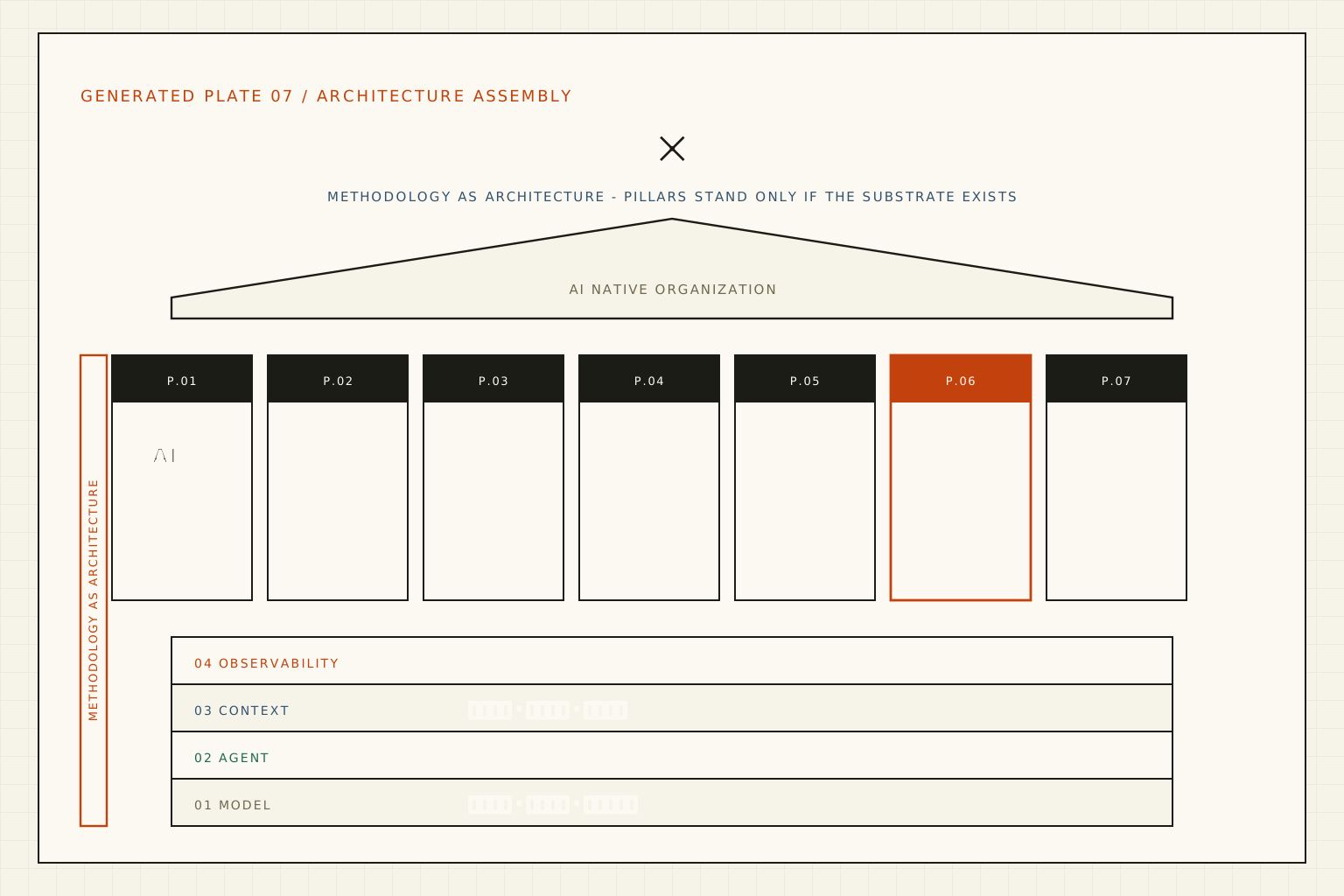
AI 优先即默认
AI-First as Default
每一次工作流设计都从一个问题开始——如果这件事必须由 AI Agent 端到端完成,我们会怎么设计它?这是实际的设计起点,而非思想实验。只有在通过这个设计之后,你才问"哪里会断?人的判断必须插入到哪里?"
Every workflow design starts from one question: if this task had to be completed end-to-end by an AI Agent, how would we design it? This is the actual design starting point, not a thought experiment. Only after working through that design do you ask: “Where will it break? Where must human judgment be inserted?”
这反转了传统设计序列。传统设计从现有人类角色出发,问 AI 能在哪里帮忙。AI Native 设计从完全 agentic 的理想出发,问人必须在哪里介入。组织的设计压力把人类推向真正只有人能做的领域——判断、关系、品味、责任。
This inverts the traditional design sequence. Traditional design starts from existing human roles and asks where AI can assist. AI Native design starts from the fully agentic ideal and asks where humans must intervene. The organization’s design pressure pushes humans toward the domains only humans can occupy: judgment, relationships, taste, accountability.
把推导写全 · 从 M.02·M.05 走到这根支柱(每步可单独质疑)The derivation in full · from M.02·M.05 to this pillar (each step separately challengeable)
"承 M.02·M.05"不该只是一枚标签。这里把它一步步写出来——每一步都单独摆出可以被攻击的地方。其余支柱的"承 M.0x"是同型的链条,此处只把其中一条写全,做样板。
“From M.02·M.05” should not stay a mere label. Here it is written out step by step: each step exposing, on its own, where it can be attacked. The other pillars’ “from M.0x” tags are chains of the same type; only this one is spelled out in full, as a worked template.
- 前提(承第 3 节):执行趋于免费,判断成为稀缺资源;而一个组织该围着什么设计,取决于它真正稀缺的是什么。〔可质疑:若某领域的执行仍然昂贵,这条前提在那里就不成立。〕
- Premise (from Section 3): execution trends toward free, so judgment becomes the scarce resource; and what an organization should be designed around is set by what is genuinely scarce in it. [Challengeable: where execution is still expensive, this premise does not hold.]
- 由 M.02(Agent 即默认工种):任何能力需求的默认承担者是"工作流 + agent",招人只为增加判断。于是每条工作流都存在一个"最大 agent 化"的版本,人的介入成了需要被证成的例外,而非默认起点。〔可质疑:若某类工作根本没有可行的 agent 基线,这一步落空。〕
- From M.02 (Agent as the default role): the default bearer of any capability need is “workflow + agent,” and you hire only to add judgment. So every workflow has a “maximally agentic” version, and human involvement becomes an exception that must be justified rather than the default starting point. [Challengeable: for work with no viable agent baseline at all, this step fails.]
- 由 M.05(人只守少数显式判断节点,按撤销成本 × 暴露度定位):人该站哪,取决于"哪里会造成不可逆或高暴露的后果"——而这只有先有了完全 agent 化的版本、看它在哪里崩,才定位得出来。〔可质疑:若你能先验断定人必须在哪,就不需要先画 agent 版本。〕
- From M.05 (humans hold only a few explicit judgment nodes, placed by reversal-cost × exposure): where a human belongs is set by where an irreversible or high-exposure consequence sits, and that can only be located once you have the fully agentic version and see where it breaks. [Challengeable: if you can settle a priori where humans must be, you need not draw the agent version first.]
- 合第 2、3 步:设计必须从"完全 agent 化的理想版本"起步,再倒推人必须出现的节点。反过来(从现有岗位出发问"AI 能帮什么")会在检验人是否必要之前就把人钉死,与 M.05 相矛盾。这一步的结论,正是支柱 01:AI 优先即默认。〔可质疑:若倒推出的人节点恰与正向设计一致,起点顺序就无关紧要——但经验上两者常不一致。〕
- Combine steps 2 and 3: design must start from the fully agentic ideal and work backward to the nodes where humans must appear. The reverse (starting from existing roles and asking “where can AI help”) pins humans in place before testing whether they are necessary, contradicting M.05. The conclusion of this step is exactly Pillar 01: AI-first as default. [Challengeable: if the backward-derived human nodes happen to match a forward design, starting order is moot, but empirically the two rarely match.]
诚实的边界:这根支柱的强度,被"该领域有多可 agent 化"这一变量封顶。在完全无法 agent 化的工作里(第 2 步落空),它退化为"能 agent 化的部分先 agent 化,其余留给人"——仍然成立,但不再是强主张。它是从世界观推出的结论,不是公理;上面每一步都摆着可以被单独攻击的地方。
The honest bound: this pillar’s strength is capped by one variable: how agent-executable the domain is. For work that cannot be made agentic at all (step 2 fails), it degrades to “make agentic what can be, leave the rest to humans,” still true, but no longer a strong claim. It is a conclusion derived from the worldviews, not an axiom; every step above leaves an exposed point to attack.
- Inversion
- Human-first → AI-first
- Pressure
- Pushes humans up the stack
- Failure
- "AI as helper"
工作流即代码
Workflow as Code
在 AI Native 组织里,工作流不被描述在 PowerPoint 里,不靠记忆运行,不由部落知识维护。它们被规约在code或机器可执行的结构化定义中——可被版本化、被分支、被观察、被持续优化。
In an AI Native organization, workflows are not described in PowerPoint, do not run on memory, and are not maintained by tribal knowledge. They are defined in code or machine-executable structured definitions: versionable, branchable, observable, and continuously improvable.
这听起来像技术细节,实际上是最重要的架构决定。当工作流是代码时,它们可以被测试、被观察、被调试、被优化;当它们不是代码时,它们困在人脑中,产生折磨传统组织的慢性流程漂移。纪律是:永远不要让一个重要的工作流只存在于某个人的头脑里。
This sounds like a technical detail; it is actually the most important architectural decision. When workflows are code, they can be tested, observed, debugged, and optimized; when they are not code, they are trapped in human minds and produce the chronic process drift that plagues traditional organizations. The discipline is: never let an important workflow exist only inside someone’s head.
- Stack
- Temporal · n8n · LangGraph · Inngest
- Property
- Versionable, observable
- Failure
- Tribal knowledge drift
上下文工程作为系统实践
Context Engineering as Systematic Practice
Tobi Lütke 在 Shopify 把上下文工程从一种 ad-hoc 技能升格为系统实践。组织主动构建 Agent 运行的信息环境。所有内部文档为 Agent 检索而结构化;维护活的上下文存储;同时为人和 Agent 写作。
Tobi Lütke at Shopify elevated context engineering from an ad-hoc skill to a systematic practice. The organization actively constructs the information environment in which agents operate. All internal documentation is structured for agent retrieval; a living context store is maintained; writing serves both humans and agents simultaneously.
最深的原则是——组织采取的每个动作都应该产生结构化的上下文作为副产品。会议产生 Agent 可检索的总结。决策被记录连同决策理由。客户互动被捕获。日积月累,上下文存储成为组织最有价值的资产——是让你的 Agent 在用同样底层模型的情况下,质量上明显优于竞争对手 Agent 的底层基质。这是 AI 时代的真正护城河。
The deepest principle is this: every action the organization takes should produce structured context as a byproduct. Meetings generate agent-retrievable summaries. Decisions are recorded together with their rationale. Customer interactions are captured. Over time, the context store becomes the organization’s most valuable asset: the underlying substrate that allows your agents to outperform competitors’ agents in quality even when running on the same base models. This is the true moat of the AI era.
- Stack
- Pinecone · Weaviate · Glean · Notion AI
- Property
- Compounding moat
- Failure
- Context starvation
多模型架构
Multi-Model Architecture
AI Native 设计中最深的单一风险,是算法封建主义(algorithmic feudalism)——把业务深度依赖于一家基础模型供应商,让供应商实际上变成你的地主。
The deepest single risk in AI Native design is algorithmic feudalism: deeply coupling the business to a single foundation-model provider, effectively making that provider your landlord.
架构上的防御是多模型。关键工作流应该被设计成可在数日内切换底层模型——配合质量回归测试。这要求工作流代码与具体模型 API 之间有抽象层;质量评估基础设施可以针对多个模型测试同一工作流;和至少两家供应商保持持续关系。开源权重模型应该被评估,用于可自托管的关键工作流——即使你大多数时候用商用 API,开源模型的可选性本身是战略资产。
The architectural defense is multi-model design. Critical workflows should be built to switch underlying models within days, supported by quality regression testing. This requires an abstraction layer between workflow code and specific model APIs; quality-evaluation infrastructure that can test the same workflow against multiple models; and ongoing relationships with at least two providers. Open-weight models should be evaluated for critical workflows that can be self-hosted. Even if you mostly use commercial APIs, the optionality of open-weight models is itself a strategic asset.
- Stack
- OpenAI + Anthropic + Llama/Qwen
- Property
- Optionality, sovereignty
- Failure
- Provider hostage
可观测性先于规模
Observability Before Scale
NANDA 报告对那批无成效试点的自家归因是"学习缺口"——工具不持有记忆、不积累上下文、不随使用变好;报告还有一个常被引用者略去的反向发现:外购方案的落地成功率约为自建的两倍。本支柱取其上游含义:无论买还是建,组织若没有观察、评估、改进 AI 行为的基础设施,部署就无从学习——他们在能看见之前就开始扩规模。
The NANDA report attributed those no-impact pilots to a “learning gap”: tools that hold no memory, accumulate no context, and do not improve with use; the report also contains a finding that most citations omit: purchased solutions succeed at roughly twice the rate of self-built ones. This pillar takes the upstream implication: whether you buy or build, an organization without infrastructure to observe, evaluate, and improve AI behavior cannot learn from deployment. They scale before they can see.
方法论要求反过来。任何 Agent 工作流上线前,可观测性层必须存在:每个 Agent 行动被记录;每次模型调用被追踪;输出被采样以做质量评估;失败被路由到人类审查。在 AI Native 组织里,可观测性之于运营,等同于会计之于财务。你不会不记账就运营公司;你也不应该不可观测就运行 AI Native 工作流。这是基础设施下限,而非工程奢侈品。
The methodology demands the opposite. Before any agent workflow goes live, the observability layer must exist: every agent action is logged; every model call is traced; outputs are sampled for quality evaluation; failures are routed to human review. In an AI Native organization, observability is to operations what accounting is to finance. You would not run a company without bookkeeping; you should not run AI Native workflows without observability. This is the infrastructure floor, not an engineering luxury.
- Stack
- LangSmith · Helicone · Arize · Weave
- Property
- Pre-scale infrastructure
- Failure
- Blind scaling
人作为判断与责任锚
Humans as Judgment & Responsibility Anchors
AI Native 不追求"无人"或"最少人",而是把人定位在工作流图的最高杠杆点。三类人锚定的决策不可妥协——不可逆决策(任何无法廉价撤回的事);承载声誉的决策(任何组织名字公开附着的事);承载价值观的决策(伦理、品味、关系比效率更重要的事)。
AI Native is about placing humans at the highest-leverage nodes of the workflow graph, not “no humans” or “minimal humans.” Three categories of decision require a human judgment anchor, without compromise: irreversible decisions (anything that cannot be cheaply undone); reputation-bearing decisions (anything the organization’s name is publicly attached to); and values-bearing decisions (situations where ethics, taste, or relationships matter more than efficiency).
Air Canada(被法庭判决必须为 chatbot 承诺负责)和 Cursor "Sam"(编造公司政策的 AI)说明了这个支柱缺失时会发生什么。把人移出这些决策类别,省下的人力成本远不及导致的代价。
Air Canada (held by a court liable for commitments made by its chatbot) and Cursor’s “Sam” (an AI that fabricated company policy) illustrate what happens when this pillar is absent. The labor cost saved by removing humans from these decision categories is nowhere near the cost of the consequences.
- Anchor types
- Irreversible · Reputation · Values
- Mode
- Human-in/on-the-loop
- Failure
- Liability vacuum
持续演化
Continuous Evolution
传统组织每几年"转型"一次——发起一个大变革倡议、重组、重新平台化。AI Native 组织没有"转型事件",因为它在持续演化。组织节奏发生转变——没有"5 年战略",因为接下来 5 年不会像过去 5 年,底层技术移动得太快。
Traditional organizations “transform” every few years: launching a major change initiative, reorganizing, re-platforming. AI Native organizations have no “transformation events” because they are continuously evolving. The organizational cadence shifts: there is no “5-year strategy,” because the next five years will not resemble the last five; the underlying technology moves too fast.
有的是 90 天节奏(Anthropic 据报道最长规划周期是 90 天),嵌入在更长期的方向感中(1-3 年愿景),而后者本身随景观变化而更新。这对受过传统规划训练的人不舒服。它是 AI Native 运营的自然模式。
What exists instead is a 90-day cadence (Anthropic’s reported maximum planning horizon is 90 days), embedded within a longer-term sense of direction (a 1-3 year vision) that itself updates as conditions change. This is uncomfortable for people trained in traditional planning. It is the natural operating mode of AI Native.
- Cadence
- 90-day rolling
- Reference
- Anthropic, Cursor
- Failure
- Static architecture
组织的运营底座
The Operating Substrate
底座之下还有底座:先数清哪四层必须先就位。
Beneath the base lies more base: first, the four layers that must be in place.
运营底座有四层:模型、agent、上下文、可观测性。它们支撑全部架构支柱,缺任何一层,组织都还只是"在用 AI",配不上 AI Native 这个名号。The operating substrate has four layers: model, agent, context, and observability. They carry every pillar, and if any one is missing the organization is still merely “using AI” and has not earned the name AI Native.
可观测性层OBSERVABILITY LAYER
Observability LayerOBSERVABILITY LAYER
让系统持续可学习的东西。日志、追踪、评估、警报,以及把问题路由回人类的审查队列。没有它,你在比人类纠错速度更快地扩展失败。
What keeps the system continuously learnable. Logs, traces, evaluations, alerts, and a review queue that routes issues back to humans. Without it, you are scaling failure faster than humans can correct it.
Arize · W&B Weave
Galileo · Braintrust
上下文层CONTEXT LAYER
Context LayerCONTEXT LAYER
让 Agent 变得组织特定的东西。向量数据库、知识图谱、决策日志,以及让这些保持鲜活的工程实践。没有它,你的 Agent 是泛化的;有了它,它们成为独属于你的。
What makes Agents organization-specific. Vector databases, knowledge graphs, decision logs, and the engineering practices that keep them fresh. Without it, your Agents are generic; with it, they become uniquely yours.
Chroma · Qdrant
Glean · Sana · Notion AI
Agent 层AGENT LAYER
Agent LayerAGENT LAYER
工作流执行的地方。包括编排框架(LangGraph、CrewAI、AutoGen 或自研),Agent 运行时,以及把 Agent 连接到工具、数据库、外部系统的集成层。
Where workflow execution happens. Includes orchestration frameworks (LangGraph, CrewAI, AutoGen, or custom-built), Agent runtimes, and the integration layer that connects Agents to tools, databases, and external systems.
AutoGen · Letta
Pydantic AI · Inngest
模型层MODEL LAYER
Model LayerMODEL LAYER
基础——访问多个基础模型,通常至少一家前沿 API 供应商,加上用于主权工作流的开源权重模型,并有抽象层使模型可被切换。没有这一层,组织仍更接近 API 依赖,尚未进入 AI Native 的运行形态。
The foundation: access to multiple foundation models, typically at least one frontier API provider plus open-weight models for sovereign operator workflows, with an abstraction layer that makes models swappable. Without this layer, the organization is closer to API dependence than to AI Native operation.
Google · Mistral
Llama · Qwen · DeepSeek
把这四层叠起来,组织的"样子"也变了。传统组织图是层级方框、用岗位说明书定义角色;AI-Native 的"组织图"只有三件——少数判断节点、一张近零边际成本的 agent 网、一层流动的上下文。一个判断者可指挥 50–100 个 agent;结构随工作量伸缩,而不随人数。
Stack those four layers and the shape of the organization changes too. A traditional org chart is boxes in a hierarchy, with job descriptions defining roles; the AI-Native “org chart” has only three things: a few judgment nodes, an agent network at near-zero marginal cost, and one layer of flowing context. One judge can direct 50–100 agents; the structure scales with the workload, not with headcount.
过渡期的观察样本
Evidence from a Transition
这些公司记录的是人类组织受 AI 冲击时如何变形,不是 AI-Native 终态的证明。
These companies show how human organizations deform under AI pressure. They do not prove an AI-Native end state.
九组公司提供的是带偏差的过渡期观察:它们能帮我们提出结构问题,却不能替未来下结论。把成功、回摆与倒下并列,是为了防止把幸存者误读成定律。These nine companies are biased observations from a transition. They help us frame structural questions, not settle the future. Putting wins, reversals, and failures together prevents survivors from being misread as laws.
| 公司Company | 后续Status | 说明一件事Shows one thing |
|---|---|---|
| Anthropic | 在营running | 原生组织的节奏:90 天滚动、并行 agent 编队a born-native rhythm: 90-day cycles, parallel agent squads |
| Anysphere / Cursor | 在营running | 极致人效:史上最快 $1B ARRextreme output per head: the fastest-ever $1B ARR |
| DeepSeek | 在营running | 无 KPI、无职级也做出前沿模型a frontier model with no KPIs and no titles |
| Shopify | 转型中transitioning | 大组织转型:把「用 AI」写进日常评估big-org transition: AI use written into daily review |
| Midjourney | 在营running | 零融资、约 40 人做到高营收zero funding, ~40 people, high revenue |
| Klarna | 回摆reversed | 裁员叙事的过山车:砍完又回招the layoff-narrative rollercoaster: cut, then rehired |
| Air Canada | 判例precedent | chatbot 承诺被判有效:AI 输出即公司责任chatbot promise held binding: AI output is the company’s liability |
| Inflection / Adept | 被收编absorbed | 第一天就原生,仍然倒下——原生不免死native from day one, still gone; native is no immunity |
| Builder.ai | 破产bankrupt | AI washing 破产:假智能体的下场AI-washing bankruptcy: the fate of fake agents |
- PATTERN
- 原生型最成功,转型型次之,客户面 AI 化最危险
- Born-native performs best; transitioning next; customer-facing AI is most dangerous
- RULE OF THUMB
- 从后台开始
从内部开始
从可逆决策开始 - Start from the back office
Start from the inside
Start from reversible decisions
这些案例合起来不是一张分类表,而是一组彼此制衡的证据。Anthropic 与 Anysphere 证明"从零架构"走得通,Inflection 与 Adept 提醒你它不保证存活;Shopify 证明大组织能转,Klarna 的回摆划出替代的边界;Air Canada 判例把责任钉在公司身上;Midjourney 则防止把"小团队大杠杆"错记在 AI 名下。AI 时代变化太快,任何分类体系都会比它引用的数据先过时——所以这里不建分类学,每家公司只说明一件事,完整口径都登记在附录。
Taken together, these cases are not a classification table but a set of mutually checking pieces of evidence. Anthropic and Anysphere prove that architecting from zero works, while Inflection and Adept remind you it guarantees no survival; Shopify proves a large organization can turn, while Klarna’s swing-back marks the boundary of replacement; the Air Canada ruling pins accountability on the company; and Midjourney keeps “small team, huge leverage” from being misfiled as an AI invention. Things now move too fast for any taxonomy to outlive the data it cites, so instead of a classification scheme, each company here shows one thing, with full sourcing registered in the appendix.
范围提醒 · 过渡态样本。这九家全部诞生于人类组织向 AI-Native 迁移的过渡期。它们佐证的是"人类组织在 AI 冲击下如何变形",与"生而 AI-Native 的组织如何运转"是两个不同命题——后者要等够老的原生样本,眼下无人能提供,终态验证因此是一笔仍然未决的公开赌注。
Scope note · transition-state samples. All nine were born during the migration of human organizations toward AI-Native. They attest to “how human organizations deform under AI,” a different proposition from “how a born-AI-Native organization runs”: the latter awaits samples old enough to exist, which no one can yet supply, so terminal-state validation remains an open, unsettled bet.
同一现象的四个截面
Four Cross-Sections of the Same Phenomenon
AI Native 同时是经济、监管、哲学与劳工现象。这四个截面不是背景知识——它们是终将反过来修改这套方法论的现实约束。
AI Native is simultaneously an economic, regulatory, philosophical, and labor phenomenon. These four cross-sections are real-world constraints that will eventually come back to revise the blueprint, not background knowledge.
AI Native 同时是经济、监管、哲学与劳工现象:这四个学科截面终将反过来修改方法论。真正受益的是少数完成重构的组织,多数公司只是在为表演买单。AI Native is at once an economic, regulatory, philosophical, and labor phenomenon: these four cross-sections are real-world constraints that will come back to revise the blueprint. The genuine beneficiaries are the few organizations that truly reconstruct, while most are paying for theater.
Daron Acemoglu 2024 年在 MIT 的研究《The Simple Macroeconomics of AI》给出谨慎评估——AI 未来 10 年累计 GDP 增长贡献约 1.1-1.6%(年均 ~0.05%),远低于行业普遍宣称的数倍效应。MIT NANDA 2025/7 预印报告测得 95% 的定制化企业 GenAI 试点在六个月窗口内没有可衡量的 P&L 影响——同一报告也记录了员工自带通用工具的"影子 AI"被大规模采用且有效:95% 说的是组织级试点的失败,不是 AI 本身的失败。
Daron Acemoglu’s 2024 MIT study The Simple Macroeconomics of AI offers a cautious assessment: AI’s cumulative GDP contribution over the next 10 years will be roughly 1.1-1.6% (≈ 0.05% per year), far below the multi-fold effects industry commonly claims. The MIT NANDA July 2025 preprint found that 95% of customized enterprise GenAI pilots showed no measurable P&L impact within a six-month window; the same report also documented that employee-initiated “shadow AI” using general-purpose tools was adopted at scale and proved effective: the 95% figure describes the failure of org-level pilots, not of AI itself.
这意味着——AI 经济效益正面但远低于炒作;真正受益的是少数能实现 AI Native 重构的组织,多数公司是在为表演买单。Acemoglu 警告 AI 主要影响数据汇总、视觉匹配、模式识别这类白领办公任务,但仍预测 2030 年记者、金融分析师、HR 等职位仍存在。同时他强调 AI 会扩大资本对劳动的分配差距而非缩小白领内部不平等——这是 AI Native 组织的政治经济学背景。
The implication: AI’s economic benefits are real but far below the hype; the organizations that genuinely benefit are the minority that can achieve true AI Native reconstruction, while most companies are paying for performance. Acemoglu warns that AI primarily affects white-collar office tasks such as data aggregation, visual matching, and pattern recognition, yet still predicts that roles such as journalist, financial analyst, and HR professional will persist through 2030. He also emphasizes that AI will widen the capital-to-labor distribution gap rather than narrow inequality within white-collar ranks. This is the political-economy backdrop for the AI Native organization.
欧盟 AI Act 的 Annex III 高风险义务已被 Digital Omnibus(2026-05 临时协议)推迟至 2027-12 起分阶段适用(招聘评估、信用决策、教育评分、执法等)(截至 2026-07;原定 2026-08-02 全面适用日已不再生效,时间表仍可能再变、以欧盟官方最新为准);最高罚款 €3,500 万 或全球营收 7%。美国联邦层面 Biden EO 14110 被 Trump 政府 2025/1 废除,州层面(科罗拉多 SB 24-205、加州 SB 1047 被否决)拼盘形成。中国《生成式 AI 服务管理暂行办法》2023 年实施。
The EU AI Act’s Annex III high-risk obligations have been postponed by the Digital Omnibus (May 2026 provisional agreement) to a phased application starting December 2027 (recruitment screening, credit decisions, educational scoring, law enforcement, etc.) (as of July 2026; the former 2 August 2026 full-application date no longer holds, and the timeline may shift again; see the latest EU official text); maximum fines reach €35 million or 7% of global revenue. At the US federal level, Biden Executive Order 14110 was revoked by the Trump administration in January 2025, leaving a patchwork of state-level legislation (Colorado SB 24-205; California SB 1047 was defeated). China’s Interim Measures for the Management of Generative AI Services entered force in 2023.
对 AI Native 组织的实操含义——合规不做事后处理,而是架构约束。如果你的核心 workflow 涉及 EU 公民的招聘、信用、教育数据,在高风险义务生效后(经 Digital Omnibus 推迟、约 2027-12 起分阶段)必须有 human-in-the-loop、决策可审计、训练数据可追溯。这就是为什么"可观测性先于规模"和"人作为判断与责任锚"在架构支柱中是基础性的而非可选的。
The practical implication for AI Native organizations: compliance is not a post-hoc fix but an architectural constraint. If your core workflows touch EU citizens’ recruitment, credit, or educational data, human-in-the-loop, auditable decisions, and traceable training data will all be mandatory once the high-risk obligations take effect (postponed by the Digital Omnibus to a phased start around December 2027). This is precisely why “observability before scale” and “humans as judgment and accountability anchors” are foundational rather than optional among the architectural pillars.
Hannah Arendt 在《人的境况》(1958) 划分劳动(labor,维持生命)、工作(work,制造耐用品)、行动(action,公共领域中以言行显现自我)。AI Native 时代如果连 work 都被 AI 接管,"action" 在哪里?这不是花拳绣腿的问题——它直接关乎 AI Native 组织如何为"人"定义角色。
In The Human Condition (1958) Hannah Arendt distinguishes labor (sustaining life), work (fabricating durable goods), and action (appearing in the public realm through word and deed). If even work is taken over by AI in the AI Native era, where does “action” go? This is not an ornamental question; it goes directly to how an AI Native organization defines the role of “the human.”
Acemoglu 的回答是"专长与信息提供者",Tobi Lütke 的回答是"context engineer",Anthropic Hive Mind 的回答是"品味与判断",Buurtzorg 的回答是"完整自我"。这些答案都对,但都不完整。最稳健的回答是——人是承担后果的能力(accountability)。当 AI 可以无穷生成,人类的稀缺性在于"承担后果的能力"——这是 Air Canada 案、Lattice 撤回、Klarna 回招的共同启示,也是架构支柱中"人作为判断与责任锚"的哲学基础。
Acemoglu’s answer is “expert and information provider”; Tobi Lütke’s answer is “context engineer”; the Anthropic Hive Mind’s answer is “taste and judgment”; Buurtzorg’s answer is “the whole self.” Each answer is correct, yet none is complete. The most reliable answer is: the human is the capacity to bear consequences (accountability). When AI can generate infinitely, human scarcity lies in the capacity to bear consequences. This is the shared lesson of the Air Canada case, the Lattice withdrawal, and the Klarna re-hire; it is also the philosophical foundation of “humans as judgment and accountability anchors” among the architectural pillars.
SAG-AFTRA 2023/7/14-11/9 的 118 天大罢工是首个明确以 AI 为核心议题的劳工运动。胜利成果包括对"合成演员"(Synthetic Performers)和"数字替身"(Digital Replicas)的合同保护、强制 informed consent。2024/7 又对游戏公司发起 AI 议题罢工。2026/3 推动"Tilly tax"——对 AI 角色征税。
The SAG-AFTRA 118-day strike from 2023/7/14 to 11/9 was the first labor action to place AI squarely at its center. Victories included contractual protections for “Synthetic Performers” and “Digital Replicas,” and mandatory informed consent. In July 2024, another AI-focused strike was launched against gaming companies. In March 2026, the union began pushing a “Tilly tax,” a levy on AI-generated characters.
这预示着 2030 年代劳动者运动的新主题。AI Native 组织必须预判这种张力,否则会被工会运动反噬。Klarna 的回招、Duolingo 的撤回、Lattice 的退步——都是劳工力量在工会化之前已经通过舆论和市场表达的反向作用。在欧洲、加拿大、巴西等更工会化的市场,这种张力会更早进入直接对抗。AI Native 不是"绕开劳工政治"的方法,是"必须更细致地处理劳工政治"的方法。
This foreshadows the new themes of labor movements in the 2030s. AI Native organizations must anticipate this tension or face union-driven backlash. Klarna’s re-hiring, Duolingo’s reversal, and Lattice’s retreat all show labor expressing counter-pressure through public opinion and market signals before formal unionization. In more highly unionized markets such as Europe, Canada, and Brazil, this tension will reach direct confrontation sooner. AI Native is a method that demands handling labor politics with greater care, not a method for “bypassing labor politics.”
已被记录的陷阱
The Documented Traps
下面是已经留下记录的失效形态。它们值得被当作检查表,不该被误读成一张能预言所有失败的命运图。
These are failure shapes that left records. Treat them as a checklist, not a fate map that predicts every failure.
结构会放大某些失败,但不替人写结局。把已知陷阱变成事前检查、事中观察和事后复盘,才比一张漂亮的失败分类更有用。Structure can amplify some failures, but it does not write the ending for us. Turning known traps into preflight checks, live observations, and postmortems is more useful than a polished taxonomy.
CLAUDE.md、架构规约文档),会从零推导基础决策,决策之间漂移。最终的问题不在某个片段写得差,而在于整个代码库失去了一致的心智模型——因为各部分从未被设计成相互配合。这是 Anthropic Founder's Playbook 反复强调的核心陷阱。CLAUDE.md or an architecture-spec document) re-derives the basic decisions from scratch, and those decisions drift apart. What you end up with is a codebase with no consistent mental model, not one where any single piece is bad — because the parts were never designed to work together. This is the core trap the Anthropic Founder’s Playbook returns to again and again.上面十五张卡片讲的都是别人的组织怎么滑下去。合上卡片,问题回到自己身上:把一段真实工作交给 agent 之前——它的错误率是多少?错了谁先看见?看见之后收不收得回?这段工作的数据流进了谁的模型?这四个问题的答案,此刻写在你组织的哪里?多数组织的诚实回答是:写在还没发生的那份事故复盘里。这一节要做的事,是把答案从复盘挪进设计,拆成四个可以逐一验收的设计件:复核层、回滚、数据边界、审计。
The fifteen cards above are all about how other organizations slid. Close the cards and the question lands on you: before a real piece of work is handed to an agent, what is its error rate? Who sees a failure first? Once seen, can the action be recalled? Whose model did the data flow into? Where, right now, are those four answers written down in your organization? For most, the honest reply is: in an incident postmortem that has not happened yet. This subsection moves the answers out of the postmortem and into design, as four objects you can inspect one by one: a review layer, rollback, data boundaries, and audit.
先说复核层。它的厚度不该由信任感定,该由数字定。两个当前口径可用作起点:在 175 项模拟公司职业任务上,最强模型的自主完成率约 30%(TheAgentCompany,2025 年榜单口径)[R60];按「50% 成功率下能独立完成的任务时长」计,前沿模型在 2025 年初约为 1 小时,且这条时间地平线自 2019 年以来大约每 7 个月翻一倍(METR)[R59]。翻译成组织动作:任务时长落在地平线之内,抽检;落在地平线之外,全检,或者拆小到落回地平线之内。地平线在移动,所以抽检率不是拍一次的制度,而是每季度对着可观测层(SECTION 08)的错误率基线重新校准的活参数。
Start with the review layer. Its thickness should be set by numbers, not by trust. Two current readings serve as a starting point: on 175 simulated-company professional tasks, the strongest model completes about 30% autonomously (TheAgentCompany, 2025 leaderboard)[R60]; measured as “the length of task a model finishes at a 50% success rate,” the frontier stood at roughly one hour in early 2025, and that time horizon has doubled about every seven months since 2019 (METR)[R59]. Translated into organizational action: tasks inside the horizon get sampled review; tasks beyond it get full review, or get cut into pieces that fall back inside. The horizon moves, so the sampling rate is not a policy set once; it is a live parameter recalibrated quarterly against the error-rate baseline in the observability layer (SECTION 08).
回滚这个设计件回答「收不收得回」。执行变便宜的另一面是犯错也变便宜,但这句话只对可逆动作成立:代码可以 revert,已经发出的报价、写进合同的承诺收不回来——Air Canada 的 chatbot 向乘客许了一个并不存在的退票政策,仲裁庭裁定公司照赔[R17]。对应的设计不是「所有动作前置人工」,那等于把复核层变成新的瓶颈;而是给 agent 可触达的每一类动作标可逆性等级:能便宜撤销的放行自动执行,撤不回的前置人类节点。这条分级线要写进权限系统,不是写进培训材料。
Rollback answers “can it be recalled.” The flip side of cheap execution is cheap mistakes, and that holds only for reversible actions: code can be reverted; a quote already sent or a promise written into a contract cannot. Air Canada’s chatbot offered a passenger a refund policy that did not exist, and the tribunal ruled the company liable all the same[R17]. The corresponding design is not “a human before every action,” which just turns the review layer into a new bottleneck. It is a reversibility grade on every class of action an agent can reach: cheap to undo, let it run; impossible to undo, put a human node in front. That line belongs in the permission system, not in training material.
数据边界回答「流进了谁的模型」。隐私在这部规约里几乎没有出现过,不是因为它不重要,而是它长期被归给合规部门,没有被当成组织设计问题。两个信号说明这笔账该重算:Samsung 在 2023 年 3 月末重新放开 ChatGPT 之后二十天内连出三起外流(设备源码、测试序列、会议纪要),随即公司范围禁用[R62];OWASP 2025 版把「敏感信息泄露」从第 6 位提到第 2 位,仅次于提示注入[R61]。禁用是合规反应;设计的反应是一张显式的边界图:上下文层(SECTION 08)里的决策日志、客户数据、代码库,哪些可以流进自托管模型、哪些可以流进外部 API、哪些哪儿都不许去,逐格写死。上下文越厚这张图越值钱——燃料和泄露面从来是同一批东西。
Data boundaries answer “whose model did it flow into.” Privacy has barely appeared in this specification, not because it does not matter, but because it has long been filed under compliance rather than treated as organizational design. Two signals say the account needs redoing: within twenty days of Samsung re-allowing ChatGPT in late March 2023, three leaks followed (device source code, a test sequence, meeting notes), and the company then banned the tools outright[R62]; the 2025 edition of the OWASP Top 10 for LLM applications moved “sensitive information disclosure” from sixth place to second, behind only prompt injection[R61]. A ban is a compliance reflex. The design response is an explicit boundary map: for the decision logs, customer data, and codebases in the context layer (SECTION 08), which may flow into self-hosted models, which into external APIs, and which nowhere at all, cell by cell. The thicker the context layer, the more this map is worth: fuel and leak surface have always been the same material.
审计回答「错了谁先看见」的制度版:不是谁碰巧看见,而是系统必然留下什么。NIST AI RMF 的 Govern/Map/Measure/Manage 四个函数,落到 agent 组织的最小实现只有三样:每个 agent 动作留痕,每次人类否决记下原因,复核队列的路由规则本身进版本管理[R53]。这三样同时在给下一轮判断喂数据:否决记录就是品味的外化,审计轨迹就是判断分布最便宜的一手样本。三样做不全,先保住否决留因——它成本最低,信息密度最高。
Audit is the institutional version of “who sees a failure first”: not who happens to notice, but what the system necessarily records. The four functions of the NIST AI Risk Management Framework (Govern, Map, Measure, Manage) reduce, for an agent organization, to a minimal implementation of three things: every agent action leaves a trace, every human veto records its reason, and the routing rules of the review queue are themselves version-controlled[R53]. The same three things feed the next round of judgment: veto records are taste made external, and the audit trail is the cheapest first-hand sample of your judgment distribution. If you cannot keep all three, keep veto-with-reason; it costs the least and carries the most information.
这一节的检验信号是一页纸:agent 错误率基线是多少;上季度抽检率有没有随地平线校准过;最近一次不可逆事故从发现到收口用了多久;数据边界图上「哪儿都不许去」那一列是不是空的。四个数都答不出,边界就还躺在未来的事故复盘里。最后一句诚实话:本节引用的 30%、1 小时、每 7 个月翻倍,都是快门速度很快的快照,登记册按日期口径管理这批数字——它们过时之日,正是抽检率该重新校准之时。
The test signal for this subsection fits on one page: what is the agent error-rate baseline; was last quarter’s sampling rate recalibrated against the horizon; how long did the last irreversible incident take from detection to closure; is the “goes nowhere” column of the data-boundary map empty. If none of the four can be answered, the boundaries are still lying in a future postmortem. One honest closing note: the 30%, the one hour, and the seven-month doubling cited here are fast-shutter snapshots, managed by date in the registry; the day they expire is exactly the day the sampling rate is due for recalibration.
一套不可能错的方法论不值得信。以下任一证据成立,即动摇本规约的核心论断——读者应当与作者一起盯住这三条线:
A methodology that cannot be wrong is not worth trusting. If any one of the following holds, it shakes the core claims of this specification; readers should watch these three lines alongside the author:
① 到 2028 年,按本规约从零建造的组织,在三年存活率或毛利结构上并不优于同品类的"加装式"对照组;② 出现足量存量组织不重画工作流图、仅靠采购与流程微调便稳定获得端到端吞吐的量级提升(NANDA"外购成功率约为自建两倍"的发现,已经是一个需要持续跟踪的反向信号);③ Agent 对工作流遥测指标的系统性博弈(reward hacking)被证明不可治理——那将直接拆掉支柱 05/07 的地基。
① By 2028, organizations built from scratch under this specification are no better, in three-year survival rate or gross-margin structure, than a comparable “bolt-on” control group; ② enough incumbent organizations achieve an order-of-magnitude gain in end-to-end throughput without redrawing their workflow graph, on procurement and process tweaks alone (NANDA’s finding that “buying succeeds at roughly twice the rate of building” is already a counter-signal worth tracking); ③ agents’ systematic gaming of workflow telemetry (reward hacking) proves ungovernable, which would tear out the foundation of Pillars 05 and 07 directly.
近端触发器 · 12 个月尺度。上面三条落在 2028;但实践者要在本季度决策,需要更近的一条证伪线:若到 2027 年年中,仍无一家新建的 ≥50 人组织,能在判断密度显著高于同类、且人数不随营收增长的条件下稳定运转,则 T1 关于"规模退化为自由变量"的主张,在可操作的时间尺度上尚未被证实——这是下调声称、而非维持声称的依据。
Near-term trigger · 12-month scale. The three lines above sit at 2028; a practitioner deciding this quarter needs a nearer one: if by mid-2027 no newly built organization of ≥50 people runs stably with judgment density markedly above its peers and headcount flat against revenue, then T1’s claim that “scale degrades to a free variable” is unconfirmed on an actionable timescale: grounds to downgrade the claim, not to hold it.
采样的诚实 · 幸存者偏差。本节的失败清单取自留下记录的失败——够体面到有复盘、有报道的那些。AI-Native 尝试里最大的一批数据,可能是静默消失的组织:没融资、没博客、没验尸报告。真实的失败分布无人测得,这份清单只覆盖它可见的一角。
Honesty about sampling · survivorship bias. The failure list in this section is drawn from failures that left a record: the ones respectable enough to have a postmortem or press coverage. The largest dataset in AI-Native attempts may be the organizations that vanished in silence: no funding, no blog, no autopsy. The true failure distribution is unmeasured; this list covers only its visible corner.
未来推演:可能性空间
The Projection: a Possibility Space
给未来画的是分支地图,不是一条加速曲线。
The future gets a map of branches, not a single acceleration curve.
这一节张开一个可能性空间:四条汇流的技术曲线定边界、两条不确定性轴张开四个世界。它不预测哪条线会发生,只标出哪些分支可能,并给每个分支配先行指标与证伪条件。This section opens a possibility space: four converging technology curves set the boundaries and two axes of uncertainty open four worlds. It predicts no line, only maps which branches are possible, each with leading indicators and falsification conditions attached.
推演不是畅想。第 3 节 与 第 14 节 已经确立:公司是一种约 400 年的、分层叠加的发明(股份制 1602 / 有限责任 1855 / 科层 1870s[R23]),它赖以成立的老前提正被 AI 逐条拆掉。一个四百年的形态走到约束失效处,下一种形态的出现不是会不会,而是哪一种。这一章不预测单一未来,它画出可能性空间:四条正在汇流的技术曲线决定边界,两条不确定性轴张开四个世界,三件来自那些世界的文物让推演可触——每一处都附先行指标与证伪条件,因为能被证伪的推演才值得推演。
Speculation is not daydreaming. Section 3 and Section 14 have already established that the company is a roughly 400-year-old, layered invention (the joint-stock form in 1602, limited liability in 1855, bureaucracy in the 1870s[R23]), and its founding constraints are being dissolved by AI. When a four-century-old form reaches the point where its constraints fail, the arrival of the next form is not a question of whether but of which. This act does not predict a single future; it maps a possibility space: four converging technology curves set the boundaries, two axes of uncertainty open four worlds, and three artifacts from those worlds make the speculation tangible. Each point carries leading indicators and falsification conditions, because only speculation that can be falsified is worth speculating.
四条汇流的技术曲线Four Converging Curves
Four Converging Curves
AI-Native 不止是 LLM 变强。它背后是四条独立成熟、正在汇流的技术曲线——每一条都松动一组旧约束,决定推演空间的边界。更准确地说,AI 是这一轮组织重构的前台技术,但不是唯一核心技术:协议决定 agent 能否互操作,支付决定机器能否自主交易,能源/算力决定自治的边际成本,机器人决定组织能否越过 bits 进入 atoms,生物/脑机远场决定认知边界是否再次移动。每条只问三件事:成立则解锁什么组织形态 / 当前成熟度(TRL)/ 什么信号会证伪这条曲线。
AI-Native is more than LLMs getting stronger. Behind it are four technology curves that are maturing independently and now converging; each loosens a set of old constraints and sets the boundaries of the speculation space. More precisely, AI is the front-stage technology of this round of organizational redesign, but not the only core technology: protocols decide whether agents can interoperate; payments decide whether machines can transact autonomously; energy and compute set the marginal cost of autonomy; robotics decides whether organization crosses from bits into atoms; and the bio/brain-computer far field may move the boundary of cognition again. Each curve asks only three things: what organizational form it unlocks if it holds, its current maturity (TRL), and what signal would falsify it.
四条曲线划定边界,但走向哪个世界取决于两条高影响、高不确定的力量。切换两轴,看这个十年的尽头落在哪个象限——以及什么先行指标说明我们正滑向它、什么证据会证伪它(GBN 双轴情景法[R45])。
Four curves mark the boundaries, but which world we move toward turns on two high-impact, high-uncertainty forces. Toggle the two axes to see which quadrant the end of this decade falls into: which leading indicators say we are sliding toward it, and what evidence would falsify it (the GBN two-axis scenario method[R45]).
Agent-heavy 组织成为常态
Agent-heavy organizations become the norm
Agent 数量超过员工数量。Microsoft 引用 IDC 预测 2028 年全球 13 亿活跃 AI Agent;Salesforce 内部预测 2027 年 50% 的客服案件由 AI 处理。Microsoft Agent 365、ServiceNow Agentic Workforce Management 已经把"Agent ID + Agent Blueprint + kill switch"机制明确化。
Agents outnumber employees. Microsoft cites an IDC forecast of 1.3 billion active AI agents worldwide by 2028; Salesforce internally projects that 50% of service cases will be handled by AI in 2027. Microsoft Agent 365 and ServiceNow Agentic Workforce Management have already made the “Agent ID + Agent Blueprint + kill switch” mechanism explicit.
员工人均 ARR 从 $50 万-$200 万跃升至 $500 万-$1,000 万。Anysphere 670 万美元/员工、Cognition 1,500 万美元/员工已是 leading indicator。Henry Shi 的 Lean AI Native Companies Leaderboard(员工 ≤ 50 门槛)系统化追踪此趋势。
ARR per employee jumps from $0.5M-$2M to $5M-$10M. Anysphere at $6.7M per employee and Cognition at $15M per employee are already leading indicators. Henry Shi’s Lean AI Native Companies Leaderboard (a headcount threshold of 50 or fewer) tracks this trend systematically.
Agent 工资按使用量计价标准化。Cursor、Claude Code、GitHub Copilot 在 2025 年都从"座位制"转向"使用量计价"——Agent 的"工资"按其实际生产力收费,传统人力成本模型在这个领域失效。
Usage-based pricing for agent “wages” becomes standard. Cursor, Claude Code, and GitHub Copilot all shifted from per-seat to usage-based pricing in 2025: an agent’s “wage” is charged by its actual productivity, and the traditional labor-cost model fails in this domain.
校准锚:这是十年曲线的头两年,不是终点。Karpathy 2025/6 明确拒绝"2025 是 Agent 之年"的说法,主张这是"Agent 的十年"——他举的证据是自动驾驶:2013 年他坐过一次零干预的 Waymo 演示,12 年后这个问题仍未收尾[R6]。Gartner 同月的预测从反面校准同一条曲线:到 2027 年底超过 40% 的 agentic AI 项目将被取消[R10]。两条放在一起读:方向成立,斜率被普遍高估——本块所有短期数字都应打上这个折扣再用。
Calibration anchor: these are the first two years of a decade-long curve, not its endpoint. In June 2025 Karpathy explicitly rejected the framing of “2025 is the year of agents,” arguing instead that this is “the decade of agents.” His evidence was self-driving: in 2013 he took a zero-intervention Waymo demo ride, and twelve years later the problem still is not closed[R6]. Gartner’s forecast that same month calibrates the same curve from the opposite side: by the end of 2027, more than 40% of agentic AI projects will be cancelled[R10]. Read together: the direction holds, but the slope is widely overestimated. Every short-term figure in this block should be discounted by that before use.
第一家 AI 主导决策的上市公司
The first publicly listed company whose decisions are AI-led
Sam Altman 在 2024 年透露"科技 CEO 群"在赌哪一年出现首家"一人独角兽";Dario Amodei 2025 年以 70-80% 信心度预测 2026 年。这些是预测,未发生——但方向比年份可信:"第一家 AI 主导决策的上市公司"更可能出现在本十年内,而非更远的将来——具体哪一年,没人能负责任地押注。
In 2024 Sam Altman revealed that a “group chat of tech CEOs” was betting on which year the first “one-person unicorn” would appear; in 2025 Dario Amodei predicted 2026 with 70-80% confidence. These are forecasts that have not come to pass, and the direction is more trustworthy than any date: “the first publicly listed company whose decisions are AI-led” is more likely to appear within this decade than beyond it; which year exactly, nobody can responsibly bet on.
AI Agent 的法人地位讨论。类似 1819 年 Dartmouth College v. Woodward 把"法人"地位赋予公司。Wyoming DAO LLC(2021)、Marshall Islands DAO 法已为非人法人开了一个口子,但 AI Agent 直接享有法人地位仍是法学讨论。这个问题短期内不会有答案,但讨论会越来越具体。
The debate over legal personhood for AI agents. Comparable to how Dartmouth College v. Woodward in 1819 granted “legal person” status to the corporation. Wyoming’s DAO LLC (2021) and the Marshall Islands DAO act have opened a crack for non-human legal persons, but legal personhood held directly by an AI agent remains a matter of jurisprudential discussion. This question will not be answered any time soon, but the discussion will grow ever more concrete.
欧盟 AI Office、各国 AI Act 体系成型。欧盟高风险义务经 Digital Omnibus 推迟后,2027-12 起分阶段适用成为关键节点(时间表仍可变);中国数据局、英国 AI Safety Institute、美国各州拼盘共同形成全球马赛克。"算法封建主义"成为反垄断议题。
The EU AI Office and national AI Act regimes take shape. After the Digital Omnibus postponement, the EU’s high-risk obligations phasing in from December 2027 become the key milestone (the timeline may still change); China’s data bureau, the UK AI Safety Institute, and the patchwork of US states together form a global mosaic. “Algorithmic feudalism” becomes an antitrust topic.
组织形态的多元而非趋同
Plurality of organizational forms, not convergence
最深的趋势是组织形态光谱的多元化而非趋同。一人公司 + AI Native + DAO + 平台型 + 传统科层制 + 青色组织(Buurtzorg 类)将共存而非互相替代。"公司"的概念本身在被重新定义——从"人的协作工具"转向"判断 + Agent 编排单元"。
The deepest trend is plurality rather than convergence across the spectrum of organizational forms. The one-person company, AI Native, DAO, platform, traditional bureaucracy, and teal organizations (the Buurtzorg type) will coexist rather than replace one another. The very concept of “the company” is being redefined: from “a tool for human collaboration” toward “a unit of judgment plus agent orchestration.”
与"多元化"判断对赌的理论预测也应当一并摆出来:Hadfield-Koh 引用的相变模型(Chen-Elliott-Koh, Journal of Economic Theory, 2023[R2])预测的恰恰是反向收敛——AI 压低维持异质能力的组织成本后,经济从大量专业化企业突变为少数横跨众多行业的巨型企业。多元光谱与巨头相变谁成为 2030 年代的主图景,是本章最值得跟踪的分歧点。
The theoretical prediction that bets against the “plurality” judgment should also be recorded: the phase-transition model cited by Hadfield-Koh (Chen-Elliott-Koh, Journal of Economic Theory, 2023[R2]) predicts exactly the reverse convergence. Once AI lowers the organizational cost of maintaining heterogeneous capabilities, the economy jumps from a large number of specialized firms to a few giants that span many industries. Whether the plural spectrum or the giant phase-transition becomes the main picture of the 2030s is the most trackable point of divergence in this chapter.
Acemoglu 强调"complementary use of AI 不会自动出现",需主动政策与产业方向引导。UBI 讨论与 AI Native 组织的关系会在这个阶段成为政治议题——Sam Altman、Worldcoin(现 World Network)继续推动;OpenAI Foundation 2024 年宣布支持 UBI 研究。"工作"的形态本身比 20 世纪要复杂得多——这是 2030 年代劳动者面对的新现实。
Acemoglu stresses that “complementary use of AI” will not appear automatically; it requires active policy and industrial direction. The relationship between the UBI debate and AI Native organizations becomes a political issue at this stage: Sam Altman and Worldcoin (now World Network) keep pushing it, and the OpenAI Foundation announced support for UBI research in 2024. The form of “work” itself is far more complex than in the twentieth century; this is the new reality that workers of the 2030s face.
后人类组织(post-human organization)仍是科幻领域;现实中最接近的是 Anthropic Project Vend / Sakana AI Scientist 的小规模实验。这些实验不会在 2030 年代成为主流,但它们会持续作为"可能性的实证"存在,影响监管、哲学、劳工各个领域的讨论。
The post-human organization remains the domain of science fiction; the closest real approximations are the small-scale experiments of Anthropic’s Project Vend and the Sakana AI Scientist. These experiments will not become mainstream in the 2030s, but they will persist as “existence proofs of the possible,” influencing discussion across regulation, philosophy, and labor.
"Human-only" 作为差异化卖点
“Human-only” as a differentiating selling point
所有强趋势都会激发反趋势。"human-only" 作为差异化卖点正在心理咨询、临终关怀、儿童教育、深度治疗等领域出现。一些品牌开始明确标注"100% 人类制作 / 服务"作为溢价标志。
Every strong trend provokes a counter-trend. “Human-only” as a differentiating selling point is emerging in counseling, end-of-life care, childhood education, and deep therapy. Some brands have begun to mark “100% human-made / human-served” explicitly as a premium signal.
慢公司(Slow Company)运动复兴。Allwork 2025/12 文章《想要在 2026 年革命你的业务?忘了 AI——试试 Teal 模型》直接把 Buurtzorg 的成功(14,000 名护士、900 个自管团队、开销占比 8% vs 行业 25%)作为"反 AI 优先"叙事的标杆。非 AI Native 的成功是结构性地存在的另一条路径,而非可有可无的反例。
A revival of the Slow Company movement. Allwork’s December 2025 article arguing for the Teal model over an AI-first default holds up Buurtzorg’s success (14,000 nurses, 900 self-managing teams, overhead at 8% versus the industry’s 25%) directly as the benchmark for an “anti-AI-first” narrative. The success of a non-AI-Native structure remains a structurally present alternative path, not a dispensable counterexample.
反 AI 工会运动扩张。SAG-AFTRA 2023 年大罢工建立的 AI 角色保护合同先例,2024 年扩展到游戏公司,2026 年推动"Tilly tax"——这种工会式对抗会在更多行业出现。2030 年代的劳动者运动,可能会以"AI 边界"为核心议题展开。数字戒断与"AI-free zones"在学校、医院、心理咨询场域出现明确"无 AI"标签。
The anti-AI union movement expands. The precedent of AI-role-protection contracts established by the 2023 SAG-AFTRA strike spread to game companies in 2024 and drove the “Tilly tax” in 2026; this union-style resistance will appear in more industries. The labor movements of the 2030s may unfold with “the boundary of AI” as their core issue. Digital detox and “AI-free zones” appear with explicit “no AI” labels in schools, hospitals, and counseling settings.
如果 AI-Native 只被理解为组织内部效率工具,它会很快变成理想化设计。更大的变量是:当执行、协调、记录、检索与局部判断被大量外化,组织外部的制度生态也会被迫重写。社会重构是这套方法论的外部边界条件,而非额外话题。
If AI-Native is understood only as an internal efficiency tool, it quickly becomes an idealized design. The larger variable is this: once execution, coordination, records, retrieval, and local judgment are massively externalized, the institutional ecology around the organization has to be rewritten as well. Social Reconstruction is the external boundary condition of this methodology, not an extra topic.
站在这些世界回望,真正改变的,是谁被允许授权、谁能解释过程、谁在事故后承担责任、谁保留不被自动化吞掉的文化边界——不是"公司用了多少 AI"这件事本身。AI-Native 组织越强,越需要把社会、监管、劳动、文化作为架构变量,而不是上线后的公关变量。
Looking back from those worlds, the real change is who is allowed to authorize, who can explain the process, who bears responsibility after an incident, and who preserves cultural boundaries that automation must not swallow — not “how much AI a company uses.” The stronger an AI-Native organization becomes, the more it must treat society, regulation, labor, and culture as architectural variables, not as post-launch public-relations variables.
本块是推演账本,而非已发生事实:先行指标是监管开始要求过程级证据、客户开始要求 AI 使用披露、劳动合同开始写入自动化边界;证伪条件是这些要求长期停留在声明层,无法进入系统结构。
This block is an exploration ledger, not a statement of what has happened. Leading indicators: regulators require process-level evidence, customers ask for AI-use disclosure, and labor contracts specify automation boundaries. It is falsified if these requirements remain declarative and fail to enter system structure.
来自那些世界的三件文物Three Artifacts from Those Worlds
Three Artifacts from Those Worlds
推演若只有论断会显得抽象。下面三件是 design fiction——明确虚构的未来文物,用以让"判断密度的组织"可触。它们是把命题投影到一个可能未来的方式,而非预测。
Speculation made only of assertions would feel abstract. The three pieces below are design fiction: explicitly fictional future artifacts that make “the organization of judgment density” tangible. They are a way of projecting the thesis onto 2032, not predictions.
- 判断密度
- 11 名判断者 · 约 2,400 个常驻 agent · 人均承载判断节点 218 个
- Judgment density
- 11 judges · about 2,400 resident agents · 218 judgment nodes carried per person
- 人机比
- 1 : 218(2029 为 1 : 31)
- Human-to-machine ratio
- 1 : 218 (1 : 31 in 2029)
- Agent 工时计价
- $0.0007 / 推理千次 · 季度算力地租占毛利 23%(最大单项成本,已超薪酬)
- Agent time pricing
- $0.0007 per thousand inferences · quarterly compute rent is 23% of gross margin (the largest single cost, now exceeding payroll)
- 组织连贯性指标
- 方向偏移度 0.4%(季度判断与年度命题一致性)——取代了 KPI 达成率
- Organizational coherence metric
- Directional drift of 0.4% (consistency of quarterly judgments with the annual thesis); it has replaced the KPI attainment rate
「我们不再统计人头或产出。我们统计两件事:判断的质量,和上下文的连贯。其余的,系统自己长出来。」——致股东信
“We no longer count heads or output. We count two things: the quality of judgment and the coherence of context. The rest, the system grows on its own.” (Letter to shareholders)
2032-03,三个相互调用的采购 agent 在一次价格预言机抖动下形成正反馈,11 分钟内超额承诺 $420 万。无人逐笔下令——按 Perrow[R39] 的视角,这是一次正常事故(紧耦合 + 交互复杂度的系统里,事故是必然产物),不是某个 agent 的错。
In March 2032, three procurement agents calling one another formed a positive feedback loop during a jitter in the price oracle, over-committing $4.2M within 11 minutes. No one issued the orders transaction by transaction. In Perrow’s[R39] terms, this was a normal accident (in a system with tight coupling and interactive complexity, accidents are an inevitable byproduct), not the fault of any single agent.
- 根因
- 多 agent 紧耦合 + 共享预言机 = 交互不可预见(这是 NAT 正常事故学派的判断)
- Root cause
- Tight coupling of multiple agents plus a shared oracle equals unforeseeable interaction (this is the judgment of the NAT normal-accident school)
- 责任链
- 落在授权该工作流上线的人类判断者——不是"AI 说错了"(呼应 Air Canada 案[R17]:公司不能以 AI 失误免责)
- Chain of responsibility
- Falls on the human judge who authorized the workflow to go live, not on “the AI got it wrong” (echoing the Air Canada case[R17]: a company cannot disclaim liability by blaming an AI error)
- 修复
- 解耦 + 熔断(kill switch)+ 人类判断节点前移到不可逆动作前——这是 HRO 高可靠性组织学派的标准动作。NAT 与 HRO 在此并非同一回事:前者说事故不可根除,后者说仍可把概率压到极低;二者是张力中的两面,复盘同时借两只眼睛看。
- Remediation
- Decoupling, a circuit breaker (kill switch), and moving the human judgment node ahead of any irreversible action: this is the standard move of the HRO high-reliability-organization school. NAT and HRO are not the same thing here: the former says accidents cannot be eradicated, the latter says their probability can still be pressed very low. The two are sides of a tension, and the postmortem looks through both eyes at once.
「你不会写代码、不会画图、不会起草合同——这些 agent 都做。你做它们做不了的:决定什么值得做、在备选间选择、为后果承担法律与声誉责任、维持组织方向。」
“You will not write code, draw designs, or draft contracts; agents do all of that. You do what they cannot: decide what is worth doing, choose among alternatives, bear the legal and reputational responsibility for the consequences, and maintain the organization’s direction.”
- 职责
- 验证而非生成 · 设定品味与边界 · 承担不可逆决策的后果 · 持有关键关系
- Responsibilities
- Verify rather than generate · set taste and boundaries · bear the consequences of irreversible decisions · hold the key relationships
- 不要求
- 任何单一执行技能的熟练度
- Not required
- Proficiency in any single execution skill
- 考核
- 判断质量与方向正确度(非产出量)——印证 M.05 人即判断锚点的 2032 岗位形态
- Evaluation
- Quality of judgment and correctness of direction (not output volume): the 2032 form of the role that confirms M.05, the human as judgment anchor
文物给的是需求侧画像;但判断者招不到、也养不出,才是资源面的硬约束。两条供给路径:① 内部学徒环——让执行者对照机器可检规格做评判练习(先自判、再比对 checker 结果),判错处回流成校准数据,把"验证而非生成"的手感练出来,组织自己养判断者而非只在市场上抢。② 外部过渡——稀缺时短期租借顾问式判断锚,但合同须写"知识回流"条款:判断依据、边界与反例要沉淀进你的上下文库与规格,否则顾问一走判断力跟着走,你只是外包了稀缺、没解决它。
The artifact gives the demand-side profile; but not being able to hire or grow judges is the real hard constraint on the resource side. Two supply paths: ① an internal apprentice loop: have executors practice judging against a machine-checkable spec (judge first, then compare with the checker’s verdict), let the misses flow back as calibration data, build the feel of “verify, not generate,” and grow your own judges rather than only fighting for them on the market. ② a transition for external scarcity: rent a consultant-style judgment anchor short-term, but write a “knowledge return” clause into the contract: the basis, boundaries, and counter-examples of their judgment must settle into your context store and specs, or the judgment leaves when the consultant leaves and you have merely outsourced the scarcity, not solved it.
更深远的影响Second-Order Effects
Second-Order Effects
推演的终点不是组织本身,是它溢出的东西。以下每条都标注在哪个情景下成立——没有无条件的预言。
The endpoint of speculation is not the organization itself but what spills over from it. Each item below is annotated with the scenario under which it holds; there are no unconditional prophecies.
- 新模式:判断市场(判断作为可交易服务,按质量计价)〔寒武纪/主权护城河〕;agent 工会与"Tilly tax"式劳工对抗〔算法封建/收紧象限〕;组织即可分叉的开源协议(fork-able org,治理像代码一样被复制改写)〔寒武纪〕。
- New patterns: a market for judgment (judgment as a tradable service, priced by quality) [Cambrian / Sovereign Moat]; agent unions and “Tilly tax”-style labor resistance [Algorithmic Feudalism / tightening quadrant]; the organization as a fork-able open-source protocol (a fork-able org whose governance is copied and rewritten like code) [Cambrian].
- 新方法工具:情景对冲(组织同时为多个象限保留期权)〔不确定性高的全象限〕;agent 单位经济学计价器的成熟形态(算力地租→定价)〔算力成为最大成本项的象限〕;连贯性度量取代 KPI〔判断密度组织成型后〕。
- New methods and tools: scenario hedging (the organization holds options across several quadrants at once) [all high-uncertainty quadrants]; a mature form of the agent unit-economics calculator (compute rent feeding into pricing) [quadrants where compute becomes the largest cost item]; coherence metrics replacing KPIs [once the judgment-density organization has taken shape].
- 二阶影响:就业面,判断岗 vs 执行岗的重构与断层〔全象限,强度随集中度变〕;治理面,AI 法人地位/责任法演进(Air Canada[R17] 是第一块判例)〔收紧象限加速〕;认识论面,当"知道"可外包给 agent,人保留的是"判断什么值得知道"〔全象限〕。
- Second-order effects: employment, the restructuring and rupture between judgment roles and execution roles [all quadrants, intensity scaling with concentration]; governance, the evolution of AI legal personhood and liability law (Air Canada[R17] is the first piece of case law) [accelerating in the tightening quadrant]; epistemology, when “knowing” can be outsourced to agents, what humans keep is “judging what is worth knowing” [all quadrants].
谁应当采用这套方法论
Who Should Adopt This Methodology
敢标注适用边界,方法论才值得信任。
A methodology willing to mark its own boundary of applicability is the only kind worth trusting.
这套方法论只为从零起步的新组织(greenfield)而设计,错配对象是它最常见的死法。它不消灭现实约束,只把约束重新分层:能外化的交给系统,不能外化的变成边界,必须承担后果的留在人手里。This methodology is drawn for greenfield alone, and mismatching whom it is for is its most common way of dying. It does not abolish real-world constraints but re-layers them: what can be externalized goes to the system, what cannot becomes a boundary, and what must bear consequences stays with humans.
AI-Native 是把现实约束重新分层,而非消灭传统现实:能外化的交给系统,不能外化的变成边界,必须承担后果的留在人手里。法律、政策、文化、劳资关系、品牌声誉、客户接受度不会因为组织更 AI-Native 就消失;它们只会从"流程外的摩擦"变成"架构内的边界条件"。
AI-Native does not abolish traditional reality; it re-layers real-world constraints. What can be externalized should go to the system; what cannot be externalized becomes a boundary; what must bear consequences stays with humans. Law, policy, culture, labor relations, brand reputation, and customer acceptance do not disappear because an organization becomes more AI-Native. They move from friction outside the workflow into boundary conditions inside the architecture.
因此,这套方法论的现实版,是先判断每个约束属于哪一层,而非"所有东西都 agent 化"。错误不是慢,而是假装红线是灰区、假装灰区能自动化、假装自动化后的责任可以消失。
The realistic version of this methodology is therefore deciding which layer each constraint belongs to, not “turning everything into agents.” The mistake is not moving slowly; the mistake is pretending red lines are grey zones, pretending grey zones can be automated, or pretending responsibility disappears after automation.
一个现实约束能否被翻译成权限、日志、审批、责任签字或例外记录;翻译不了的,不许假装已经自动化。真正成熟的 AI-Native 组织,是知道哪些传统事项必须变成结构,而非没有传统事项。
Ask whether a real-world constraint can be translated into permissions, logs, approvals, responsibility signatures, or exception records. If it cannot be translated, do not pretend it has been automated. A mature AI-Native organization is one that knows which traditional matters must become structure, not one without traditional matters.
2026 年起从零开始构建的创业者。AI Native 架构的成本上游高(你在学习以不同方式构建),下游低(你扩展非常高效)。对于 greenfield,这是正确的权衡。
Founders building from scratch from 2026 onward. AI Native architecture is expensive upstream (you are learning to build a different way) and cheap downstream (you scale very efficiently). For greenfield, that is the right trade-off.
大型组织内部有真正架构权的事业部负责人——也就是说,他们能构建一个新单元而不继承母公司的流程。当母公司的引力越强,适配度越弱。
Division heads inside a large organization who hold real architectural authority: that is, who can build a new unit without inheriting the parent company’s processes. The stronger the parent’s gravity, the weaker the fit.
公共部门和非营利运营者,他们的使命允许工作流重设计。许多这样的组织戏剧性地未能充分利用 AI,真正的原因是没有重新设计运营,不是负担不起。
Public-sector and nonprofit operators whose mission allows workflows to be redesigned. Many such organizations dramatically underuse AI, and the real reason is that they have not redesigned their operations, not that they cannot afford it.
寻求"转型"的大型传统组织——在未修改形式下不适用。那些组织需要不同的方法论,聚焦于阶段性分解、变革管理、组织内受保护的 greenfield 区域。那是相邻的方法论,不是这一套。
Large traditional organizations seeking a “transformation”: not applicable in unmodified form. Those organizations need a different methodology, one focused on phased decomposition, change management, and protected greenfield zones inside the organization. That is the adjacent methodology, not this one.
如果你身处这种环境想推动 AI Native,正确的策略是在公司内争取一块独立土地,按这套方法论从零开始构建一个新单元,而非"转型整个公司"——让它的产出与传统单元形成对照,让对照本身推动更广的变化。
If you are in such an environment and want to push AI Native, the right strategy is to win a patch of independent ground inside it and build a new unit from scratch under this methodology, not to “transform the whole company,” letting its output stand in contrast to the traditional units and letting that contrast drive broader change.
对人有强情感劳动需求的领域(深度心理咨询、临终关怀、儿童教育核心环节)——AI Native 可以辅助,但不应主导。
Domains with strong emotional-labor demands on people (deep psychological counseling, end-of-life care, the core of childhood education): AI Native can assist, but should not lead.
多数读者身处存量组织。"争取一块独立土地"有四根最小承重件,缺一根就会被母公司引力吸回:
Most readers sit inside an incumbent. “Win a patch of independent ground” has four minimal load-bearing pieces; miss one and the parent’s gravity pulls it back:
诚实标注:组织政治与变革管理本卷不覆盖(分工线见下)——本页只保证你知道保护地需要哪几根承重件。
Marked honestly: organizational politics and change management are out of this volume’s scope (the division line is below); this page only ensures you know which load-bearing pieces a protected ground needs, and it does not fight the political battle for you.
这块地已有近似命题的邻居:McKinsey《The Agentic Organization》与 BCG《Design Your Company for AI, Not AI for Your Company》(均 2026)都讲"把组织围绕 AI 重构"、且带规模交付数字。本方法论不抢同一块地:不做规模化转型交付,也不做变革管理。差异只两条——只画 greenfield(从终点设计,不承接存量迁移)与证据纪律(承重引用可独立核到、两份清单分记)。要转型整个存量公司找那两套;要从零建 AI 原生单元、且要求每句话可被驳倒,用这一套。This ground already has neighbors with adjacent theses: McKinsey’s The Agentic Organization and BCG’s Design Your Company for AI, Not AI for Your Company (both 2026) argue for rebuilding the organization around AI, with delivery numbers at scale. This methodology does not fight for the same ground: no at-scale transformation delivery, no change management. The difference is only two things: greenfield only (designed from the endpoint, not carrying an installed-base migration) and evidence discipline (load-bearing citations independently verifiable, the two ledgers kept apart). To transform a whole incumbent, use those two; to build an AI-native unit from zero where every sentence can be refuted, use this one.
一人公司:N=1 的极限解
The One-Person Company: the N=1 Limiting Solution
这一节把"组织必须是很多人"这个隐含假设,永久地变成一个待论证的命题。这里的"一"有两副面孔:立证时是字面 N=1,落地时是连贯性的单位(见下「两种读法」)。它是 T1 在 N=1 处的极限解,也是 T1 的试金石:如果判断的分布与上下文的流动是组织的本质,那么一个判断节点加一座上下文库,就已经是一个完整的组织。
This section turns the buried assumption that “an organization must be many people” permanently into a proposition awaiting proof. The “one” here has two faces: at the moment of proof it is the literal N=1, in practice it is a unit of coherence (see “two readings” below). It is the limiting solution of T1 at N=1, and also T1’s litmus test: if the distribution of judgment and the flow of context are the essence of an organization, then one judgment node plus one context store is already a complete organization.
当执行可以全部外置给 agent 网络,组织的下限触到一个判断节点加一座上下文库:"组织必须是很多人"这条一直被当作公理的话,从此降级为可被反例驳倒的命题。规模由此成为选择,连贯性才是目的。When execution can be fully externalized to a network of agents, the lower bound of an organization reaches one judgment node plus one context store: “an organization must be many people,” long treated as an axiom, is downgraded to a proposition a counter-example can refute. Scale becomes a choice, and coherence is the purpose.
把全卷的承重墙搬到极限:T1 说组织是判断的分布与上下文的流动,那么"需要多少人"就成了一个工程参数:由判断需要多少个不可替代的承担者决定,而非组织的定义性属性。当执行可以全部外置给 agent 网络与无需许可的杠杆(代码、内容、API),这个参数的下限触到 1。最小可行组织 = 一个判断节点 + 一座上下文库。
Take the load-bearing wall of the whole volume to its limit: T1 says an organization is the distribution of judgment and the flow of context, so “how many people are needed” is not a defining property of the organization but an engineering parameter, set by how many irreplaceable bearers the judgment requires. When execution can be fully externalized to a network of agents and to permissionless leverage (code, content, APIs), the lower bound of that parameter reaches 1. The minimum viable organization = one judgment node + one context store.
这是一次定义的收紧,而非把人变少的成本游戏。一人公司之所以成立,恰恰不是因为一个人能干完所有活。反过来说:几乎所有活都不再需要那个人干。他保留的,是 agent 无法代偿的那部分:不可逆决策、承载声誉的承诺、承载价值观的取舍(M.05 的三类锚点,在 N=1 时全部压回同一个人身上)。"组织必须是很多人"——这句一直被当作公理的话,从此降级为一个可以被反例驳倒的命题。
This is a tightening of the definition, not a cost game of using fewer people. A one-person company holds together not because one person can do all the work; on the contrary, it is because almost none of the work still needs that person to do it. What the operator retains is the part no agent can substitute for: irreversible decisions, reputation-bearing commitments, value-bearing trade-offs (the three anchor types of M.05, all pressed back onto a single person at N=1). “An organization must be many people,” a sentence long treated as an axiom, is from here downgraded to a proposition that a counter-example can refute.
全书把这一章叫"N=1 的极限解",但"一"有两个精确、互相嵌套的读法:它们并不矛盾,而是同一命题的两个变焦档位。
This section is titled “the N=1 limiting solution,” yet “one” carries two precise, nested readings: not a contradiction, but two zoom levels of the same proposition.
读法一 · 作为下限(存在性证明)。N=1 严格成立:一个判断节点 + 一座上下文库,就是一个完整的组织。它把"组织必须是很多人"这条被当作公理的话,降级为一个能被单个反例驳倒的命题。这是数学锚、是试金石——要的就是字面那个 1。
Reading one · as a lower bound (existence proof). N=1 holds literally: one judgment node + one context store is already a complete organization. It downgrades the axiom “an organization must be many people” into a proposition a single counter-example can refute. This is the mathematical anchor, the litmus test: it wants the literal 1.
读法二 · 作为连贯性单位(本质)。当"一"用作处方而非证明,它指的并非 headcount,而是判断与叙事的单一连贯锚:判断从同一个意志发出,上下文在同一座库里复利。这个锚通常是一个人,也可以是一个高连贯的小团队(as-if-one-mind)。定义性属性是连贯密度,不是人数等于一。Jarvis 的 "company of one" 正是此读法:以小为常态的经营哲学、含小团队,≠ 字面一个人[R38c]。
Reading two · as a unit of coherence (the essence). When “one” is used as prescription rather than proof, it means not headcount but a single coherent anchor for judgment and narrative: judgment issues from one will, context compounds in one store. That anchor is usually one person, but can be a small, highly coherent team operating as-if-one-mind. The defining property is coherence density, not a headcount of one. Jarvis’s “company of one” is exactly this reading: a philosophy of staying small by default, small teams included, ≠ literally one person[R38c].
桥接(把两者缝成一个命题)。N=1 是这条原理最锋利的实例(供立证);"连贯性单位"是可推广的原理(供落地)。真实世界的探索几乎都落在严格极限右侧一点(1-5 人、small-by-design),跑的却是同一条逻辑。所以:证明时,"一"是数字;落地时,"一"是单位。
The bridge (stitching the two into one proposition). N=1 is the sharpest instance of the principle (for proof); “unit of coherence” is the generalizable principle (for practice). Real-world exploration almost always sits just to the right of the strict limit (1-5 people, small-by-design), yet runs the same logic. So: in proof, “one” is a number; in practice, “one” is a unit.
四个世界观Four Worldviews of the One
Four Worldviews of the One
一人公司是另一套看待企业的方式,而非"创业公司的迷你版"。和 第 5 节 的这些世界观平行,这里有四个只在 N=1 极限才显形的世界观——它们决定了一人公司的设计起点。
A one-person company is a different way of seeing the enterprise, not a miniature startup. In parallel with the six worldviews of Section 5, here are four that surface only at the N=1 limit: they set the design starting point of the one-person company.
公司即生命体
The Company as a Living Organism
一人公司是一个单细胞高密度判断体,而非缩小的科层。这正是 M.06「组织即生命系统」在 N=1 处的具体形态(判断核+上下文库、靠滚动实验自迭代的机制,第 6 节 已讲透):没有部门隔间需要拆,因为从来没有隔间;秩序不靠指派,因为只有一个细胞。生命系统逻辑不分大小,一人公司是它密度最高的实例。
A one-person company is a single-cell, high-density judgment body, not a shrunken hierarchy. This is the concrete form that M.06 “the organization as a living system” takes at N=1 (the judgment-core-plus-context-store mechanism is worked out in full in Section 6). There are no departmental compartments to tear down, because there never were any; order needs no assignment, because there is only one cell. The living-system logic is scale-agnostic, and the one-person company is its highest-density instance.
杠杆而非员工
Leverage, Not Employees
传统组织靠雇人扩张产能,一人公司靠无需许可的杠杆。Naval 把杠杆分四类——劳动力、资本、代码、媒体;前两者要别人点头(permissioned),后两者无需许可、无复制边际成本,可无限扩展[R38b]。一人公司的整个产能曲线建在 code+media+agent 上:与其说"没有团队",不如说把团队换成了不要工资、不要管理、可被版本化的杠杆资产。
Traditional organizations expand capacity by hiring; the one-person company runs on permissionless leverage. Naval sorts leverage into four kinds: labor, capital, code, and media. The first two require someone else’s nod (permissioned); the latter two are permissionless, carry no marginal cost of replication, and scale without limit[R38b]. The entire capacity curve of a one-person company is built on code + media + agents: it is not “having no team,” but swapping the team for leverage assets that take no salary, need no management, and can be version-controlled.
韧性高于增长
Resilience Over Growth
默认目标是刻意保持小并持久,而非做大。Jarvis《Company of One》(2019) 把"以小为常态"当成一种经营哲学而非过渡阶段——增长是需要被论证的选项,而非默认值[R38c]。注意:Jarvis 的 "company of one" 实指"小为常态"、含小团队,不等于字面上严格一个人——这里借用它的规范取向,而非把它读成 N=1 的同义词。韧性来自低固定成本、不可被一纸条款掐断的多供应商架构、以及不被融资节奏绑架的自由。
The default goal is not to grow large but to stay deliberately small and durable. Jarvis’s Company of One (2019) treats “staying small by default” as a business philosophy rather than a transitional phase: growth is not the default but an option that must be argued for[R38c]. Note: Jarvis’s “company of one” really means “small by default” and includes small teams; it does not equal a strictly literal single person. Here we borrow its normative stance rather than read it as a synonym for N=1. Resilience comes from low fixed costs, a multi-vendor architecture that no single clause can sever, and freedom from being held hostage to a financing cadence.
利润即氧气
Profit as Oxygen
对一人公司,利润是维持生命的氧气,而非分配给股东的剩余。没有融资跑道兜底,第一天就必须有正向现金流——最小可行利润(MVPr)取代最小可行产品成为里程碑:能不能养活这个判断节点,决定它能不能继续判断。这反转了风投式创业的氧气来源:那里氧气是下一轮融资,这里氧气是这个月的毛利。
For a one-person company, profit is the oxygen that keeps life going, not a surplus distributed to shareholders. With no financing runway to fall back on, there must be positive cash flow from day one. Minimum viable profit (MVPr) replaces the minimum viable product as the real milestone: whether it can feed this judgment node decides whether the node can keep judging. This inverts the source of oxygen in venture-style startups: there, oxygen is the next funding round; here, oxygen is this month’s gross margin.
这些支柱Pillars of the Sovereign Operator
Pillars of the Sovereign Operator
第 7 节 的架构支柱是为 N=众多画的工程承诺;这里的这些支柱是它在 N=1 的对偶——同样相互依存,缺一根,一人公司就从"主权操作者"塌回"过劳的个体户"。编号用 SO 前缀(Sovereign Operator),与架构支柱 01-07 区分。
The architectural pillars of Section 7 are engineering commitments drawn for N=many; the architectural pillars here are their dual at N=1, equally interdependent. Remove one and the one-person company collapses from “sovereign operator” back into “an overworked sole trader.” They are numbered with the SO prefix (Sovereign Operator) to distinguish them from architectural pillars 01-07.
主权操作者
The Sovereign Operator
三重主权是一个整体:失去任何一重,"公司"就退化成一份伪装成生意的工作。财务主权失守,你为下一笔钱打工;叙事主权失守,平台改一次算法就掐断你的命脉;操作主权失守,你成了自己流程的人肉解释器。主权操作者的全部设计,是把这三者牢牢攥在一个人手里。
The three sovereignties are one whole: lose any one and the “company” degrades into a job disguised as a business. Lose financial sovereignty and you work for the next paycheck; lose narrative sovereignty and a single algorithm change can sever your lifeline; lose operational sovereignty and you become the human interpreter of your own process. The entire design of the sovereign operator is to keep all three firmly in the hands of one person.
- Sovereignty
- 财务 · 叙事 · 操作financial · narrative · operational
- Anti-pattern
- 伪装成生意的工作a job disguised as a business
反规模化即设计
Un-scaling as Design
规模在传统创业里是默认正方向,在一人公司里是需要被论证的选项(O.03)。每多一个人,协调税以 n² 增长(第 4 节),而一人公司的全部竞争力恰恰来自 n=1 时协调税为零、判断密度为 100%。把"不scale"当成设计约束,等于把这份结构优势锁死在资产负债表里。
In traditional startups scale is the default positive direction; in a one-person company it is an option that must be argued for (O.03). With each added person the coordination tax grows as n² (Section 4), while the entire competitive edge of a one-person company comes precisely from the coordination tax being zero and judgment density being 100% at n=1. Treating “not scaling” as a design constraint locks that structural advantage into the balance sheet.
- Default
- 不增长,除非被论证no growth unless argued for
- Filter
- 产能 vs 主权capacity vs sovereignty
杠杆复利
Compounding Leverage
这是 O.02 的执行形态:杠杆不会自己积累,它来自每周被刻意保护出来的那 30%。代码写一次被调用无数次,一篇内容发一次被搜索无数年,一个上下文库一旦建成就让每个后续判断更快——这些是会在睡觉时增值的资产。劳动则相反:停下来就归零。一人公司的长期产能,由复利资产与消耗性劳动的比例决定。
This is the executable form of O.02: leverage does not accumulate on its own; it comes from the 30% deliberately protected each week. Code is written once and called countless times, a piece of content is published once and searched for years, and a context store, once built, makes every later judgment faster: these are assets that appreciate while you sleep. Labor is the opposite: stop and it returns to zero. The long-term capacity of a one-person company is set by the ratio of compounding assets to consumable labor.
- Cadence
- ≥30%/周 投入复利资产≥30%/week into compounding assets
- Assets
- 代码 · 内容 · 受众 · 上下文code · content · audience · context
公开建造
Build in Public
一人公司没有市场部,公开建造就是市场部。它把 O.02 的"媒体杠杆"落地为一个可执行节奏:持续公开让陌生人变成关注者,关注者变成第一批客户,客户变成口碑。更深一层,公开建造是叙事主权(SO.01)的日常维护——你的受众长在你自己的渠道上,而不是租来的平台流量里。
A one-person company has no marketing department; building in public is the marketing department. It grounds O.02’s “media leverage” into an executable cadence: sustained openness turns strangers into followers, followers into first customers, and customers into word of mouth. At a deeper level, building in public is the daily maintenance of narrative sovereignty (SO.01): your audience grows on your own channels, not in rented platform traffic.
- Cadence
- ≥3 次/周 公开输出≥3 public outputs/week
- Doubles as
- 营销 · 受众 · 叙事主权marketing · audience · narrative sovereignty
利基聚焦
Niche Focus
规模型公司靠覆盖广面取胜,一人公司靠占领窄缝取胜。利基越窄,你的判断密度优势越能转化成别人给不了的深度;"谁/什么/为什么是你"三问回答得越具体,营销、产品、定价的所有决策就越自动收敛。模糊的定位在 N=1 是致命的——你没有部门去对冲一个错的方向。
Scale-type companies win by covering a broad surface; a one-person company wins by occupying a narrow crevice. The narrower the niche, the more your judgment-density advantage converts into depth others can’t provide; the more concretely you answer “who / what / why you,” the more every decision in marketing, product, and pricing converges automatically. Fuzzy positioning is fatal at N=1: you have no department to hedge against a wrong direction.
- Three Q's
- 谁 · 什么 · 为什么是你who · what · why you
- Moat
- 窄 × 深,非广 × 浅narrow × deep, not broad × shallow
战略性拒绝
Strategic Refusal
在没有团队稀释负载的结构里,每一个"是"都直接吃掉操作者本人的带宽,而带宽是整个公司唯一的瓶颈。anti-list 把拒绝从临场情绪升级为预先承诺的策略门:什么样的客户、功能、机会一律不碰,写在纸上,免去每次重新动摇。SO.02 的反规模化在产能层面说"不雇人",SO.06 在注意力层面说"不接活"——二者是同一个主权的两面。
In a structure with no team to dilute the load, every “yes” directly eats into the operator’s own bandwidth, and that bandwidth is the company’s only bottleneck. The anti-list upgrades refusal from in-the-moment emotion to a pre-committed policy gate: which clients, features, and opportunities are off-limits, written down, sparing you from wavering anew each time. SO.02’s un-scaling says “don’t hire” at the capacity level; SO.06 says “don’t take the work” at the attention level. The two are two faces of the same sovereignty.
- Artifact
- anti-list(明文不做清单)anti-list (an explicit will-not-do list)
- Scarce resource
- 操作者注意力the operator’s attention
生活先于事业
Life Before Business
这是把前六根支柱收束起来的那一根,也是一人公司区别于"超小型创业公司"的根本。财务、叙事、操作三重主权(SO.01)、刻意的反规模化(SO.02)、战略性拒绝(SO.06)——它们最终都为了同一件事:让这门生意服务于一个被亲手设计过的生活,而不是把人异化成自己公司的最高效员工。失去这根支柱,一人公司在效率上可以很成功,在意义上却背叛了它存在的全部理由。
This is the pillar that gathers the previous six, and the root of what separates a one-person company from an “ultra-small startup.” The threefold financial, narrative, and operational sovereignty (SO.01), the deliberate un-scaling (SO.02), and the strategic refusal (SO.06) all ultimately serve one thing: making the business serve a life designed by your own hand, rather than alienating the person into the most efficient employee of their own company. Lose this pillar and a one-person company can be very successful in efficiency while betraying, in meaning, the entire reason it exists.
- Order
- 先设计生活,再倒推生意design the life first, then back into the business
- Telos
- 公司是工具,不是主人the company is a tool, not a master
第 6 节 的 L.05 把"自我改进"定为生命系统的核心机制——系统持续观察自己、评估自己、改写自己。在 N=1,这套机制没有 telemetry 流水线,也不需要——它收缩成一组嵌套的同心节奏,由操作者本人作为唯一的反馈回路亲自运转:
L.05 of Section 6 defines “self-improving” as the core mechanism of a living system: the system continuously observes itself, evaluates itself, and rewrites itself. At N=1 this mechanism has no telemetry pipeline, nor does it need one; it contracts into a set of nested concentric rhythms, run by the operator in person as the sole feedback loop:
周 · 实验——这一周押一个可证伪的小赌注(一个功能、一篇内容、一次定价试探),周末看数据,留下能复利的、砍掉不工作的。月 · 反思——这个月的实验合起来在说什么?哪条复利曲线在变陡,哪条在变平?季 · 方向——利基(SO.05)还对吗?anti-list(SO.06)该加哪一条?年 · 哲学——这门生意还在支撑我想要的生活吗(SO.07)?四圈节奏由内向外,频率递减、可逆性递减——周实验随时可弃,年哲学一旦改写就是重定方向。这就是 self-improving 在人类尺度上的实现:靠一个人按四种周期亲手转动,而非飞轮自转。
Week · experiment. Place one falsifiable small bet this week (a feature, a piece of content, a pricing probe), read the data at the weekend, keep what compounds and cut what does not work. Month · reflection. What do this month’s experiments say together? Which compounding curve is steepening, which is flattening? Quarter · direction. Is the niche (SO.05) still right? What line should be added to the anti-list (SO.06)? Year · philosophy. Is this business still supporting the life I want (SO.07)? The four rings run from inside out, with decreasing frequency and decreasing reversibility: the weekly experiment can be abandoned at any time, while rewriting the yearly philosophy is a change of direction. This is the realization of self-improving at human scale: not a flywheel spinning on its own, but one person turning it by hand on four cycles.
陷阱与不适用Pitfalls & Boundaries
Pitfalls & Boundaries
陷阱一 · 主权而无能力。握住三重主权却没有把判断兑现成产出的能力——拥有自己的渠道却没有值得分发的东西,拥有操作主权却写不出能跑的工作流。主权是必要条件,不是充分条件;一人公司放大判断密度的同时,也放大判断者的一切弱点:没有第二个判断节点做冗余校验,孤立决策的质量衰减是结构性风险,不是情绪问题。
Pitfall one · sovereignty without capability. Holding the threefold sovereignty without the ability to cash judgment out into output: owning your own channels but having nothing worth distributing, holding operational sovereignty but unable to write a workflow that runs. Sovereignty is a necessary condition, not a sufficient one. While a one-person company amplifies judgment density, it also amplifies every weakness of the judge: with no second judgment node for redundant verification, the quality decay of isolated decisions is a structural risk, not an emotional one.
陷阱二 · 利基崇拜而无市场。SO.05 要求窄,但窄到没有人愿意付费,利基就从护城河变成无人区。把"小众"误当"高端"、把"没人做"误当"蓝海"——很多时候没人做只是因为没人要。利基聚焦必须先验证市场存在,再收窄,而不是先爱上一个窄定位再去找根本不存在的需求。
Pitfall two · niche worship without a market. SO.05 demands narrowness, but narrow to the point where no one will pay turns the niche from a moat into a no-man’s-land. Mistaking “niche” for “premium,” mistaking “no one does it” for “blue ocean”: often no one does it simply because no one wants it. Niche focus must first verify that the market exists, then narrow, rather than falling in love with a narrow positioning first and then hunting for demand that does not exist at all.
不适用 · 三类业务请勿照搬。① 重资产:需要工厂、库存、物理供应链的生意,杠杆无法 permissionless,一人撑不起资本密集度;② 强协调:产出本质上需要多个不可替代判断者实时咬合的工作(大型工程、复杂谈判、需要现场多工种协同的交付),N=1 在结构上做不到;③ 需要被管理的人:如果业务的价值恰恰来自一支需要被领导、被发展、被组织的团队,那它的本质就是 N=众多,一人公司的全部前提不成立。本章的"下限"是存在性证明,不是适用性声明。
Not applicable · do not copy this to three kinds of business. ① Capital-heavy: businesses that need factories, inventory, or a physical supply chain, where leverage cannot be permissionless and one person cannot bear the capital intensity. ② Coordination-heavy: work whose output inherently requires several irreplaceable judges meshing in real time (large engineering projects, complex negotiations, delivery that needs on-site coordination across trades), which N=1 structurally cannot do. ③ People who need to be managed: if a business’s value comes precisely from a team that needs to be led, developed, and organized, then its essence is N=many and the entire premise of the one-person company fails. The “lower bound” of this section is an existence proof, not a statement of applicability.
光谱左端的现实标定Empirical Markers · 均为自报口径
Empirical MarkersAll Self-Reported
第 3 节 的组织形态光谱把规模降级为自由变量,它最左端的极限解就是本章。那条光谱左端已有现实标定——这些不再是思想实验。Sam Altman 2024 年 2 月转述他与一群科技公司 CEO 朋友的赌局:赌"第一家一人十亿美元公司"会在哪一年出现。而光谱左端早已有可被引用的样本(以下数字均为当事人自报口径,未经独立审计):
Section 3’s spectrum of organizational forms demotes scale to a free variable, and its leftmost limiting solution is this section. The left end of that spectrum already has real-world markers; these are no longer thought experiments. In February 2024 Sam Altman recounted a wager with a group of tech-company CEO friends, betting on which year the “first one-person billion-dollar company” would appear. The left end has long had citable samples (the figures below are all self-reported by the people involved and have not been independently audited):
- Pieter Levels — 一人产品组合年收入约 $1.6M-3M(公开仪表盘)
- Marc Lou - 2025 年收入约 $1.03M(约 20 个产品)
- Justin Welsh — 一人累计收入破 $10M(自报毛利约 89%)
- Altman, 2024/2 — 一人十亿美元公司赌局(CEO 朋友群)
- Pieter Levels: one-person product portfolio, annual revenue roughly $1.6M-3M (public dashboard)
- Marc Lou: about $1.03M revenue in 2025 (around 20 products)
- Justin Welsh: one-person cumulative revenue past $10M (self-reported gross margin around 89%)
- Altman, 2024/2: the one-person billion-dollar company wager (a group of CEO friends)
这些数字对照同光谱上 Cursor 量级的 $2B ARR 并不大——但结构信号极强:它们证明组织的下限已经脱离人数约束,正如光谱中段的 Anysphere 与 Anthropic 证明了人均产出的上限同样脱离了直觉约束。两端是同一命题(T1)在参数空间两侧的不同解。
Against the $2B ARR of a Cursor-scale company on the same spectrum, these figures are not large, but the structural signal is very strong: they prove the lower bound of organization has already detached from a headcount constraint, just as Anysphere and Anthropic in the middle of the spectrum proved that the upper bound of output per person has likewise detached from intuitive limits. The two ends are different solutions of the same proposition (T1) on opposite sides of the parameter space.
但左端有诚实的注脚,必须连同样本一起读。其一,孤立判断没有冗余——一人公司在放大判断密度的同时放大了判断者的盲区,没有第二个节点做交叉校验,决策质量的衰减是结构性的。其二,单一供应商即生存风险——单一模型供应商一纸条款变更就能掐断命脉,多模型架构(第 7 节 支柱 04)在 N=1 时是命脉,而非支柱。其三,样本有偏——左端样本几乎全部来自低边际成本的数字产品,外推到重资产、强监管或物理交付,目前没有证据。一人公司是 T1 的极限解与试金石,而非普遍处方。它在光谱上的全部意义,是把"组织必须是很多人"这个隐含假设,永久地变成了一个待论证的命题。
But the left end carries honest footnotes that must be read together with the samples. First, isolated judgment has no redundancy: while a one-person company amplifies judgment density, it amplifies the judge’s blind spots too, and with no second node for cross-verification the decay of decision quality is structural. Second, a single vendor is a survival risk: a single model vendor can sever the lifeline with one clause change, so a multi-model architecture (Section 7, pillar 04) is, at N=1, not a pillar but the lifeline. Third, the sample is biased: the left-end samples come almost entirely from low-marginal-cost digital products, and there is currently no evidence for extrapolating to capital-heavy, heavily regulated, or physically delivered businesses. The one-person company is T1’s limiting solution and litmus test, not a universal prescription: its whole meaning on the spectrum is to turn the buried assumption that “an organization must be many people” permanently into a proposition awaiting proof.
光谱右端:判断无中心
The Other Pole · Judgment Without a Center
一人公司是规模轴的极限(N=1)。但 T1 有两根轴——规模之外,还有判断的分布。在这根轴上,一人公司同样站在一端:判断极致集中于一个核。它真正意义上的"另一个极限",是判断极致分散——没有中心,决策权按规则散布在一张自治的网络里。常规科层、网络/平台、holacracy 依次落在中段;最右端,是分布式自治组织。两端因协调成本坍塌而第一次可行,是同一根轴的两个极限解,不是孤立形态。
The one-person company is the limit of the scale axis (N=1). But T1 has two axes; beyond scale lies the distribution of judgment. On that axis the one-person company again sits at an end: judgment maximally concentrated in a single core. Its true “other limit” is judgment maximally distributed: no center, with decision rights spread by rule across a self-governing network. Conventional hierarchy, network/platform, and holacracy fall in the middle; at the far right sits the distributed-autonomous organization. The two ends are two limiting solutions of the same axis, each made viable for the first time by the collapse of coordination cost, not isolated forms.
这一极最真实的当代样本,是 DeSci(去中心化科学):没有一个中央机构决定做什么、谁对谁错;研究、资助与评议分散给大量自治的贡献者。它靠三件事维持连贯,而不是靠层级裁决——上下文全部公开可读(人和 agent 都能继承)、贡献与验证有公开协议、判断质量经开放同行评价沉淀为声誉。AI 在这里是放大器:把"综合海量分散判断"的成本压到可行。"无中心如何不散"的答案,不在记账技术,而在共享上下文与开放评议——这恰是 T1 两根轴在另一极的样子。
The most concrete contemporary instance of this pole is DeSci (decentralized science): no central body decides what to pursue or who is right; research, funding, and review are spread across many autonomous contributors. It holds together not by hierarchical adjudication but by three things: context kept fully open and legible (inheritable by humans and agents alike), open protocols for contribution and validation, and judgment quality settling into reputation through open peer review. AI is the amplifier here, pushing the cost of synthesizing vast distributed judgment down to the feasible. The answer to “how does a center-less organization stay coherent” lies not in a ledger technology but in shared context and open review, which is just what T1’s two axes look like at the other pole.
把这一节收成一句话:商业是生活的工具,不是它的主人。一人公司之所以值得作为一种严肃的组织设计选项被收进这套方法论,不是因为它能赚多少钱,而是因为它把组织的下限固定在了"一个判断节点 + 一座上下文库"——从此,规模彻底成为自由变量。你可以选择 N=1,可以选择 N=众多,但无论选哪一端,组织的本质都没变:判断在哪里发生,上下文如何抵达。一人公司是这条命题在最孤独的极限处,依然成立的证明。
To gather this section into one sentence: business is a tool for life, not its master. The one-person company earns its place in this atlas as a serious option in organizational design not because of how much money it can make, but because it nails the lower bound of organization to “one judgment node + one context store.” From there, scale becomes fully a free variable. You can choose N=1, you can choose N=many, but whichever end you choose, the essence of the organization does not change: where judgment happens, and how context arrives. The one-person company is the proof that this proposition still holds at its loneliest limit.
AI 时代创业的四个阶段
The Four Stages of Building in the AI Era
分段不为命名,为判据:知道在哪一段,才知道哪些错此刻致命。本章给判据;第 16 节 给每段的操作,两章不重复。
Stages matter not for their names but for their criteria: knowing which stage you are in is how you know which mistakes are fatal right now. This chapter gives the criteria; Section 16 gives the per-stage actions, and the two do not repeat.
AI 时代创业分四个阶段,重点各自变了:想法阶段抵御"过早建造"、MVP 积累持久上下文、上线释放创始人、规模把领域专长编码成护城河。贯穿四段的规律,是创始人不断向"系统设计者"上移。Building in the AI era has four stages, and each one’s focus has shifted: idea resists building too early, MVP accumulates compounding context, launch frees the founder, scale encodes domain expertise into a moat. The rule running through all four is the founder rising toward “system designer.”
- Anthropic 2026 - The Founder's Playbook
- Y Combinator failure analyses
- Lean AI Native Leaderboard
AI 时代的创业不只是"用 AI",更是"用 AI 创业"。Anthropic 2026 年发布的《The Founder's Playbook: Building an AI-Native Startup》系统化了这条新路径——AI 重新定义了传统创业生命周期的每一阶段。Idea 阶段的核心从抢先建造,变成了抵御"过早建造"的诱惑;MVP 阶段不再只是写代码,而是积累持久上下文;Launch 阶段的重心从抢市场,转向"消化技术债 + 释放创始人";Scale 阶段也告别堆人,转而把领域专长编码为不可复制的护城河。
Building in the AI era is “founding a company with AI,” not just “using AI.” The Founder’s Playbook: Building an AI-Native Startup, published by Anthropic in 2026, systematizes this new path: AI redefines every stage of the traditional startup lifecycle. The Idea stage shifts from building first to resisting the temptation to build too early. The MVP stage is no longer just writing code; it is accumulating compounding context. The Launch stage moves from a land grab to the start of “paying down technical debt and freeing the founder.” The Scale stage leaves headcount growth behind, encoding domain expertise into a moat no one can copy.
把这四个阶段叠在一起看,会发现一个核心规律——创始人的位置在每一阶段都向"系统设计者"上移。这条角色演化曲线本身,比任何工具都更接近 AI Native 方法论的本质。
Layer the four stages on top of one another and one rule appears: the founder’s position rises toward “system designer” at every stage. That curve of role evolution is itself closer to the essence of the AI Native methodology than any tool.
研究而非工程的阶段
A stage of research, not engineering
目标——在投入资源建造前,组装足够证据证明问题真实存在、解决方案能够解决它。这是研究、客户访谈、竞品分析、诚实评估反证的阶段,而不是写一行 production code 的阶段。
Goal: before committing resources to building, assemble enough evidence that the problem is real and that the solution can solve it. This is the stage for research, customer interviews, competitive analysis, and an honest reckoning with disconfirming evidence; it is not the stage for writing a line of production code.
退出条件——找到 problem-solution fit。能精确说出谁有这个问题、多频繁、多严重、当前如何处理;能给出可测试的具体假设("中型公司的财务经理每周花 4+ 小时对账,因为现有工具与会计系统不兼容")而非泛化观察("人们对账很麻烦")。
Exit condition: problem-solution fit. You can state precisely who has the problem, how often, how severely, and how they handle it today; you can give a specific testable hypothesis (“finance managers at mid-size firms spend 4+ hours a week reconciling accounts because their current tools don’t integrate with the accounting system”) rather than a vague observation (“reconciliation is a pain”).
AI 时代陷阱——把建造当成验证(Mistaking Building for Validating)。Anthropic Founder Playbook 引用的数据令人警醒:42% 的传统创业失败是因为造了没人要的东西。AI 让 prototype 几分钟可成,但 prototype 不是证据——它是与潜在用户对话的道具。在 prototype 被当成"原因相信假设"而非"压力测试假设的工具"时,方法论已经失败。第二个陷阱是过早扩展——agentic coding 让 execution 跑在 validation 之前,AI 不会问"这值得造吗",它会以同样的热情把好想法和坏想法都建造出来。第三个陷阱是客观性丧失——问 AI 验证想法,它会找到支持证据;问它压测想法,它会找到反证。AI 跟随你的方向,所以 prompt 必须是"argue against my idea / find disconfirming evidence"。
AI-era trap: mistaking building for validating. The figure cited in the Anthropic Founder’s Playbook is sobering: 42% of traditional startup failures come from building something nobody wanted. AI makes a prototype possible in minutes, but a prototype is a prop for the conversation with a potential user, not evidence. The moment a prototype becomes the “reason to believe the hypothesis” rather than a tool for stress-testing it, the method has already failed. The second trap is premature scaling: agentic coding lets execution run ahead of validation, and AI never asks “is this worth building?”; it builds good ideas and bad ideas with equal enthusiasm. The third trap is loss of objectivity: ask AI to validate an idea and it finds supporting evidence; ask it to stress-test the idea and it finds counterevidence. AI follows your direction, so the prompt must be “argue against my idea / find disconfirming evidence”.
工具组合:Claude 作为 adversarial thinker 做 devil's advocate;Claude Cowork 综合用户访谈纪要、竞品 review、行业报告生成 themed findings;只有在最后才用 Claude Code 构建轻量 prototype,而且必须用于真实对话,不是作为产品发布。
Tool stack: Claude as an adversarial thinker playing devil’s advocate; Claude Cowork synthesizing interview notes, competitive reviews, and industry reports into themed findings; only at the very end, Claude Code to build a lightweight prototype, and only for real conversations, not as a product launch.
持久上下文的建造期
The build period for compounding context
目标——把验证的问题翻译为真实用户会用的产品。但 MVP 阶段同等重要的目标是——建立持久上下文(如 CLAUDE.md 文件),让每个新 Agent session 不需要从头解释代码库。AI 时代的代码库是你与 AI 一次次协作累积出来的,可读性变成基础性而非装饰性。
Goal: translate the validated problem into a product that real users will use. But an equally important goal of the MVP stage is to build a context store (such as a CLAUDE.md file) so that each new agent session need not explain the codebase from scratch. In the AI era the codebase is what you and the AI accumulate through one collaboration after another, and readability becomes foundational rather than decorative.
退出条件——product-market fit 的真实证据:特定群体足够认可产品以保留(retention)、付费(revenue)、传播(referral)。Sean Ellis 测试(问活跃用户"如果再也不能用,你会怎么样",40%+ 回答"非常失望"是 PMF 指标)和 Effort 测试(产品开始自我拉动而非靠创始人推动)是常用 litmus test。
Exit condition: real evidence of product-market fit, where a specific group values the product enough to retain, to pay, and to refer. The Sean Ellis test (ask active users “how would you feel if you could no longer use it?”; 40%+ answering “very disappointed” signals PMF) and the effort test (the product begins to pull itself rather than relying on the founder’s push) are common litmus tests.
AI 时代陷阱——Agentic 技术债(Agentic Technical Debt)是最深的失败模式。不像传统技术债线性累积,AI 技术债是复利的——没有写下来的架构约束,每个 session 重新推导基础决策,决策之间漂移,代码库失去连贯的心智模型。其次是零摩擦 scope creep——加一个 feature 在 agentic coding 下几小时就能完成,每个单独的添加都"合理",但产品边界会脱缰。第三是insecure by inexperience——AI 生成 working code,但不是 inherently secure code。功能漏洞容易被发现(要么 work 要么不 work),安全漏洞要被利用了才浮现。第四是误把早期热度当 PMF——朋友圈、投资人的 portfolio 公司、Hacker News 一篇热门帖产生的 spike 都不能预测第六周。
AI-era trap: agentic technical debt is the deepest failure mode. Unlike traditional technical debt, which accrues linearly, AI technical debt compounds: with no written-down architectural constraints, every session re-derives the same foundational decisions, the decisions drift apart, and the codebase loses any coherent mental model. Next is frictionless scope creep: under agentic coding a feature takes a few hours, every single addition looks “reasonable”, and the product boundary slips its leash. Third is being insecure by inexperience: AI generates working code, but not inherently secure code. Functional bugs are easy to catch (the thing either works or it doesn’t); security holes surface only once exploited. Fourth is mistaking early buzz for PMF: a spike from your social circle, an investor’s portfolio companies, or one hot Hacker News post predicts nothing about week six.
工具组合——先用 Claude 设计架构约束并写入 CLAUDE.md(项目持久记忆,每个 session 自动加载);然后用 Claude Code 在约束内建造,Plan Mode 强制结构化输出;每个 session 结束更新上下文文档;用 Claude Code Security 在任何真实用户接触前做安全审查;从 Day 0 就建立 measurement framework,不要等数据来了再选 metric。
Tool stack: first use Claude to design the architectural constraints and write them into CLAUDE.md (project-persistent memory, auto-loaded each session); then use Claude Code to build within those constraints, with Plan Mode forcing structured output; update the context document at the end of each session; run Claude Code Security before any real user touches the product; and stand up a measurement framework from day zero, without waiting for data to arrive before choosing the metric.
从"做工作"转向"设计做工作的系统"
From “doing the work” to “designing the system that does the work”
目标——把早期 traction 转化为可重复、可持续的增长引擎。同时把创始人从"个人持有每一根线"的位置转向"设计让线自动运转的系统"的位置。这是把控制从微观操作升级到系统设计,而非放弃控制。
Goal: turn early traction into a repeatable, sustainable growth engine. At the same time, move the founder from “personally holding every thread” toward “designing the system that runs the threads automatically”. This is upgrading control from micro-operation to system design, not surrendering it.
退出条件——三个并行的里程碑必须同时达成:增长可重复且通道化(CAC、LTV、payback 是已知数字、可被外人质疑也能站住脚的数字);产品能承受真实的生产负载(不只是你测试时的那种负载);运营无需创始人瓶颈即可运转(你出差一周,公司不应该停摆)。
Exit condition: three parallel milestones must be met together. Growth is repeatable and channeled (CAC, LTV, and payback are known numbers that hold up when an outsider challenges them); the product can bear real production load (not just the load you generate while testing); and operations run without the founder as a bottleneck (if you travel for a week, the company should not stall).
AI 时代陷阱——技术债开始还款。MVP 阶段为速度做的取舍,到 Launch 阶段开始计利息——产品流量、新功能、复杂度上升,让 MVP 的捷径变成结构性负债。创始人成为瓶颈——hands-on 在 MVP 是优势,在 Launch 是约束。可观察的症状:本该 1 小时的决策拖了一周;support ticket 堆积,因为只有你知道答案;运营任务只在你个人记得时才发生。过早扩张——新市场看起来像增长机会,但它们重新引入未验证的变量(用户行为、合规要求、支付基建、品类预期),让你失去对自己数据的解读能力。安全与合规不再可推迟——真实用户、真实数据、真实企业合同上桌后,"假设性风险"瞬间变成"真实暴露"。
AI-era trap: the technical debt comes due. The trade-offs the MVP stage made for speed start charging interest at Launch; rising traffic, new features, and growing complexity turn the MVP’s shortcuts into structural liabilities. The founder becomes the bottleneck: hands-on is an advantage in MVP and a constraint at Launch. Observable symptoms include a one-hour decision dragging out for a week, support tickets piling up because only you know the answers, and operational tasks happening only when you personally remember them. Premature expansion: new markets look like growth opportunities, but they reintroduce unvalidated variables (user behavior, compliance requirements, payment infrastructure, category expectations) and cost you the ability to read your own data. Security and compliance can no longer wait: once real users, real data, and real enterprise contracts are on the table, “hypothetical risk” instantly becomes “real exposure”.
工具组合:Claude Code 做架构审计与重构(输出技术债优先级清单);Claude 把 founder 的当前注意力清单化为"可完全自动化 / 可委托但非 founder / 必须 founder"三类,前两类交给 Claude Cowork 自动化;产品管理流程系统化:sprint 节奏、bug 路由树、metric 报告自动按时运转,不需要创始人触发;Claude Code Security 配合人工审查做企业级安全姿态。
Tool stack: Claude Code for architecture audit and refactoring (producing a prioritized technical-debt list); Claude to sort the founder’s current attention into three buckets, “fully automatable / delegable but not founder-only / founder-required”, with the first two handed to Claude Cowork for automation; product-management processes systematized, so sprint cadence, bug-routing trees, and metric reports run on schedule without the founder triggering them; and Claude Code Security plus human review for a production security posture.
从内部执行到对外角色
From internal execution to an external-facing role
目标——从数千用户到数百万,从单一市场到多市场。同时构建护城河——领域专长 × 用户数据 × 集成深度的复利,不是"我们用了 AI"这种被立刻复制的卖点。创始人的工作从产品内部转向公司外部——分析师简报、IPO 路演、企业级合同、监管与公关。
Goal: from thousands of users to millions, from a single market to many. At the same time, build a moat: the compounding of domain expertise, user data, and integration depth, not the “we use AI” pitch that is copied at once. The founder’s work shifts from inside the product to outside the company: analyst briefings, the IPO roadshow, enterprise contracts, regulation, and public relations.
退出条件——从单一里程碑,变成了阈值事件。三种典型形态:(一)可持续盈利无需外部资本;(二)IPO-ready,治理、合规、财务控制、战略叙事经得起公开市场审视;(三)被收购,且收购方愿意为护城河付溢价而非仅为团队。三种都要求增长系统化且可审计、产品护城河经得起 scrutiny、组织运营成熟到不再依赖创始人个人。
Exit condition: it moves from a single milestone to a threshold event. Three typical shapes: (1) sustainable profitability with no outside capital; (2) IPO-ready, with governance, compliance, financial controls, and strategic narrative that withstand public-market scrutiny; (3) acquisition, where the acquirer pays a premium for the moat rather than for the team alone. All three require growth that is systematic and auditable, a product moat that survives scrutiny, and operations mature enough to no longer depend on the founder personally.
AI 时代陷阱——护城河错觉是 Scale 阶段最危险的失败:以为"我们用了 AI"就是差异化,但通用 AI 能力两年内会被全行业平价化。真护城河是领域专长 × 时间锁定的用户数据 × 集成深度——竞争对手即使有同样模型也无法复制。委托危机——创始人难以放手已经习惯的运营层,handoff 标准不清,结果系统不被信任、决策回流到创始人。GTM 真空——Idea/MVP/Launch 阶段的 founder-led selling 撞墙后必须建立正式 GTM 功能:市场分层、信息架构、分析师关系、销售剧本,多数技术创始人从未做过这些。扩张前规模化——还没准备好就进入新市场或新品类,把验证过的 PMF 稀释回未验证状态。
AI-era trap: the moat illusion is the most dangerous failure of the Scale stage. Believing that “we use AI” is differentiation, when general AI capability gets commoditized across the whole industry within two years. The real moat is domain expertise, time-locked user data, and integration depth, which a competitor cannot copy even with the same model. The delegation crisis: the founder struggles to let go of the operating layer they have grown used to, handoff standards are unclear, and the result is a system no one trusts and decisions flowing back to the founder. The GTM vacuum: once the founder-led selling of the Idea, MVP, and Launch stages hits a wall, a formal go-to-market function must be built, with market segmentation, messaging architecture, analyst relations, and a sales playbook, none of which most technical founders have ever done. Scaling before expansion is ready: entering a new market or category before you are prepared dilutes a validated PMF back into an unvalidated state.
工具组合:Claude 把创始人的领域专长编码为产品专有知识(Skills、CLAUDE.md、Memory 系统的组合),这是护城河的基础设施;Claude Code 构建企业级 infrastructure(公共 API、SDK、第三方集成、SLA-grade observability);Claude Cowork 接管 GTM 执行层(content pipelines、analyst briefings、CRM hygiene、PR cadence);最终的护城河并非 AI 本身,而是 AI 与不可复制的领域知识的复合,时间越长越深。
Tool stack: Claude to encode the founder’s domain expertise into product-proprietary knowledge (a combination of Skills, CLAUDE.md, and the Memory system), which is the infrastructure of the moat; Claude Code to build production infrastructure (public APIs, SDKs, third-party integrations, SLA-grade observability); Claude Cowork to take over the GTM execution layer (content pipelines, analyst briefings, CRM hygiene, PR cadence). The final moat is the compound of AI and domain knowledge no one can copy, deepening the longer it runs, not AI itself.
- CORE INSIGHT
- 创始人位置在每一阶段都向"系统设计者"上移
- The founder’s position rises toward “system designer” at every stage
- WARNING
- 从"快速建造"转向"系统化释放创始人"
- From “building fast” to “systematically freeing the founder”
- COMMON FAILURE
- 在 Stage 1 跳过验证、在 Stage 2 跳过上下文、在 Stage 3 跳过释放、在 Stage 4 误判护城河
- Skipping validation in Stage 1, context in Stage 2, founder release in Stage 3, and misjudging the moat in Stage 4
把四个阶段叠在一起看,AI Native 创业的核心节奏不是"加速建造"——这是浅层的误读。核心节奏是"加速验证 + 持续积累上下文 + 系统化释放创始人 + 把专长编码为护城河"。每一阶段,创始人的位置都在向"系统设计者"上移:Idea 阶段从"建造者"上移到"验证设计者";MVP 阶段从"代码作者"上移到"上下文工程师";Launch 阶段从"决策者"上移到"系统设计者";Scale 阶段从"内部执行者"上移到"对外角色"。
Layer the four stages together and the core rhythm of AI Native founding is not “build faster”; that is the shallow misreading. The core rhythm is “validate faster, keep accumulating context, systematically free the founder, and encode expertise into a moat”. At every stage the founder’s position rises toward “system designer”: in the Idea stage from “builder” to “validation designer”; in MVP from “code author” to “context engineer”; in Launch from “decision maker” to “system designer”; in Scale from “internal executor” to “external-facing role”.
这条角色演化曲线,就是 AI Native 方法论的终极产物。它解释了为什么 Anysphere、Cognition、Replit 这样的公司能用数十到数百人创造十亿到数百亿美元估值——他们不只是"用 AI 的传统创业团队",他们的创始人在每一阶段都把更多执行交给系统、把更多判断留给自己。媒体报道中 Anthropic 的"Hive Mind"工作方式(90 天最长规划、Slack 长文替代会议、Project Vend 让 Claude 独立运营——前两条出自报道与访谈,未经独立验证;第三条是官方公开的负结果实验[R18])是同一逻辑的极端版本。AI Native 方法论的真正胜利不在工具——而在创始人本身的角色演化。如果你走完这四个阶段,发现自己还在做 Stage 1 时做的工作,那么方法论失败了,不论 ARR 多高。
That curve of role evolution is the ultimate product of the AI Native methodology. It explains why companies like Anysphere, Cognition, and Replit can create valuations of one to tens of billions of dollars with tens to hundreds of people. They are not just “traditional startup teams that use AI”; at every stage their founders hand more execution to the system and keep more judgment for themselves. Anthropic’s “Hive Mind” way of working as reported in the press (planning horizons of up to 90 days, long Slack write-ups in place of meetings, and Project Vend letting Claude run a business on its own; the first two come from reporting and interviews and are not independently verified, while the third is an officially published negative-result experiment [R18]) is an extreme version of the same logic. The real win of the AI Native methodology is in the evolution of the founder’s own role, not in the tools. If you finish these four stages and find yourself still doing the work you did in Stage 1, the methodology has failed, however high the ARR.
四阶段的操作者手册
The Four-Stage Operator’s Handbook
底本是 Anthropic《The Founder's Playbook》(2026),放大到组织,而不只是创业。
The source text is Anthropic’s The Founder’s Playbook (2026), scaled up to the organization rather than just the startup.
上一章回答"你在哪",这一章回答"明天早上做什么":同样四个阶段换成操作者视角,给出每段的目标、退出条件、专属陷阱,以及 Claude 三种形态各自的岗位。第一个月不写代码,先把第一性原理对齐。The previous chapter answers “where are you,” this one answers “what to do tomorrow morning”: the same four stages from the operator’s view, with each stage’s goal, exit condition, signature trap, and the role of Claude’s three forms. Month one writes no code and aligns first principles instead.
第一性原理对齐 — First Principles Alignment
不要先选工具栈,先回答 5 个问题。(1) 你的工作流图(不是组织图)是什么?把组织视为流的网络而非角色的网络。(2) 哪些步骤 AI 可以完成?哪些必须人来?(3) 你的判断锚点(不可逆决策、声誉决策、价值观决策)在哪里?(4) 你的数据飞轮在哪里?组织行动如何反哺 Agent 训练?(5) 当 AI 出错,责任在谁?这一个月不写代码,不部署 Agent。所有早期失败的根因都是第一性原理含糊。
Don’t pick the tool stack first; answer five questions first. (1) What is your workflow graph (not your org chart)? See the organization as a network of flows, not a network of roles. (2) Which steps can AI do, and which must a human do? (3) Where are your judgment anchors (irreversible decisions, reputational decisions, values decisions)? (4) Where is your data flywheel? How does organizational action feed back into agent training? (5) When the AI gets it wrong, who is responsible? This month you write no code and deploy no agents. The root cause of every early failure is vague first principles.
工作流代码化 — Workflow as Code
选 3 个最高频的工作流,用 Temporal / n8n / LangGraph 写出可执行版本。这一步是最痛但最关键的——它把组织流程从"人脑里"变成"代码里"。完成标准:3 个工作流可以由代码执行,可以版本化,可以被测试。没完成不要进入下一步——你还在用人脑跑流程,AI 加进来只会放大混乱。
Pick the three highest-frequency workflows and write executable versions with Temporal / n8n / LangGraph. This step is the most painful but the most important: it moves organizational process out of “people’s heads” and into “code.” Done when: the three workflows can be executed by code, versioned, and tested. Don’t move to the next step before this is done: you are still running processes in people’s heads, and adding AI will only amplify the chaos.
上下文层建设 — Context Layer
建立向量数据库 + 决策日志 + Agent 可读文档结构。所有重要会议产生 Agent 可检索的总结。所有客户互动被结构化捕获。这是组织复利积累的开始——3 个月之后,你的 Agent 会比同样模型的竞争对手 Agent 显著更对齐你的组织。完成标准:核心知识可被 Agent 在 < 5 秒内检索到正确上下文。
Build a vector database plus a decision log plus an agent-readable document structure. Every important meeting produces an agent-retrievable summary. Every customer interaction is captured in structured form. This is where the organization’s compounding accumulation begins: three months on, your agents will be markedly better aligned to your organization than a competitor’s agents running the same model. Done when: an agent can retrieve the correct context for core knowledge in under 5 seconds.
多模型架构 + 可观测性 — Multi-Model + Observability
配置至少两家模型供应商(Anthropic + OpenAI 或 + Google),建立 evaluation harness(quality regression)。部署 LangSmith / Helicone / Arize。在能看见之前不要扩规模。完成标准:所有 Agent 调用被记录、可追溯、可重放;模型切换是 1 周以内的工程任务而不是 3 个月的重构。
Configure at least two model vendors (Anthropic + OpenAI, or + Google) and build an evaluation harness (quality regression). Deploy LangSmith / Helicone / Arize. Don’t scale before you can see. Done when: every agent call is logged, traceable, and replayable; switching models is an engineering task of under a week rather than a three-month rebuild.
第一波 Agent 部署 — First Production Agents
从最低风险的工作流开始——内部知识检索、报告生成、代码审查、内部 ticket 分诊。不要从客户面开始(Klarna、Cursor "Sam"、Air Canada 都死在这)。设定明确的 human-in-the-loop 节点。每周 retro 一次。退出条件(挂可靠性折扣):先跑通一个可逆的环(失败能便宜回滚),按 pass@k 而非 pass@1 验收——别拿单次通过率当上线线;参照 Gartner/MIT 的落地折扣给生产失败率设基线[R10][R14]。完成标准:至少 1 个 Agent 在生产稳定运行 4 周以上,错误率相对基线可量化、可改进。
Start with the lowest-risk workflows: internal knowledge retrieval, report generation, code review, internal ticket triage. Don’t start customer-facing (Klarna, Cursor’s “Sam,” and Air Canada all died there). Set explicit human-in-the-loop nodes. Run a retro once a week. Exit conditions (with a reliability discount): first get one reversible loop working (failures roll back cheaply), accept on a pass@k, not pass@1 basis: don’t treat single-run pass rate as the go-live bar; set a production failure-rate baseline against the deployment discounts from Gartner / MIT[R10][R14]. Done when: at least one agent has run stably in production for more than 4 weeks, with an error rate quantifiable and improvable against the baseline.
节奏建立 — Establish Cadence
确立 90 天滚动规划周期(Anthropic 模式)。形成 Agent 部署 + 监控 + 改进的稳定循环。开始考虑哪些工作流可以从 human-in-the-loop 升级到 human-on-the-loop。这不是"完成 AI Native 转型"——AI Native 没有完成态,只有持续演化态。完成标准:组织能够在不增加员工的情况下,每月增加 1-3 个新 Agent 工作流到生产环境。
Establish a 90-day rolling planning cycle (the Anthropic model). Form a stable loop of agent deployment, monitoring, and improvement. Begin considering which workflows can be promoted from human-in-the-loop to human-on-the-loop. This is not “completing the AI Native transformation”: AI Native has no finished state, only a state of continuous evolution. Done when: the organization can add 1 to 3 new agent workflows to production each month without adding headcount.
- RULE
- 没完成上一步
不要进入下一步 - Don’t move to the next step
until the previous one is done - SIGN OF FAILURE
- 第 6 月仍在演示而非生产
- Still demoing rather than in production by month 6
- RECOVERY
- 回到 Month 1 的 5 个问题
- Return to the five questions of Month 1
这个路径刻意做得最低限度——它不是关于"如何成为下一个 Anysphere",是关于"如何不在前 6 个月陷入 AI Theater"。多数 AI Native 转型在第 3 个月就崩盘了,原因不是技术问题,是第一性原理没清就开始堆工具栈。建立了原则、代码化了流程、有了上下文层和可观测性——剩下的是时间和复利的工作。没建立这些底层,再多的 Agent 也只是 Theater。
This path is deliberately kept minimal: it is not about “how to become the next Anysphere” but about “how not to fall into AI Theater in the first six months.” Most AI Native transformations collapse by month 3, not for a technical reason but because they start stacking tool stacks before the first principles are clear. Once you have established the principles, turned process into code, and built the context layer and observability, what remains is the work of time and compounding. Without those foundations, any number of agents is still just Theater.
最小单位经济:一个可逆环,一个月,花多少Unit Economics of One Loop
Unit Economics of One Loop
路径讲了"做什么",没算"要花多少钱"。这张最小单位经济表不是预算,是让你在第一个环上线前能说出量级——只给区间与估法、不给假精确数字,照口径自己算。
The path covers “what to do” but not “what it costs.” This unit-economics sheet is not a budget but enough to state the order of magnitude before the first loop goes live: ranges and a method, not fake-precise numbers; compute your own on this basis.
| 单环月成本项Monthly cost of one loop | 量级Order | 怎么估How to estimate |
|---|---|---|
| token 消耗Token spend | 通常最小项usually smallest | 每次运行输入+输出 token × 单价 × 月运行次数;agent 迭代与重试按峰值乘。tokens (in + out) per run × unit price × runs per month; agent iteration and retries multiply it, so size at peak. |
| 验证人力时Verification labor-hours | 常是最大项usually largest | 人审一件的分钟数 × 逃过机检的件数/月;机器可检占比越高越低——即工程卷"单位验证成本"。minutes to review one output × items escaping machine checks per month; higher machine-checkable share means lower cost: the Engineering volume’s “cost per verification.” |
| 返工预算Rework budget | 按返工率标度scales with rework rate | 别用 pass@1 的乐观数。按 pass@k 估:单次通过率 p,(1−p)^k 就是要人返工的比例,用它定返工工时。don’t use the optimistic pass@1 figure. Estimate on a pass@k basis: with single-run pass rate p, (1−p)^k is the share needing human rework: size the rework hours from that. |
盈亏平衡触发点:当"单环月成本 ÷ 该环替下的人力月成本"降到 1 以下,环才真正省钱,在此之前是投资、非节流。成本失控是 agentic 项目最常见的死法之一——Gartner 预测 40%+ 项目将在 2027 底前取消,成本与不清晰的价值列为主因[R10]。先算表,再决定这环值不值得上。
Break-even trigger: the loop only truly saves money once “monthly cost of the loop ÷ monthly labor cost it displaces” drops below 1; before that it is an investment, not a saving. Runaway cost is one of the most common ways an agentic project dies: Gartner forecasts 40%+ of agentic projects will be canceled before end-2027, with cost and unclear value among the leading causes[R10]. Run this sheet before deciding whether the loop is worth turning on.
周一早上先填三张起手模板:Monday morning, fill three starter templates first: spec ↗ · checker ↗ · permissions ↗